Patients in critical condition increasing amid Delta variant spread

Workers move boxes of the Pfizer COVID-19 vaccine at a cargo terminal at Incheon International Airport, Wednesday. Yonhap
By Bahk Eun-ji
The number of COVID-19 patients in serious or critical condition is increasing alongside the spread of the more infectious Delta variant strain.
This situation is raising concerns that the nation's death rate from the virus, which has dropped due to the vaccination drive, could rise again, considering the Delta and other variants are known to reduce the immune responses of vaccinated people.
According to the Korea Disease Control and Prevention Agency (KDCA), Thursday, the nation reported 1,776 daily new infection cases for Wednesday, bringing the total to 205,702.
As of Wednesday, 369 people were categorized as seriously or critically ill, meaning that they need respirators and are isolated in negative pressure wards. The figure was up 40 from a day before.
“Similar to in other countries, we understand that if the infection rate due to the Delta variant increases, the number of patients in critical condition will also rise,” Park Young-joon, the head of the KDCA's epidemiological investigation team, said in a briefing.
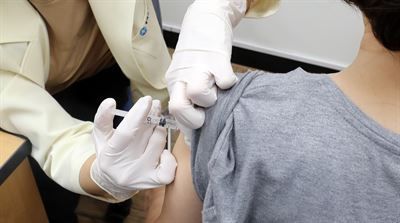
A woman receives a COVID-19 vaccine shot at a medical facility in Seoul, Thursday. Yonhap
The number of critically ill patients has decreased significantly this year compared to last year because of the nation's vaccination program, which started in late February. The vaccine program focused first on senior citizens in nursing homes where infection clusters often occured and the death rate among the patients was high compared to among younger people.
The current resurgence of the number of critically ill patients is occurring mainly among unvaccinated age groups, such as those in their 40s and 50s. But concerns of “breakthrough infections” among the vaccinated people are rising amid the rapid spread of the Delta variant, which has already become the dominant strain in Korea.
As of July 29, Korea had a total of 1,132 cases of breakthrough infections, where fully vaccinated people had contracted the virus. While the genetic sequencing for 243 of them has been completed, 61.7 percent of them, or 150 people, were infected with variants, and 128 of those 150 had the Delta variant specifically.
Amid this situation, calls are growing that Korea needs to introduce booster shots especially for vulnerable individuals to lower the possibility of those people getting breakthrough infections and of the nation experiencing a higher death rate.
“It is hard to imagine that we will be able to contain the current rapid spread by achieving a 70 percent vaccination rate while the Delta variant is becoming dominant, but still, vaccines are the only option for now,” Jung Jae-hoon, a professor of infectious medicine at Gachon University Gil Hospital, wrote on Facebook.
“The vaccination of high-risk groups should be carried out as early as possible, and the vaccination of those in their 50s should also be completed as quickly as possible, so that those older and vulnerable groups can get booster shots later this year or early next year,” Jung said.
Regarding the booster shots, the government announced that it will review additional inoculations for high-risk groups during the fourth quarter of this year.
“The plan for booster shots is one of the major tasks for the fourth quarter, following the majority of the population having received at least the first dose,” said Kim Ki-nam, an official at the government's COVID-19 vaccination response taskforce team.
However, Kim said that the booster shot plan was still in the preparation stage, and that the team was looking at the relevant data and global trends surrounding the success of booster shots.
In the meantime, the government will announce on Friday, whether to extend the current social distancing measures, which are at the highest level of 4 in the Seoul metropolitan area and at level 3 in other regions. The measures are widely expected to be extended for two more weeks.