Experts call for preemptive measures against Delta plus variant

A medical worker works at a government-designated COVID-19 treatment hospital in Pyeongtaek, Gyeonggi Province, Wednesday. Yonhap
Authorities to decide on whether to extend strictest social distancing Friday
By Lee Hyo-jin
Medical experts here are calling on the government to take preemptive measures against the possible spread of the COVID-19 Delta plus variant, as they view that downplaying its threat may pose a serious risk to the country's efforts to mitigate the coronavirus pandemic.
The Korea Disease Control and Prevention Agency (KDCA) reported Tuesday that it had identified the first two cases here of the Delta plus variant, a sub-lineage of the Delta strain first detected in India.
One of the patients was a man in his 40s with no recent overseas travel history, while the other was a man in his 50s who returned recently from the United States, according to the KDCA.
Both had been fully vaccinated with the AstraZeneca vaccine, raising concerns that the new strain may be resistant.
“Though we should be vigilant about the Delta plus variant, we don't need to be overly concerned about it,” Lee Sang-won, a senior official at the KDCA, said in a press briefing, Tuesday.
Prime Minister Kim Boo-kyum also said people don't need to be excessively worried about the emerging strain. “The Delta variant has become, so to speak, the dominant strain in the country. But there's no need for excessive fear over it,” he said during an interview with local radio, Wednesday.
Regarding the Delta plus variant, Kim said there was “no need for excessive anxiety,” adding that an epidemiological investigation was underway to discover the source of transmission.
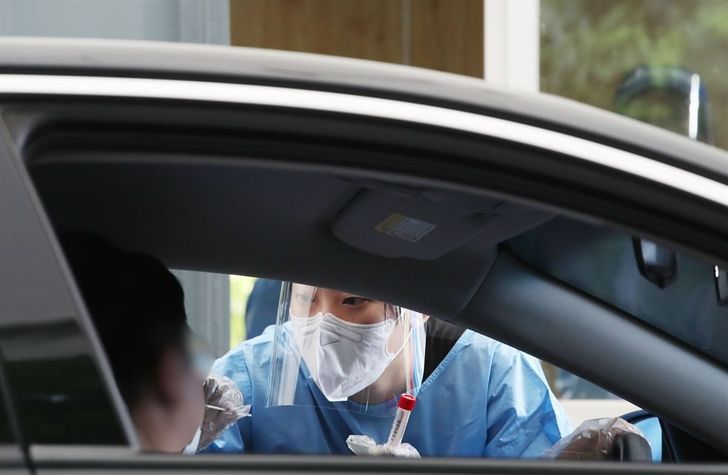
A driver receives a coronavirus test at a drive-thru testing center in Jungnang District, Seoul, Wednesday. Yonhap
But medical experts are calling for preemptive measures against the new strain, as the government's previous misjudgment over the Delta variant resulted in the further spread of the mutated virus and the current fourth wave of infections.
When Korea reported its first cases of the Delta variant in April, authorities did not respond fast enough with stronger quarantine measures, repeatedly saying that “the situation was under control.”
But the highly contagious variant has spread rapidly across the country, becoming dominant here, with around 60 percent of total infections in the last week of July found to be the Delta strain.
“The government should largely expand genetic sequencing tests to detect further cases of the Delta plus variant,” said Chon Eun-mi, a professor at Ewha Womans University Mokdong Hospital.
Chon assumed the Delta plus variant to be similar to the initial Delta strain, meaning that vaccines and treatments may be less effective against it.
Kim Woo-joo, a professor of infectious medicine at Korea University Guro Hospital, said the government shouldn't underestimate the seriousness of the new variant, just because there have only been a few cases.
“It needs to conduct a thorough epidemiological investigation while speeding up research on the Delta plus variant,” Kim said.
The coronavirus pandemic is showing no signs of abating in Korea, with the daily caseload staying above 1,000 since July 7. The KDCA reported 1,725 daily new cases for Tuesday, bringing the aggregated total to 203,926.
As the current social distancing levels ― Level 4 in the greater Seoul area and Level 3 in other parts of the country ― expire Sunday, the health authorities will decide Friday on whether to continue them or take further measures.