Worst infection cluster devastates ROK naval mission to Africa

Service members in protective clothes wait in front of an A330 MRTT aircraft after it arrived at an unidentified airport in Africa, Monday. Two multi-role tanker transport aircraft will bring back members of the 301-strong anti-piracy Cheonghae unit to Korea from aboard the destroyer Munmu the Great following a mass COVID-19 outbreak on the ship. Those returning to Korea will be replaced by a crew who arrived on the aircraft. Yonhap
82% of Cheonghae unit members test positive for COVID-19
By Lee Hyo-jin
An infection cluster among members of Korea's anti-piracy Cheonghae unit in waters off Africa has drawn the criticism that the government and the military's negligence and mismanagement of the situation have resulted in the largest group infection in the military since COVID-19 reached the country.
A total of 247 service members, or 82 percent of the 301-strong crew aboard the 4,400-ton destroyer Munmu the Great, have tested positive for the coronavirus, according to the Joint Chiefs of Staff (JCS), Monday.
All of the crewmembers are expected to be returned to Korea as early as tonight on two aerial tanker-transport aircraft sent by the military, while a replacement crew consisting of around 200 fully vaccinated sailors will bring the destroyer back to its home port here.
The outbreak is suspected to have started July 2, when one of the crew exhibited cold symptoms a day after the vessel left a nearby port where it had docked to load supplies.
He was prescribed cold medicine, and wasn't tested for the coronavirus, according to the JCS.
After several other sailors showed similar symptoms, the authorities conducted COVID-19 tests on 40 using rapid testing kits, all of which turned out negative. Such testing kits are less sensitive than polymerase chain reaction (PCR) tests, and likely to miss an early infection.
Six crewmembers took PCR tests later as their symptoms grew more severe, and all were confirmed positive. After the testing was expanded to the entire crew, an additional 61 members tested positive Sunday, and the figure climbed further to 247, Monday.
None of the crew had been vaccinated, as the vessel left Korea in early February before the nation's vaccination program kicked off later that month.
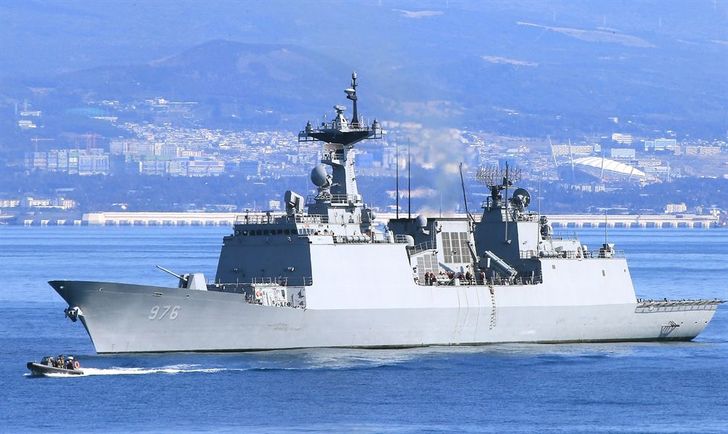
This undated file photo shows the 4,400-ton destroyer, Munmu the Great. Yonhap
The military is now facing criticism for negligence and misjudgment of the situation, which produced the mass outbreak, while some critics are accusing the government for leaving naval members on an overseas mission unvaccinated.
“A warship is extremely vulnerable to virus spread since it's a closed space. The government, however, did not send a single dose of the vaccine to the crew,” said Rep. Kang Min-guk, a spokesman for the main opposition People Power Party (PPP).
“Earlier in June, President Moon Jae-in said he will push ahead with the provision of vaccines to North Korea if the regime agreed to it,” he said. “How did the government have vaccine to give to the North but not enough to provide to Cheonghae unit members?”
Rep. Kang Dae-sik, also of the PPP, said, “As the Cheonghae unit was deployed based on the United Nations Security Council Resolutions on international cooperation on anti-piracy operation off the African coast, the military has the rights to request support from the U.N. in vaccinating its troops and it should have done so.”
The military explained that it had decided not to vaccinate the crew when Korea began to inoculate military service members in March, due to concerns over possible severe allergic reactions as they might not have been able to receive the necessary treatment on the warship.
The health authorities also said they concluded it was difficult to send the vaccines to overseas troops due to storage problems as most of the vaccines had to be kept at super low temperatures.
Meanwhile, COVID-19 infections in Korea are showing no signs of abating, with the country reporting 1,252 daily new cases, a record-high for a Sunday, raising the total caseload to 179,203, according to the Korea Disease Control and Prevention Agency.