COVID-19 outbreaks continue in and outside of Korea

Members of the Korean Confederation of Trade Unions held a mass rally in central Seoul on July 3, despite the Seoul Metropolitan Government, police and health authorities' repeated requests that it be canceled amid concerns over possible COVID-19 infections. Yonhap
61 more anti-piracy naval unit members test positive for coronavirus
By Jun Ji-hye
COVID-19 infections have continued to break out in and outside of the country over the weekend, raising concerns that the ongoing fourth wave of infections could become far more serious.
At least three protesters who took part in a recent mass rally organized by the Korean Confederation of Trade Unions (KCTU), a major umbrella labor group, in central Seoul have tested positive for COVID-19, sparking fears of even more infections to come, according to the Korea Disease Control and Prevention Agency (KDCA).
Outside the country, an infection cluster has occurred at the nation's anti-piracy naval unit in waters off Africa, with nearly 70 service members having tested positive.
On July 3, the mass rally was held in central Seoul, with about 8,000 protesters participating, to demand a revision to the labor act, despite repeated requests from the Seoul Metropolitan Government, police and health authorities for it to be canceled amid concerns over possible infections.
Following the confirmation of infections among the protesters, KDCA Commissioner Jeong Eun-kyeong issued an administrative order, Saturday, asking all rally participants to undergo COVID-19 testing.
“Since the first patient was reported on Friday, there have been two more patients. Our epidemiological investigation showed that all three attended the July 3 rally,” the KDCA said in its release.
Prime Minister Kim Boo-kyum expressed “deep” regret over the virus infections among the protesters, calling on all participants in the rally to immediately undergo COVID-19 testing regardless of symptoms, and to cooperate with the government's efforts to minimize additional infections.
Regarding the issue, the KCTU said Sunday that it had asked its members who attended the rally to take COVID-19 tests, vowing to do its best to take appropriate measures to resolve the situation.
The organization, however, claimed that the health authorities were “distorting the facts and slandering us as if the people were infected as a direct result of the rally.”
“The three infected people work in the same department and had lunch together before testing positive,” the KCTU said in its release. “It is true that they participated in the rally, but there is no evidence to conclude that they were infected at the rally.”
On July 4, a day after the rally, the Seoul Metropolitan Government filed a complaint with police against the KCTU for allegedly violating the Infectious Disease Control Law.
Amid growing concerns, the city government decided to ban all rallies between Aug. 14 and 16 as National Liberation Day falls on Aug. 15.
Meanwhile, an additional 61 service members of the Cheonghae Unit in waters off Africa have tested positive for the coronavirus, raising the total caseload on their 4,400-ton destroyer, named Munmu the Great, to 68 as of 8 a.m. Sunday, according to the Joint Chiefs of Staff (JCS).
The unit reported its first case last Thursday.
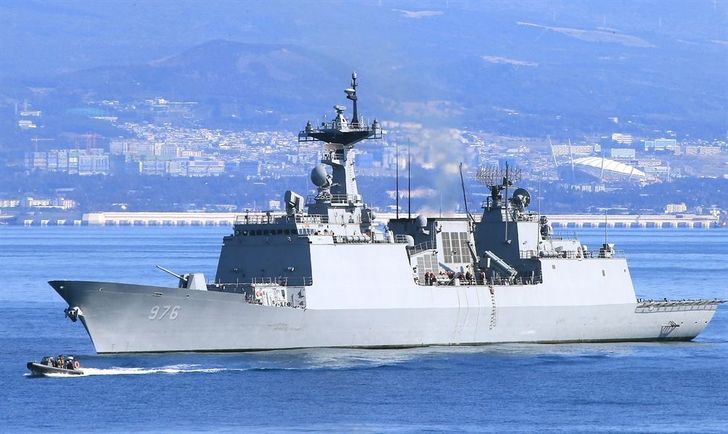
The 4,400-ton destroyer, Munmu the Great, of the Republic of Korea Navy / Yonhap
The number of cases there is feared to increase further as 200 other service members are waiting for their test results.
In a bid to bring the unit members home, the country sent two Air Force KC-330 multi-role tanker transport planes to Africa on Sunday afternoon.
Some 150 personnel, who have been fully vaccinated, also boarded the planes to bring the destroyer back to Korea.
The tanker transport aircraft is a military derivative of the Airbus A330-200 airliner, designed as a dual-role air-to-air refueling and civilian transport plane.
The Republic of Korea Air Force operates four KC-330 planes that are capable of carrying some 300 passengers and 47 tons of cargo.