Parents raising concerns over full return to in-person classes amid virus resurgence

Seniors at Yongin High School in Busan attend in-person classes, June 28, after the city government allowed schools in the region to reopen in full as COVID-19 infections had dwindled. The Ministry of Education plans to resume fully in-person classes nationwide starting in the fall semester, but parents are raising concerns over the plan, due to the latest spike in infections. Yonhap
Workers ask gov't to implement full-scale work-from-home policies
By Jun Ji-hye
Parents are raising concerns over the Ministry of Education's plan to resume fully in-person classes nationwide starting in the fall semester, amid the recent resurgence in new COVID-19 cases here, in addition to the increasing rate of infection by variants of the coronavirus, especially the highly transmissible Delta strain.
They are claiming that the ministry should reconsider the plan as sporadic infection clusters have already been occurring in schools.
“Students have yet to be vaccinated as they come almost last in the list, and younger ones are not on the list at all. I don't understand why the government is planning to let all students attend in-person classes in this situation,” a mother of a middle school student wrote on a Naver blog in which many parents gather.
Another mother of an elementary student wrote, “My son has already been tested for the virus once after a student at the same school tested positive. I don't know how many more tests my son will have to go through if he attends in-person classes every day.”
Last month, the education ministry announced its plan to allow schools to reopen fully for the fall semester starting in late August, after a year of mixed online and offline classes due to the prolonged COVID-19 pandemic.
The decision was in line with the central government's plan to implement a new four-tier social distancing system on July 1. Under the new system, all students are allowed to attend in-person classes according to the new Levels 1 and 2. The decision was also based on the ministry's evaluation that the learning gap between children has been widening during the pandemic.
But the virus' recent resurgence has been putting the brakes on expectations toward returning to pre-COVID normal life.
According to the Korea Disease Control and Prevention Agency (KDCA), Monday, the country added 711 more coronavirus infections, 644 of which were local, for Sunday, raising the total caseload to 160,795.
The nation's daily new virus cases have stayed in the 700s to 800s for a week, and the latest figure, though it decreased from 743 cases recorded on the previous day, marked a nearly six-month high among figures tallied on Sundays, when less virus testing is usually conducted.
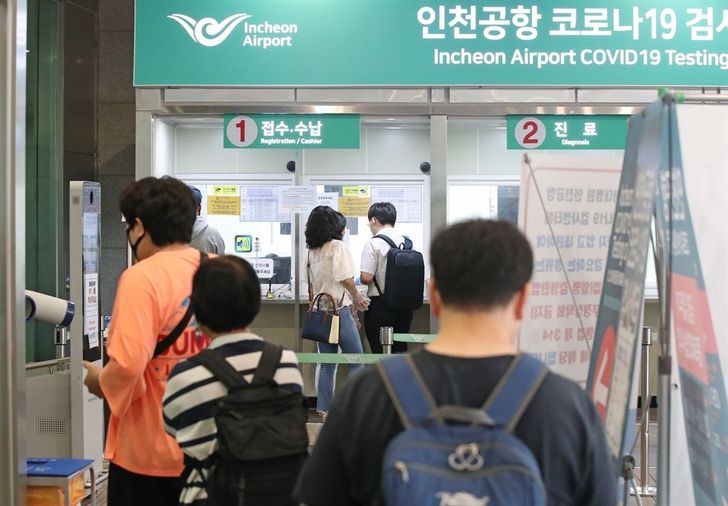
People wait in line to go through COVID-19 testing at Terminal 2 of Incheon International Airport, Monday. Yonhap
For their part, workers are calling on the government to force companies to allow their employees to work from home, rather than just “advising” them to do so.
“Fears are growing over the highly transmissible Delta variant of the coronavirus, especially in the Seoul metropolitan area, but many workers are still on packed subways and buses in order to get to work. I don't think the situation will improve this way,” said a 35-year-old man who works for a consulting company in Seoul.
“It is difficult for employees to ask their companies to allow them to work from home. I want the government to come forward more actively and implement full-scale work-from-home policies.”
The government initially planned to apply Level 2 social distancing measures under the new distancing system to the Seoul metropolitan area from July 1.
But the administrations of Seoul, Incheon and Gyeonggi Province decided to delay the implementation of the new rules for a week amid the spike in new cases.
In particular, health authorities warned against the Delta strain, saying that the situation could get out of control if the highly transmissible variant keeps spreading.
“If the virus keeps spreading at this speed in the Seoul metropolitan area, new cases will increase significantly,” Kwon Jun-wook, head of the Korea National Institute of Health, said during a briefing, Friday. “In particular, the spread of the Delta strain in the area seems to be only a matter of time.”
Authorities will decide whether to readjust distancing rules in the Seoul metropolitan area this Wednesday.