Debate continues over cameras in operating rooms

This photo disclosed by the Gyeonggi Provincial Government on Oct. 2, 2019, shows surveillance camera footage of an operating room at the Gyeonggi Provincial Medical Center's Ansung Hospital. Courtesy of Gyeonggi Provincial Government
By Lee Hyo-jin
The continuing debate over the need to have surveillance cameras inside hospital operating rooms has resurfaced after a series of alleged medical malpractice cases during surgery made headlines recently.
In May, a hospital in Incheon west of Seoul, specializing in spinal surgery was found to have allegedly allowed administrative staff to perform surgical procedures such as incisions and sutures.
In early June, a hospital in Gwangju specializing in spinal procedures made it on the news after a whistleblower employee reported to police that nurses, who weren't qualified as medical practitioners, routinely performed surgery there in 2018.
Police raided the hospital, but are facing difficulties identifying how the “proxy surgeries” were conducted due to a lack of evidence as the operating room was not equipped with any surveillance cameras.
The debate over this issue is nothing new. Bills requiring cameras in operating rooms had been proposed twice, but to no avail, in the 19th and 20th National Assemblies. At the current 21st Assembly, three such bills, proposed by lawmakers from the ruling Democratic Party of Korea, are pending.
Meanwhile, an increasing number of people seem to be supporting the installation of cameras, according to a survey released by the Anti-corruption and Civil Rights Commission, June 28.
Among the 13,959 respondents, 98 percent were in favor of installing surveillance cameras, citing the need to monitor potentially illegal medical procedures when patients are under anesthesia.
But the issue remains unresolved due to sharply divided views between medical practitioners and patients.
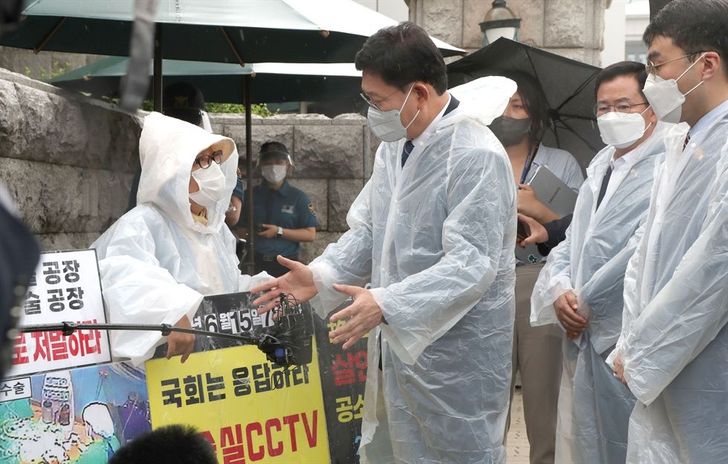
Song Young-gil, chairman of the ruling Democratic Party of Korea, talks with Lee Na-geum, who is holding a one-person rally calling for the legislation requiring CCTVs in operating rooms, in front of the National Assembly, June 15. Lee is the mother of a deceased victim of a botched plastic surgery in September 2016. Korea Times photo by Oh Dae-geun
Groups representing patients have been calling for the installation of surveillance cameras in a bid to prevent ethical misconduct by physicians, such as proxy surgery conducted by unqualified hospital staff and sexual assault on anesthetized patients.
“In many medical malpractice cases that have occurred in operating rooms, hospitals usually attempt to falsify medical records to cover up their errors,” said Ahn Ki-jong, head of the Korea Alliance of Patients Organization.
“Even if CCTVs are installed, they won't always be used to the disadvantage of doctors,” Ahn noted. “They can be useful in smoothly settling medical disputes between doctors and patients and prevent the disputes from going further into lawsuits.”
On the other hand, doctors have been strongly opposed to the cameras. They argue that taping surgical procedures could affect how they do their jobs, mindful of being involved in possible lawsuits.
They are also worried that the possible leakage of camera footage will result in serious privacy breaches of patients and doctors.
The Korea Medical Association, the country's largest group of doctors, supported such allegations, citing a letter of endorsement it received from David Barbe, head of the World Medical Association.
“CCTV monitoring in an operating room or a physician's office is a demonstration of mistrust and thus not helpful for any healing or recovery process. Such measures not only destroy trust, but ultimately will reduce vital treatment options for many patients,” Barbe said.
The KMA insists that medical malpractices can be prevented by installing CCTVs at the entrances to operating rooms. However, the patients' association is adamant, saying that cameras must be installed inside the operating rooms.
“Around 60 percent of medical institutions nationwide already have CCTVs at the entrances of operating rooms, but they have failed to prevent proxy surgery and other illicit medical practices,” the association said.