Will bilateral partnership fix Korea's vaccine shortage?

Minister of Health and Welfare Kwon Deok-cheol and U.S. Secretary of Health and Human Services Xavier Becerra pose at a meeting held in Washington, Friday. Courtesy of the Ministry of Health and Welfare
By Lee Hyo-jin
While the Korean and U.S. health authorities have agreed to build a comprehensive partnership on the production and development of COVID-19 vaccines, it remains to be seen whether such an agreement will speed up vaccine arrivals here as a much-anticipated vaccine swap deal is missing, according to experts, Sunday.
South Korean Health Minister Kwon Deok-cheol and his U.S. counterpart Secretary of Health and Human Services Xavier Becerra, held a meeting in Washington, Friday, with President Moon Jae-in in attendance, according to the Ministry of Health and Welfare.
The event came on the sidelines of the summit between Moon and U.S President Joe Biden.
Based on a mutual understanding that the speedy supply of COVID-19 vaccines is crucial to overcoming the pandemic, the two sides vowed to cooperate in the development and production of vaccines by combining the U.S.'s technology and supply of raw and subsidiary materials with Korea's biopharmaceutical production capacity.
Under the agreement, Samsung Biologics will roll out U.S. drugmaker Moderna's vaccine at the Korean firm's plant through a contract manufacturing organization (CMO) deal. The large-scale production of tens and thousands of doses is expected to begin from the third quarter, the ministry said.
Another US vaccine maker, Novavax, reaffirmed its earlier license agreement with SK Bioscience, under which the latter has the right to manufacture and sell the vaccine here through a technology-transfer deal.
The Korea Disease Control and Prevention Agency (KDCA), for its part, announced that it will conduct joint research with the U.S. National Institute of Allergy and Infectious Diseases on COVID-19 vaccines and treatments.
Such deals are expected to help Korea become a “global vaccine production hub” and contribute to bringing about an end to the pandemic in the long term.
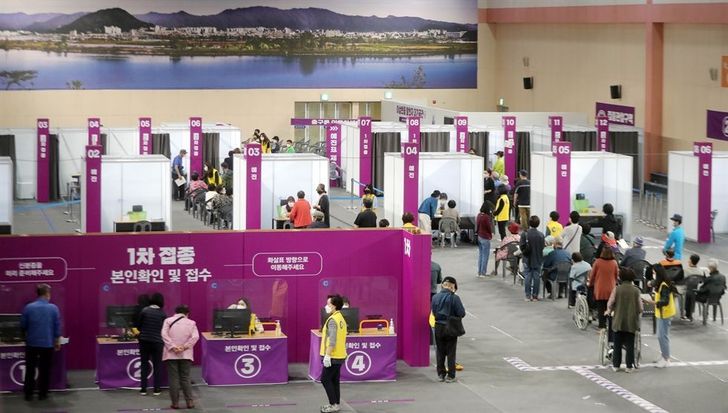
Elderly citizens aged over 75 wait to receive a vaccine against the coronavirus at a vaccination center in Chuncheon, Gangwon Province, Saturday. Yonhap
However, since the joint accord fails to include vaccine swaps, it remains uncertain whether it will have a significant effect on Korea's vaccine rollout in the near future by speeding up vaccine arrivals into the country amid growing global competition to secure supplies.
Although local production of the Moderna vaccine will become possible as early as August following the deal with Samsung Bioscience, it still remains uncertain whether Korea will be able to use the products immediately.
“We plan to discuss with the supplier the prospect of receiving domestically produced vaccines in order to more efficiently carry out distribution,” said Jeong Eun-young, senior official at the health ministry at a briefing, Sunday.
Also, the agreement does not include earlier arrivals of Moderna and Novavax vaccines. Korea has “secured” enough doses of each vaccine for 20 million people.
According to Vice Health Minister Kang Do-tae, both are expected to be introduced into the country in the second half of the year, but he did not give specific schedules for shipments, saying “these are still under discussion.”
As of Saturday, Korea is lagging behind other nations in terms of its inoculation rate, with 3.4 percent of its 52 million population fully immunized, and 7.4 percent having received at least one dose of a vaccine.
In this regard, hopes were raised that the Moon-Biden summit, which came a day after the U.S. leader announced a plan to share 80 million doses with other countries, would serve as an opportunity to expedite a vaccine swap.
Prior to the summit, the government proposed such a “vaccine swap” with the U.S., under which the latter would provide surplus vaccine to Korea and the latter would return the same amount later.
Despite preliminary discussions on the deal ahead of the summit, a swap arrangement was not included in the set of agreements announced by the health authorities.
“It is a little disappointing that earlier arrivals of vaccines from Novavax or Moderna were not included in the outcomes of the summit. The government should have put in more diplomatic efforts to speed up vaccine arrivals to achieve its goal of reaching herd immunity by November,” said Chon Eun-mi, a professor at the Department of Pulmonology at Ewha Womans University Mokdong Hospital
Meanwhile, the main opposition People Power Party pointed out that the government's vaccine partnership with the U.S. lacked specific details, and called for follow-up measures to ensure a stable vaccine supply in order to ease public concern.