'Vaccination passport' faces both expectations and concerns

A debate on whether to adopt the “vaccination passport,” a certificate confirming a person has been vaccinated against COVID-19, has sparked hopes and worries at the same time. gettyimagesbank
By Jun Ji-hye
Many countries are under active discussion on whether to adopt the so-called “vaccination passport,” and Korea is no exception. People here are showing mixed reactions, with some expressing hopes for it to expedite economic recovery, while others worrying about possible discrimination against those who do not hold such a passport.
The vaccination passport refers to a certificate confirming that a person has been vaccinated against COVID-19.
Those who show this certificate may receive several benefits, such as being allowed to travel more freely or enjoy leisure activities that have been largely closed off during the prolonged public health crisis.
Some countries have already introduced similar programs and some others are planning to do so. Korea hasn't adopted any such vaccination passport yet, but, starting May 5, the country has been allowing fully vaccinated people to be exempted from the mandatory 14-day isolation period following return from any overseas trip or having any close contact with a virus patient. It is also considering allowing vaccinated people to show a mobile app to prove they have received the shot, when visiting facilities frequented by many people, such as restaurants and senior citizen community centers.
Supporters say that introducing a vaccine passport will help invigorate the economy.
In a poll of 838 adults, issued by the Federation of Korean Industries (FKI), a major business lobbying group, Sunday, 67.4 percent of the respondents believe that the use of a vaccine passport will help revitalize the economy, while only 11.7 percent said that they think it will not be that helpful.
When asked about what they want to do most if the passport is introduced, 36.4 percent said they want to go on trips overseas, followed by 24 percent who want to go on domestic trips more freely, and 19.3 percent who want to engage in cultural activities, such as attending concerts or movies.
“Koreans believe that the adoption of a vaccine passport will help the nation's economy,” said Kim Bong-man, director of international cooperation at FKI. “The government should step up its efforts to hold discussions with other countries with regard to cross-border movement, in addition to the procurement of vaccines.”
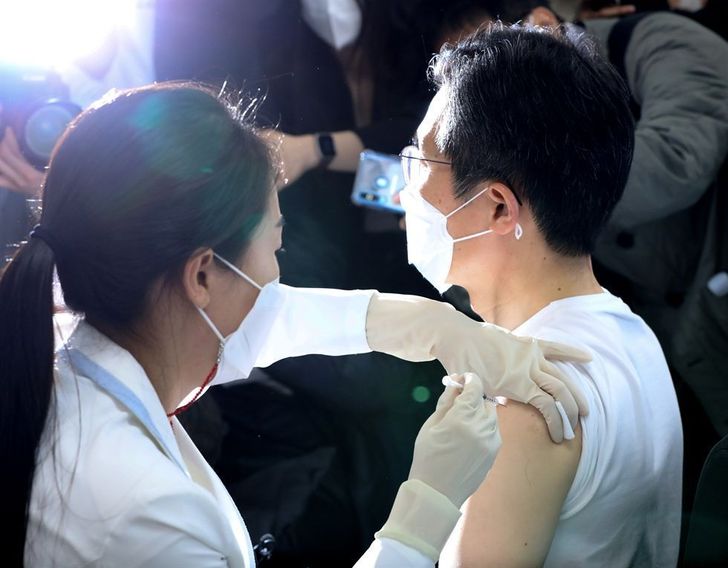
Lee Pil-soo, the president of the Korea Medical Association, receives the first dose of the AstraZeneca vaccine at a public health center in Yongsan, Seoul, May 3. Yonhap
But concerns are also growing that these measures could cause inequality and discrimination against people who have no intention of being vaccinated, or are categorized as members of groups of people who are not able to receive the shot.
“I am around seven weeks pregnant, thus not permitted to be inoculated. Even if the government decides to administer vaccines to pregnant women, I am not sure if I will get the shot due to safety concerns,” said Kim Ji-hyun, a 37-year-old office worker living in Seoul's Jungnang District. “It's horrible to think of a situation in which many people can show their vaccination certificate to enter a restaurant, while I cannot do so.”
The World Health Organization (WHO) has also expressed its opposition to requiring vaccination passports for travel, raising concerns about whether the inoculation indeed prevents virus transmission as well as inequity.
“We as the WHO are saying at this stage that we would not like to see the vaccination passport as a requirement for entry or exit into any country because we are not certain at this stage that the vaccine actually prevents transmission,” WHO spokeswoman Margaret Harris told a U.N. news briefing last month. “There are all those other questions, apart from the question of discrimination against the people who are not able to get the vaccine for one reason or another.”
Israel has already deployed a “green pass” that shows whether people have been fully vaccinated or whether they have presumed immunity after recovering from the disease, allowing green pass holders to get exclusive access to facilities such as gyms, hotels, restaurants and theaters. But this campaign has been facing condemnation and protests from some critics in that country over equality concerns.
Experts here said the government should take a cautious attitude toward a vaccine passport as it is uncertain whether vaccination could justify discrimination against others.
“As long as the COVID-19 outbreak continues, it will be more effective for the government to maintain face mask-wearing guidelines and social distancing measures, and then wait for a more appropriate time to lift the antivirus measures, while making efforts to develop treatments for the virus and monitoring virus situations and medical capacity,” Kim Jang-han, a professor at Asan Medical Center, wrote in his column.
“On the other hand, I believe there is no logical basis yet for pushing for any discriminatory moves, such as adopting a vaccination passport.”