Korea's immunization plan depends on timely delivery of vaccines

People over age 75 receive the Pfizer coronavirus vaccine at a vaccination center in Daegu, Friday. Yonhap
Gov't secures additional Pfizer doses for 20 million people
By Lee Hyo-jin
The government's immunization plan against COVID-19 depends on the timely delivery of vaccines without any delay, according to medical experts, even though the country has signed contracts to acquire enough doses for nearly double the entire population.
The administration announced Saturday that it had reached a deal with Pfizer for additional doses for 20 million people, which would allow it to vaccinate 99 million with the total amount of vaccines “secured.”
This is 1.9 times Korea's total population and 2.75 times the 75 percent of the people ― 36 million ― that need to be vaccinated in order to achieve herd immunity.
Through separate deals with five pharmaceutical companies, the government has already signed contracts for vaccines from Pfizer for 33 million people, AstraZeneca for 10 million, Johnson & Johnson for 6 million, and Moderna and Novavax for 20 million people each.
In addition, the country will receive vaccines for 10 million people through the COVID-19 Vaccines Global Access (COVAX) program, a global initiative for vaccine production and distribution.
The government stated that this abundant supply may enable the provision of booster shots ― an additional dose to bolster the recipient's immunity ― or be used when the nationwide vaccination program is expanded to those under the age of 18.
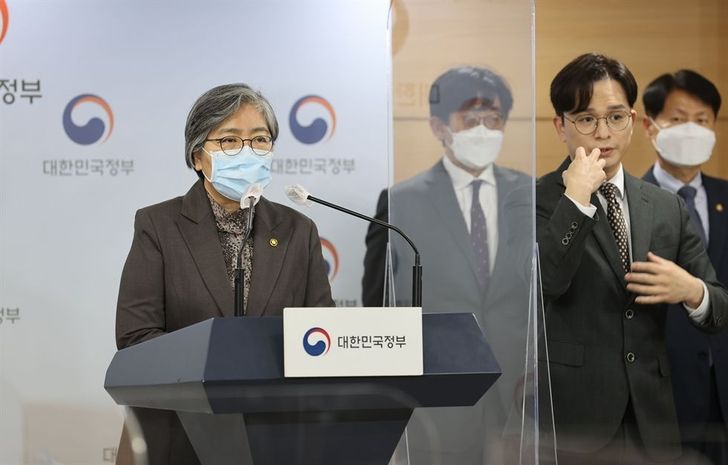
Korea Disease Control and Prevention Agency (KDCA) Commissioner Jeong Eun-kyeong speaks during a briefing on the government's latest deal with Pfizer, which will provide it with additional vaccines for 20 million people, at the Government Complex Seoul, Saturday. Yonhap
However, medical experts argue that it is too early not to be concerned about a possible shortage of vaccines, as the contracts may not lead to direct and timely shipments amid a growing global competition. They say the government should make sure the secured supplies arrive on schedule.
“As global demand for mRNA vaccines is increasing, with countries such as the U.S. and Japan making additional deals with Pfizer, it is not guaranteed when the products will be delivered to the country,” said Kim Woo-joo, a professor of infectious diseases at Korea University.
Due to ongoing safety concerns about the viral vector vaccines from AstraZeneca and Johnson & Johnson, due to possible links to rare blood clots as side effects, more countries are choosing to secure an additional supply of mRNA vaccines from Pfizer, he said.
“Also, our agreements with drug companies may include indemnity clauses that do not hold the vaccine suppliers responsible for delays in shipments,” Kim added.
The conservative main opposition People Power Party (PPP) demanded the administration disclose the detailed shipment schedules for the vaccines.
“The government has been reiterating announcements about its additional vaccine deals. But what the public wants is a clear explanation about when they will be administered. The government should provide the exact dates of the deliveries and disclose a specific inoculation schedule by age and occupation categories,” said Yun Hee-suk, a PPP spokesman, Saturday.
According to the health authorities, out of the Pfizer doses secured for 33 million people, those for 3.5 million people are expected to be delivered before July, with the remainder to be shipped beginning in the latter half of the year.
But they did not elaborate on the detailed schedule, citing confidentiality obligations.
“We cannot reveal the specific amounts in each shipment, due to confidentiality agreements with the vaccines suppliers,” said Lee Gi-il, an official at the Ministry of Health and Welfare, at a briefing Saturday.
Meanwhile, according to the Korea Disease Control and Prevention Agency (KDCA), the country recorded 644 new virus cases for Saturday, including 603 local transmissions, raising the total caseload to 118,887. The daily tally was below 700 for the first time in five days, due mainly to fewer tests on the weekend.