Korea's COVID-19 vaccination timeline faces uncertainties

Special school teachers receive their first shots of the AstraZeneca vaccine at a vaccination site in Gwangju, Monday. Yonhap
By Lee Hyo-jin
As Korea's COVID-19 vaccination timeline is facing multiple uncertainties, the country may not be able to reach its goal of achieving herd immunity by November considering the low inoculation rate so far.
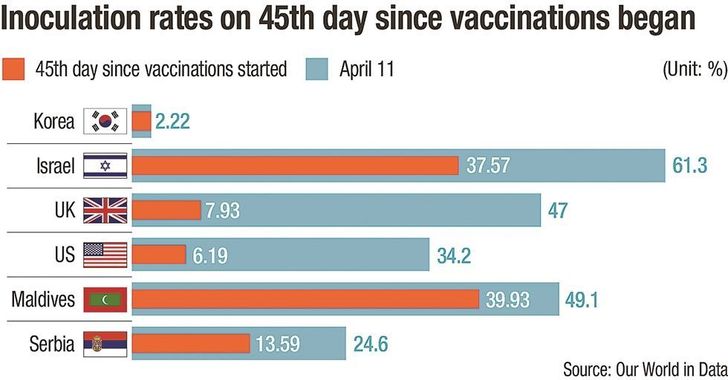
According to data collected by the University of Oxford-based Our World in Data, during the 45 days since the Feb.26 nationwide vaccination rollout, 2.26 percent of the population had been given at least one shot of the vaccine as of April 11.
The data show that other countries had vaccinated a larger percentage of their populations during the first 45 days of their COVID-19 inoculation programs.
Israel, which began public vaccinations Dec. 19, marked a rate of 37.57 percent, Feb. 25, the 45th day since it started vaccinating people. The inoculation rate in the United Kingdom, the first country to begin vaccinations, stood at 7.93 percent Jan. 21; while The Maldives and Serbia recorded 39.93 percent and 13.59 percent, respectively, on their 45th days.
The Bloomberg vaccine tracker showed that Korea's daily rate of doses administered stood at an average of 32,500, a significantly low figure compared to 3.2 million in the U.S. and 400,000 in the U.K. Bloomberg predicted that, at this speed, it will take six years and four months for Korea to create herd immunity.
Prof. Kim Woo-joo at Korea University's Infectious Disease Department viewed that the low number is attributable to a lack of vaccines in the country. According to Kim, seasonal flu vaccination drives in the past have shown that the country's medical capacity can cover up to around 300,000 people a day.
“The government's failure to preemptively secure a vaccine supply has resulted in such a situation. It is impossible to speed up inoculations without drastically increasing the supply,” he told The Korea Times.
Amid a continuous unstable vaccine supply worldwide, the government announced all-out efforts Monday to deliver enough doses in order to meet the vaccination timeline, but uncertainties lie ahead.
According to the health authorities, 3.37 million doses from AstraZeneca and Pfizer have arrived in the country so far, which accounts for 18 percent of the planned amount for the first half of the year.
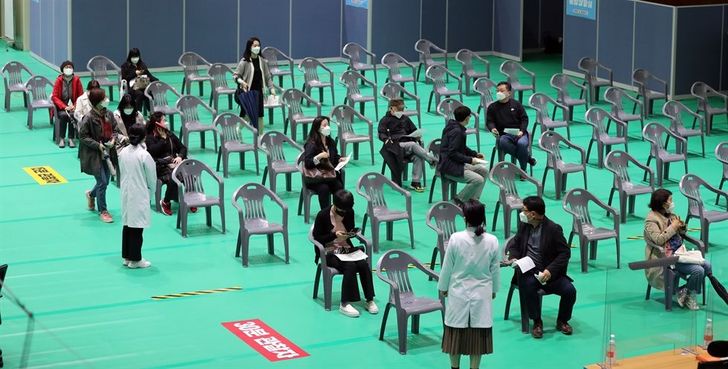
People wait for 15 minutes after receiving the AstraZeneca vaccine in case of allergic reactions at a vaccination site in Gwangju, Monday. Yonhap
Local production of Novavax vaccine enough for 10 million people will begin as early as June through a licensing contract signed by SK Bioscience with the U.S. drug company.
But actual use of the vaccine could be months away as it is uncertain when it will be able to win approval for use. Novavax, which has not gained approval anywhere in the world yet, is undergoing the approval process in the U.K. and the U.S.
Johnson & Johnson's product, which won approval from the Ministry of Food and Drug Safety on April 7, has come under scrutiny following four reports of blood clotting overseas. The European Medicines Agency (EMA) is looking into the possibility that the vaccine may be associated with a rare risk of serious blood clots.
The Moderna vaccine, which the government plans to deliver enough doses for 20 million people, is waiting for a three-phase review at the drug ministry.
“Due to the global vaccine shortage, it has become difficult to guarantee early shipments no matter how much additional budget the government is willing to allocate,” Kim said, adding that the government should actively use diplomatic strategies to negotiate with countries that have secured enough doses.