Gov't ups efforts to solve organ donation shortage

Organ donation activists hold a campaign in Jung-gu, Seoul, to encourage public participation in organ donation while calling on the government for better treatment of donors after organ procurement, Dec. 8, 2017. Korea Times file
Health ministry announces comprehensive plan to boost organ donation by 2025
By Lee Hyo-jin
Kim Myung-seung, 58, a security guard at the Korea Airports Corp., fell unconscious on his way to work, March 1.
During hospital treatment, he was declared brain dead due to heart failure. Upon his family's consent, Kim's organs ― lungs, liver, kidneys, and eyes ― were donated through the Korea Organ Donation Agency (KODA), to six patients in dire need of transplant surgery.
The same month, a 54-year-old woman surnamed Kim in Busan was pronounced brain dead during nasal polyp surgery. Based on her consent form which she had submitted in 2008, her family agreed to donate her heart, lungs, liver and kidney, to five people in need.
But such humanity-affirming stories of ordinary people displaying potentially life-saving generosity are very rare in Korea, as the number of registered organ donors is extremely low compared to the number of patients on organ transplant waiting lists.
More people have become open to organ and tissue donation in recent years. But many still find it difficult to actually sign the consent form while they are in good health.
According to a survey of 1,000 people aged 19 and above conducted in 2020 by the Korean Network for Organ Sharing, 96 percent said they are aware of the organ donation system, while 60 percent supported it and 61 percent were willing to sign up.
However, only three percent of the population was registered as donors as of last year, a significantly low figure compared to 59 percent in the U.S. or 39 percent in Britain.
When asked why they chose not to register, 48 percent replied that they just felt hesitant, and 24 percent did not know where and how to register, while 15 percent cited disapproval by their families and friends.
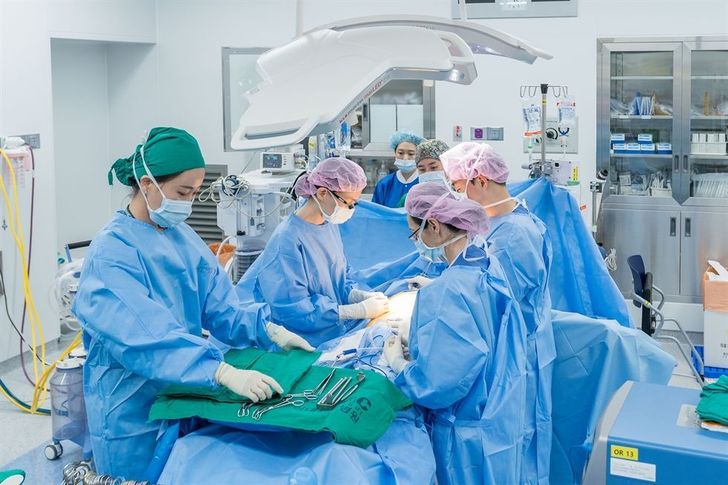
Medical staff at Ewha Womans University Medical Center stand in silence and pay tribute to a donor ahead of organ harvest, Sept. 30, 2019. Courtesy of Ewha Womans University Medical Center
Meanwhile, data from the Ministry of Health and Welfare showed that the number of people waiting for organ transplants increased to 38,152 last year from 26,584 in 2016, while the number of organ donors who died decreased to 478 from 573 during the same period.
The average waiting period of a transplant recipient is three and a half years. Among the patients on the waiting list, 5.8 people died every day in 2020.
According to the ministry, a major reason why people feel hesitant to register for organ donation is concern over poor management of the donor's body after procuring organs.
Another reason for the low participation rate is insufficient promotion of the organ donation program. Despite continuous efforts by authorities to encourage the public through various platforms such as public advertisements and promotional materials, only one out of five people said they have seen such ads.
The low donation rate can also be attributed to the current system, under which the actual process of organ donation cannot be carried out without the consent of the family of the deceased. So in cases where a donor's family is unaware of their loved one's decision, the consent form bears no weight.
In this regard, the health ministry on Tuesday announced comprehensive plans to boost the registration rate of organ donation from the current three to 15 percent by 2025.
The government plans to improve existing problems, first by strengthening support for donors and their families to ensure they are treated with respect during the whole procedure by implementing a “one-stop total service.”
In addition to financial support for funeral procedures that are currently offered, the service will include emotional support for bereaved families and opportunities for communication between the donor and recipient, which are currently strictly regulated in order to prevent illegal organ trades.
Also, promotion of organ donation will be largely expanded using online chat bot services. Accessibility to registration will be enhanced by making it possible to sign up at public health centers and driver's license test centers.
In the long term, the ministry plans to revise relevant laws to better reflect a donor's decision and make sure that such intentions are shared among family members.