Seoul City withdraws COVID-19 testing order for foreign residents

People including foreign residents wait in a long line at a makeshift COVID-19 testing center in front of Guro Station in Seoul, Friday, to undergo testing. Controversy has intensified over Seoul City and Gyeonggi Province's administrative orders forcing all foreign workers to undergo COVID-19 testing, with critics calling the orders “racial discrimination.” Yonhap
Human rights watchdog launches investigation into alleged racial discrimination
By Jun Ji-hye
The Seoul Metropolitan Government on Friday withdrew its controversial administrative order forcing all foreign workers in the capital region to undergo COVID-19 testing, after having faced mounting criticism over alleged discrimination and violations of foreign residents' human rights.
The city said its order, issued on Wednesday, was changed to an “advisory” for foreign workers to receive a test by the end of the month if their workplaces have a high risk of infection.
Workplaces with high risk of infection refer to concentrated, closed and confined environments.
“The advisory also applies to Koreans working at the same workplaces,” a city official said.
The decision was made after the central government asked the city administration to rescind its recent order for mandatory COVID-19 tests on foreign workers “promptly,” amid mounting controversy.
“Our request is aimed at preventing any antivirus measures from causing discrimination and human rights violations against both Koreans and foreign residents,” said an official from the Central Disaster Management Headquarters under the Ministry of Health and Welfare.
The request came as the city government's administrative order has invited criticism from various quarters including universities and embassies here.
Earlier on Friday, Seoul National University said it had sent its official statement to the city government the previous day, asking it to retract its order.
Some 2,000 foreign professors, employees and students are working or studying at the university.
“The root cause for infection clusters is poor, concentrated and confined working and residential environments, and is not related to the nationality of workers,” the university's Human Rights Center said in its statement. “The city's administrative order constitutes an act of discrimination and violates the right to equality as guaranteed in South Korea's Constitution.”
The center noted that the order, which generalizes all foreign workers here as “groups with a high risk of infection,” could aggravate hatred or fear of foreigners.
Rep. Lee Sang-min of the ruling Democratic Party of Korea also urged the city government to withdraw its order “immediately.”
“The order is an act of unfair racial discrimination against foreigners and a human rights violation that will make us an international disgrace,” the five-term lawmaker wrote on Facebook. “This is why the legislation of the Anti-Discrimination Act is necessary.”
British Ambassador to Korea Simon Smith said in a video posted to Twitter that the British Embassy “has made clear to the national government and to the Seoul and Gyeonggi administrations that we consider these measures unfair. They are not proportionate, nor are they likely to be effective.”
He added the embassy had raised the issue as a matter of urgency with the National Human Rights Commission of Korea (NHRCK).
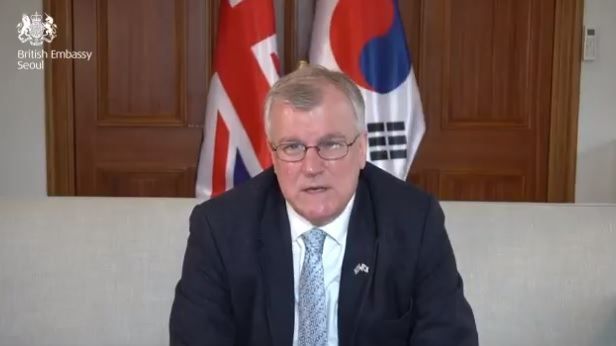
British Ambassador to Korea Simon Smith speaks in a video posted on Twitter, Thursday, saying Seoul City and Gyeonggi Province's administrative orders forcing all foreign workers to undergo COVID-19 testing were unfair. Captured from Twitter
For its part, the NHRCK said that its investigation into the controversial administrative orders issued by some local governments including Seoul City began Friday, as complaints were filed alleging hatred and discrimination against foreigners.
“Policies excluding or separating immigrants can cause negative perceptions of them as well as discrimination against them. Such measures can even lead to hate crimes,” the NHRCK said in a statement, indirectly criticizing local governments that issued the controversial orders.
“Foreigners have filed complaints about experiencing hate and racial discrimination from the order, so we will swiftly make a decision about whether the order is discriminatory and violates human rights.”
The city issued the controversial order on Wednesday, asking all foreign workers and their employers to undergo testing by the end of the month. This came after the Gyeonggi provincial government issued a similar order, March 8, for all foreign workers and their employers in the area to take a COVID-19 test by March 22.
Such orders came as COVID-19 infection clusters traced to companies that have many foreign workers have been increasingly reported in the Seoul metropolitan area that includes Gyeonggi Province and Incheon.
According to the Seoul city government, foreign virus patients accounted for 6.3 percent of the total cases in the capital between January and March, up rapidly from 2.2 percent between November and December last year.
The city had encouraged all foreign workers to actively go get tested, offering free testing and ― if they test positive ― free treatment. Any violators of this order could face fines of up to 2 million won ($1,770), in accordance with the Infectious Disease Control and Prevention Act, it noted.
Amid growing controversy, James Kim, chairman and CEO of the American Chamber of Commerce in Korea (AMCHAM Korea), said in an email sent Thursday to AMCHAM members, “We received a preliminary notice from the Korean government that the directives of Seoul City and Gyeonggi Province requiring all foreign workers to be tested will be corrected.”
He said the notice from the Korean government was the result of AMCHAM conveying the foreign business community's concerns.
Regarding the controversy, Song Eun-cheol, a senior city government official, said during an online briefing that the city government's measure was “designed to secure people's safety, and did not intend to discriminate against foreign residents.”
A Gyeonggi provincial government official said there are no plans to withdraw the administrative order in the province despite the controversy.
“We will continue working to alleviate foreigners' dissatisfaction about overcrowded and understaffed testing centers in some areas,” he said.
Separately, the Gyeonggi provincial government decided on Thursday not to push ahead with another controversial policy requiring foreign workers to present negative COVID-19 test results as part of the hiring process.
“There were opinions that forcing foreign workers to present negative test results in the employment process can disadvantage and discriminate against them,” Im Seung-kwan, a senior quarantine official, said at a press briefing. “We apologize for causing confusion.”