Legal experts discuss legislative efforts on COVID-19 responses

Minister of Government Legislation Lee Kang-seop, fifth from right, poses during the Asian Legislative Experts Symposium hosted by the ministry at the Millennium Hilton Seoul, Wednesday, together with other participants attending the event both online and offline. / Courtesy of Ministry of Government Legislation
By Jun Ji-hye
Legal experts from Korea and other Asian countries discussed legislative measures, Wednesday, to cope with the global public health crisis amid the COVID-19 pandemic.
The Asian Legislative Experts Symposium (ALES), hosted by the Ministry of Government Legislation, was held in Seoul under the theme of “Legislation on Infectious Diseases and Cooperative Measures of Asian Countries in the post-COVID-19 era.”
This year's event took place both online and offline with a limited number of in-person participants, considering the difficulties of inviting speakers from abroad amid the prolonged pandemic.
The ministry has been hosting the event every year since 2013 in an effort to promote the co-prosperity of Asian countries.
“Legislation underpins the effective epidemic prevention and control policies of each Asian country and Korea's response to the pandemic,” Minister of Government Legislation Lee Kang-seop said during his opening remarks. “Legislation such as the Infectious Disease Control and Prevention Act, which has been revised steadily since the MERS outbreak in 2015, supported Korea's response to COVID-19.”
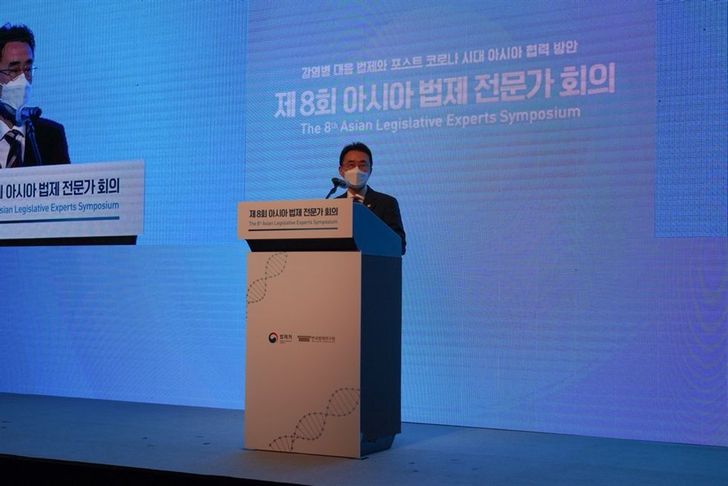
Minister of Government Legislation Lee Kang-seop gives his opening speech during the Asian Legislative Experts Symposium hosted by the ministry at Millennium Hilton Seoul, Wednesday. / Courtesy of Ministry of Government Legislation
Yeo Han-koo, presidential secretary for New Southern and Northern Policies, delivered the keynote speech, saying, “Korea and the New Southern Policy region should seize the COVID-19 crisis as an opportunity to advance cooperation to the next level through the New Southern Policy.”
In the first session of the symposium, Lee Jun-seo, senior research fellow at the Korea Legislation Research Institute, introduced Korea's legislative efforts regarding the pandemic, saying the so-called three COVID-19 acts ― the Quarantine Act, the Infectious Disease Control and Prevention Act, and the Medical Service Act ― which were revised at the end of February have helped the country cope with the contagious virus more effectively and promptly.
The Quarantine Act, which newly defined infectious disease based on “contact” rather than “symptoms,” obligates anyone entering from areas with large numbers of infections to report their health conditions.
The Infectious Disease Control and Prevention Act toughened punishment against violators of self-isolation regulations. Under the new measures, those who violate a 14-day self-isolation period can face up to one year in prison or fines of up to 10 million won ($9,000), much higher than the previous 3 million won fine.
“The law also strengthened authority of the Korea Disease Control and Prevention Agency to better control and investigate infectious diseases,” Lee said. “The Medical Service Act obligated operators of medical institutions to comply with hospital infection preventive guidelines and implement relevant measures.”
Lee said, on the back of the country's legislative measures in addition to policies such as the implementation of the social distancing system and drive-thru virus testing centers, Korea's COVID-19 responses have been garnering attention from a number of international health experts and media.
He noted, however, that the nation is tasked with looking into some unresolved questions, raised amid the COVID-19 crisis, such as conflict between strengthened antivirus measures and basic rights.
“The country's obligation to protect people's life and health may conflict with the freedom of assembly and religious gatherings,” he said. “The government can also face a question of whether it can indiscriminately collect personal information while working to trace those who may have come into close contact with virus patients.”
Following Lee's presentation, Nguyen Tien Duc, research fellow at the Institute of State and Law of Vietnam; Wang Teying, project manager at the Institute for Information Industry of Taiwan; and Nattanun Asawalertsak, permanent law councilor at the Office of the Council of State of Thailand, talked about laws and policies related to COVID-19 in their respective countries.
In the second session, experts on the economy, trade and industry, education and healthcare discussed legislative modification strategies and international cooperation measures for the post-COVID-19 era.
The ministry said it will continue to make efforts to deal with shared matters of interest for Asian countries and invite more countries, so that the Asian Legislative Experts Symposium can contribute to the prosperity of Asia.