New virus cases under 200 for 11th day

One of the shops at Malbawoo street market in Gwangju's Buk-gu District displays a sign issued by an association of the market vendors that reads “Tested Negative for COVID-19” on Sept. 12. Yonhap
South Korea's new virus cases stayed below 200 for the 11th consecutive day Sunday, but sporadic cluster infections and untraceable cases continued to put health authorities on alert.
Later in the day, the country will decide whether to extend stricter antivirus curbs in the greater Seoul area by another week amid expectations that it may ease some restrictions on eateries and franchise coffee shops.
The country added 121 more COVID-19 cases, including 99 local infections, raising the total caseload to 22,176, according to the Korea Disease Control and Prevention Agency (KDCA).
It marked a fall from the 176 and the 136 new cases reported Friday and Saturday, respectively. The number of local infections also declined below 100 for the first time in a month.
After the country kept new virus cases under 100 for months, it has seen daily infections grow by triple-digit figures since Aug. 14, due mainly to cases tied to a Protestant church and an anti-government rally in Seoul.
Since new virus cases soared to 441 on Aug. 27, they have recently slowed to the 100 range on the back of stricter social distancing guidelines. But daily infections are not on a markedly downward trend.
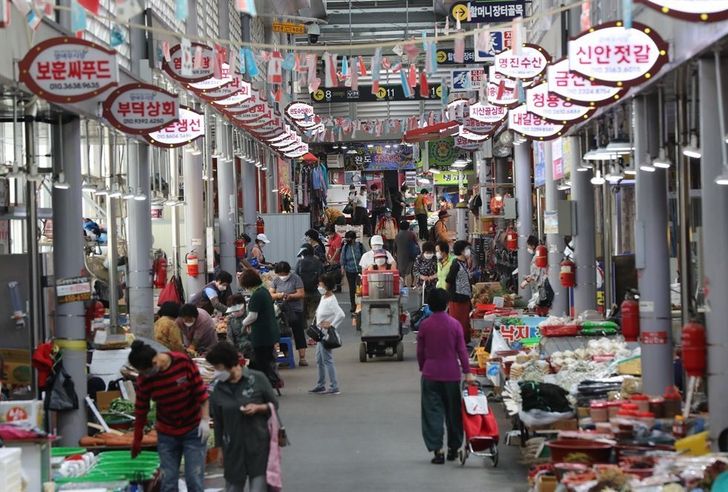
Malbawoo street market, with less than three weeks remaining until Thanksgiving holiday, one of the major statutory holiday seasons in Korea, shut down for two days earlier September after a COVID-19 case was confirmed and conducted disinfection inside the place. Despite the vendor operators demonstrating they tested negative to the coronavirus, the market didn't bustle with visitors as expected with the upcoming holiday. Yonhap
Health authorities said the current phase of the COVID-19 pandemic in the densely populated Seoul area is more serious than the first wave of the virus outbreak that gripped the southeastern city of Daegu in February and March.
The country is standing at a critical juncture in deciding whether to further extend the enhanced social distancing scheme in the capital region, called Level 2.5 measures. The measures are set to end at midnight.
Under the scheme, eating at restaurants is only allowed until 9 p.m. Franchise coffee chains, bakeries and ice cream parlors are permitted to offer only takeout and delivery.
Health authorities are struggling to bring new virus cases below 100 on concerns that virus cases may rebound after the upcoming Chuseok fall harvest holiday, set for early next month. But the prolonged virus curbs have dealt a heavy blow to small merchants and the self-employed.
Government sources said the country may keep the Level 2.5 steps in the Seoul metropolitan area but ease some business restrictions at "mid-risk" facilities, such as eateries and coffee shops.
Of the newly identified local infections, 30 cases were reported in Seoul and 27 in Gyeonggi Province that surrounds the capital. Incheon, west of Seoul, reported three more cases.
Other municipalities reported new infections, with the southeastern city of Daegu adding 14 cases and the southeastern port city of Busan reporting three new cases.
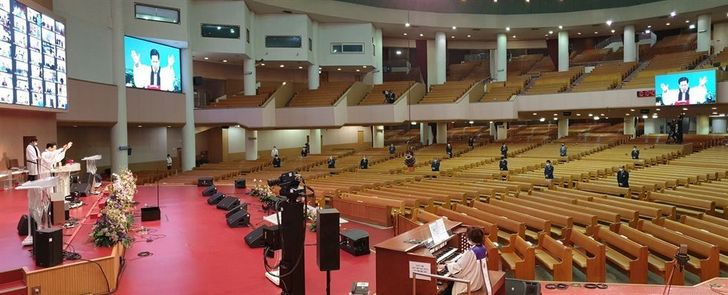
A Sunday service at Yoido Full Gospel Church in Seoul's Yeongdeungpo-gu District, Sept. 13, is being held for online participants while pews remain vastly empty as the country banned large-scale gatherings at churches to prevent COVID-19 infection. Yonhap
Cases traced to Sarang Jeil Church in northern Seoul, a hotbed of the recent spike in new infections, stayed unchanged for a fourth day at 1,167 as of noon Saturday.
Cases tied to the anti-government rally in Seoul on Aug. 15 reached 565.
Sporadic cluster infections showed no signs of letup, with cases linked to a general hospital in western Seoul hitting 23.
The country, meanwhile, reported 22 imported cases, with seven cases coming from Uzbekistan and four from India. Total cases coming in from overseas reached 3,003.
South Korea reported three more deaths, raising the death toll to 358. The fatality rate was 1.61 percent.
The number of seriously or critically ill COVID-19 patients reached 157 as of midnight, down seven from the previous day.
The total number of people released from quarantine after making full recoveries stood at 18,226, up 197 from the previous day.
The country has carried out 2,143,270 coronavirus tests since Jan. 3. (Yonhap)