Self-quarantine violators fitted with location-tracking bracelet

Vice Health Minister Kim Gang-lip, left, holds an electronic bracelet equipped with a location-tracking system before a regular meeting on the coronavirus at the government complex in Sejong, April 24. /Yonhap
By Bahk Eun-ji
People who broke self-quarantine rules began wearing electronic bracelets, Monday, as the government steps up measures against those who could possibly spread the coronavirus, according to Korea's top infectious disease official. The number of violators reached 286.
The Central Disaster and Safety Countermeasures Headquarters introduced the controversial plan on April 11 because the number of cases of people breaching self-quarantine has raised public concerns.
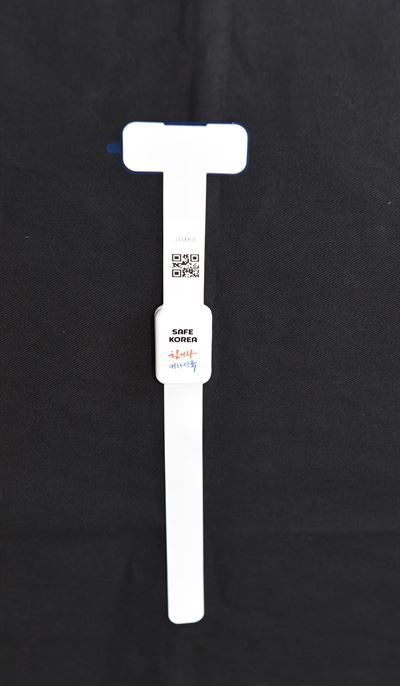
An electronic bracelet to be worn by violators of self-quarantine rules to prevent further spread of COVID-19, starting Monday /Yonhap
“Violators will be given two options ― either wearing the bracelets or being sent to state-designated quarantine facilities ― in order to avoid the controversies over human rights,” said Park Jong-hyun, an official of the Ministry of Health and Welfare during a regular briefing at the government complex in Sejong.
According to the Korea Centers for Disease Control and Prevention (KCDC), 39,740 people were under self-quarantine as of Sunday. Of those, 37,818 were people who returned recently to the country, while only 4.8 percent, or 1,922, were detected to have COVID-19 symptoms in regional communities.
Some 286 people under self-quarantine among a total 289 cases violated the quarantine rules, such as going outside without notice or not answering phone calls from officials. The bracelet, which the KCDC calls a "safe band," will interconnect with the government's mobile application for people under self-quarantine. If a person damages the device, it will automatically send a notification to health authorities.
Although the country has observed signs of the successful containment of COVID-19, health authorities said they still remain on high alert over cluster infections as holidays, such as Buddha's Birthday and Children's Day, are upcoming. Local health authorities especially remain alert ahead of the upcoming holidays, when people are expected to make short trips locally, as air travel overseas is virtually suspended.
The KCDC said 10 new infections were detected on Sunday, bringing the nation's total to 10,738. One new case was reported in Daegu, with continuing signs of a slowdown in the region. Three new cases were detected in Gyeonggi Province, and one was reported in South Chungcheong Province. Of these five regional cases two were imported cases that were discovered after the infected persons cleared checkpoints. Another five were detected at immigration checkpoints making a total of seven imported cases, raising the total number of such cases to 1,044.
A total of 8,764 patients have been released from quarantine after recovery. The death toll from the virus rose by one to 243.
Despite the positive signs, the government is still calling for people to comply with social distancing measures. The drive is still in force until May 5, while it eased some restrictions in the guidelines last week. However, the country is likely to move toward "everyday life quarantine" after May 5, which means schools and workplaces will mostly return to normal operation.