'Moon Jae-in Care aims at offering equal opportunities for healthcare'

Rep. Kim Jin-pyo of the ruling Democratic Party of Korea /Korea Times photo by Shim Hyun-chul
By Bahk Eun-ji, Kim Eil-chul
Korean citizens have a strong desire for equality, and equal access to healthcare is no exception, so it should be the government's basic duty to provide it for the lowest costs possible because it is related to the people's lives, said Rep. Kim Jin-pyo of the ruling Democratic Party of Korea.
“This is the basic concept of the Moon Jae-in administration's policy on healthcare ― expanding the coverage of the state-run health insurance,” Kim said in an interview with The Korea Times at his office in the National Assembly on Dec. 9.
Kim was the head of the “committee on national policy planning,” which was the de facto transition team for the Moon administration which took power in May 2017 without a proper transition period from the previous administration of Park Geun-hye who was ousted. He was in charge of drawing up a blueprint of the Moon government's major policies, including healthcare.
“Dubbed as “Moon Jae-in Care” or “Mooncare,” the government's goal is to expand the coverage ratio of the national health insurance to 70 percent of the medical expenses for the five years [of Moon's term],” he said.
There are many treatments that have not been covered by the national insurance program because of high costs, and the government is aiming to provide insurance for all medical treatments, according to the lawmaker.
“Mooncare is basically necessary for the improvement of medical services to guarantee the people's right to full and affordable healthcare, especially for the underprivileged. It is based on the government's theory of protecting the people,” Kim said.
Korea has experienced rapid growth, rising from one of the poorest countries in the world right after the Korean War to the world's 12th-largest economy, as well as achieving democracy.
“But all the growth was chaebol-centered. So, we are among the G20 among 38 members of the OECD in terms of income as of 2017, and other nations call Korea rich, but when it comes to welfare, we are almost at the bottom of the OECD,” Kim said.
“We have a gap between levels of income and welfare, and we have to narrow it.”
Essence of Mooncare
Korea provides universal healthcare through the National Health Insurance Service (NHIS). It requires all citizens to pay premiums and the insurance covers parts of medical costs in general. People usually purchase additional policies of private insurance to cover larger medical expenses, such as treatments for major accidents or cancer.
The key of Mooncare is expanding the insurance coverage to include costs for MRIs, ultrasounds, hospital rooms and nursing care.
In 2018, the government abolished “optional treatment,” which was usually charged when receiving treatment by experienced doctors at large hospitals. In the latter half of 2019, the state-run insurance was expanded to cover fees for more various sizes of hospital rooms, emergency room visits and MRIs for specific body parts, among others.
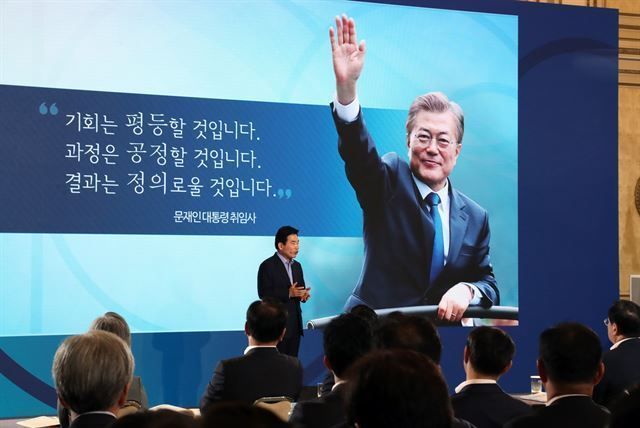
Rep. Kim Jin-pyo of the ruling Democratic Party of Korea announces the blueprint of the Moon Jae-in administration's policy at Cheong Wa Dae, Seoul, July 19, 2017, as the head of a committee on national policy planning that was the de facto transition team. /Yonhap
The government is also increasing the number of hospitals where patients can get not only medical services but also care by nurses when their family members are unavailable.
Insurance coverage for treatment of Alzheimer's and other forms of dementia as well as dentures and implants has been also expanded ― measures that meet the aging society.
“Through this plan, the Moon administration pledges to continue to build a country where people can receive treatments without having to worry about expenses,” Kim said.
Strength of Korean healthcare system
Korea has achieved a high level of healthcare compared to what it has invested in the field, as well as high quality of medical treatment in cancer.
Koreans' life expectancy was 82.7 on average in 2017, higher than the OECD's 80.7, and the infant mortality rate for the country in 2017 was 2.8 deaths per 1,000 births, lower than the OECD average of 3.8. Compared to the good achievement, Korea's total medical spending was 8.1 percent of GDP, lower than 8.8 percent.
Compared to other countries, Korea has a high quality of medical treatment for acute diseases and cancers ― according to 2016 data from Samsung Medical Center, the survival rate of Korean patients with colorectal cancer was 70.9 percent, higher than the OECD average of 60.2. More than 77 percent of patients recovered from cervical cancer, compared to the OECD's 60.7.
Korea had an average of 12 beds per every 1,000 people in 2016, compared with the OECD average of 4.7, according to the Ministry of Health and Welfare and the NHIS.
The country's medical institutions also have a higher number of high-tech instruments, such as CT and MRI scanners, than other OECD members, the data showed.
Remaining tasks
Despite its considerable achievements, there are challenges and new tasks facing Korea's healthcare system.
“There are various factors of change in the healthcare sector, such as changing demographics, aging society, low economic growth, climate change and increasing international exchanges. Among them, Korea's biggest challenges are rapid aging and low economic growth, and we need to prepare and seek various alternative policies for a sustainable healthcare system,” Kim said.
Long life expectancy is resulting in an increase in chronic diseases compared to acute ones, and patients need to control their diseases for their whole lifetimes. “By 2025, one in two people is expected to have a chronic disease, such as diabetes or high blood pressure,” he said.
In the aging society, both patients and medical workers are getting old. Also the medical expenses for the elderly aged 65 or older are forecast to jump from 36.3 trillion won in 2020 to 390.8 trillion won in 2060, taking up 6.57 percent of the GDP.
Also climate change and increasing international exchanges are boosting the chances of infectious diseases and new kinds of diseases, like Middle East Respiratory Syndrome (MERS) in 2015 and Zika virus in 2016. “The need for a stronger system to deal with infectious diseases is growing,” the lawmaker said.
Kim also said that although Mooncare and other policies are aimed at enhancing public healthcare, not everybody consents to it because it means higher national health insurance premiums or taxes and sometimes clash with specific groups' interest.
“The aging of society is taking place faster than we expected initially [when coming up with the policy plan in 2017]. It requires changes in budget spending and the medical system for the elderly, but the government has not drawn enough consensus from the medical sector. We need social consensus to cope with factors that could risk the sustainability of the nation's healthcare system,” he said.
“So expanding coverage of the national health insurance is the prerequisite for drawing public consensus.”