Calls grow to hire firefighters as central gov't workers
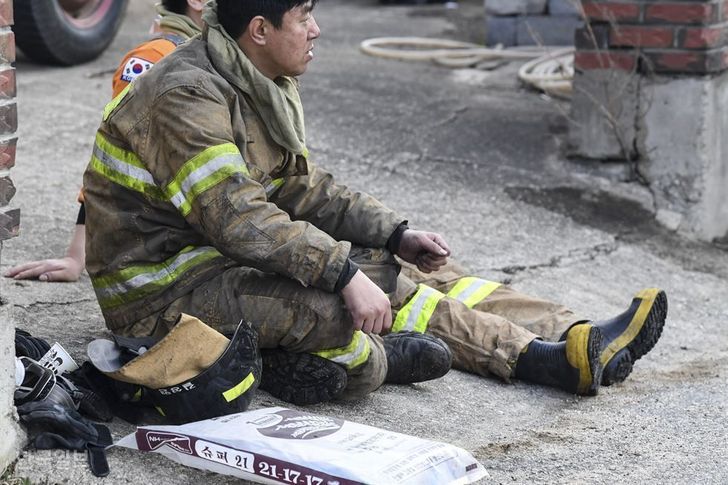
Firefighters take a break after putting out flames at Jangcheon Village in Sokcho, Gangwon Province, Friday. / Korea Times photo by Lee Han-ho
By Lee Suh-yoon
Public support is growing to change the job status of firefighters to central government civil servant positions from the current local government status, for more systematic mobilization of the firefighting workforce and improvement of their working conditions.
The consensus comes after firefighters from all across the country came to Gangwon Province last week to help contain massive forest fires in the region and such joint efforts were proven to be effective.
Currently, just 630, or 1.2 percent, of the 52,245 firefighters in the country are appointed and managed by the central government, according to Statistics Korea's 2018 report. The rest are hired by regional fire agencies supervised by local governments, which usually guarantees lower pay and fewer benefits than the central government due to budgetary constraints. The nation's police forces, on the other hand, are directly hired and operated by the central government except for those on Jeju Island.
A public petition on Cheong Wa Dae's website calling for firefighters to be directly hired by the central government gained over 200,000 signatures in three days.
“Under the local governments, each region has to hire firefighters and prepare equipment with its own budget. The regions with smaller populations with large areas to cover, or those with people with lower incomes, have a small budget so they cannot allocate enough money for fire prevention,” the petition read.
“I believe all firefighters should be directly hired and managed by the central government for firefighters' welfare and better crisis management and safety in various regions.”
The fire in Gangwon Province, which quickly spread with strong winds, was declared a state of national disaster by the government on Friday. Some 138 public facilities and 487 homes were burned, mostly in Goseong, Sokcho and Gangneung. Forests spanning the size of 750 soccer fields and 40,000 livestock were also destroyed in the fire.
Some 800 fire trucks and 3,200 fire personnel were speedily deployed to Gangwon Province from other regions through the mediation of the National Fire Agency ― set up in 2017 to respond to large-scale disasters. The fire was mostly put out by Friday morning, with the confirmed death toll at one.
“We already have a control tower that manages concrete disaster response systems,” Lee Young-ju, a professor at the University of Seoul's fire prevention department, said in a phone interview, Monday. “This system will stay in place whether the firefighters become central government employees or not, but if they do, it will make disaster response coordination on the ground more effective and thorough.”
Changing firefighters' status to that of central government employees was one of President Moon Jae-in's campaign promises. After being elected, Moon acknowledged the transition as a necessary measure in public speeches.
Growing public support for the centralization of fire personnel is likely to push through relevant bills, which have been pending at the National Assembly for months.
The ruling party publicized its support for the bills in a press briefing on Friday, saying it will work to get them passed through this month.
“The transition of firefighters' status to that of national service employees is not just the President's campaign promise but the people's request,” Lee Jae-jung, spokesman for the Democratic Party of Korea, said.