Korea moving to advance 'death with dignity'
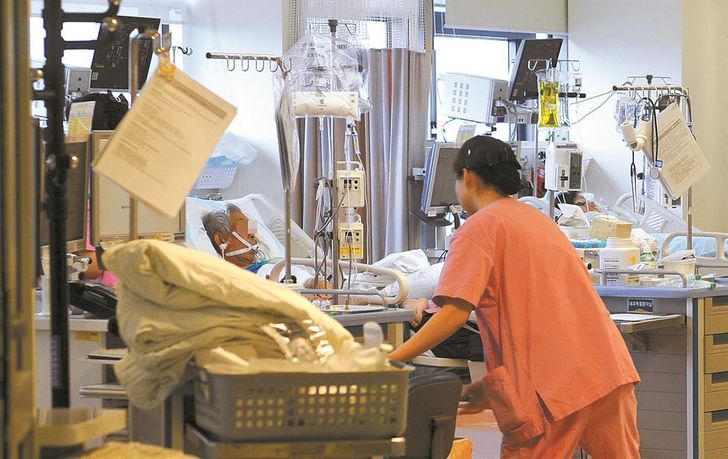
A nurse takes care of patient in an intensive care unit at Yonsei University Severance Hospital in this March 21, 2018 file photo. /Korea Times file
By Bahk Eun-ji
Sixty-five-year-old housewife Lee Sun-hwa recently filled out an advanced directive refusing life-sustaining treatment in the event she falls terminally ill.
She did so after watching her friend's death and the trouble it caused between the two sons.
Lee's friend suffered from pancreatic cancer, and ended up lying in a coma kept alive by a life support system. Her children began to argue about whether they should continue treatment or not mainly due to financial reasons.
“It was truly hard for me to observe their agony to decide whether they would keep going or help her to be relieved. The most difficult part was they didn't know their mother's intention,” Lee said.
Lee said she wants to use her own wishes to end her life, if she faces a similar situation to her friend.
“This decision is for myself of course, but at the same time it's for my children because I don't want them to get involved in unnecessary trouble,” Lee added.
Such registration has become possible since February when Korea adopted the law to allow ending of life-sustaining medical treatment to terminally ill patients with no chance of survival.
Any adult over 19 years old can document his or her intention whether to receive such treatment in preparation for the event where the person becomes an end-of-life stage patient.
The document is registered with the Korea National Institute for Bioethics Policy, and the person can request its withdrawal at any time.
According to the Ministry of Health and Welfare (MOHW), 35,431 terminally ill patients chose to die without receiving any further life-prolonging treatment between Feb.4, 2018, when the law took effect, and Jan.28 this year.
The stopping of “meaningless extension of life” relates to four treatments: cardiopulmonary resuscitation, use of a respirator, hemodialysis and anti-cancer drug administration.
If patients become unconscious and are unable to make a decision themselves, family members must agree to cease treatment. It used to require the consent from all lineal family members, which was criticized as being unrealistic. A revised rule will take effect March 28 to allow consent from only direct family members including spouse, parents and children.
At least two doctors must confirm that the patient's condition is incurable before terminating the treatment.
The health ministry announced Tuesday that it would add three more life-sustaining treatments to the list of treatments to be stopped _ extracorporeal life support, blood transfusion and using vaso-dilator or constrictor agents. All three treatments are only meant to prolong life without any actual treatment purpose, the ministry said.
A health ministry official said the changes of the rules were to guarantee the patients' rights.
“Ultimately it is for patients who suffer from terminal illness to help end their life with dignity as a human being,” said Ha Tae-gil, chief managing director of the ministry's bioethics department.
Some critics say, however, ceasing life-sustaining treatment, although made through the person's advanced directives, is not a real “death with dignity.”
“I would say it is not a death of dignity, but a passive form of euthanasia,” said Ahan Ki-jong, the president of Korea Alliance of Patients Organization.
“Most patients in Korea forgo life-prolonging treatment mainly because of financial reasons. When this situation is changed, people can discuss the right to death with dignity,” Ahan added.
Some people more actively seek to decide their own life.
According to a Swiss-based nonprofit organization Dignitas, two Koreans were confirmed to have died through euthanasia in Switzerland.
The organization accepts foreign nationals and assists them in taking their own lives through the injection of drugs by qualified doctors. The procedures for the Koreans took place at the organization's facility in Zurich between 2016 and 2018, it said.