No. of measles patients surges more than 6-fold: report
By Kim Hyun-bin
Measles infections have been rising around the world and Korea is no exception, with the number of cases surging over six times in 2018 compared to the previous year. Thanks to modern medicine, measles no longer results in death but is still a highly contagious disease which continues to keep health officials on their toes.
It had been thought that measles had been eradicated here thanks to vaccinations. But health officials say frequent international travel by Koreans, as well as an increase in the number of infected foreigners entering the country, have increased the infection rate.
Reason behind 6.4 times increase
According to the Korea Centers for Disease Control and Prevention (KCDC), there were 45 measles cases reported in 2018, a 6.4-fold increase from seven the year before.
In the recent decade, the number of measles patients has fluctuated _ 17 in 2009, 114 in 2010, 42 in 2011, three in 2012, 107 in 2013, 442 in 2014, seven in 2015, 18 in 2016 and seven in 2017.
“The infections used to occur in local communities such as schools and hospitals, but infections these days are not from a naturalized virus,” the KCDC said. “Most of the patients contracted the disease abroad.”
In December, a woman in her 30s was confirmed to have measles. She was infected while volunteering in Thailand and showed symptoms of measles after returning to Korea.
The patient has been fully cured and returned to normal activities, although health officials will continue to provide vaccinations and monitor those who had contact with her. They will also remain on high alert until Jan. 13 as measles has a maximum three week incubation period.
“Measles is highly contagious but with proper vaccinations, there isn't a big chance of infection,” a health official said.
In March 2014, the World Health Organization accredited Korea for stamping out measles.
Out of the 45 people infected last year, 20 were male and 25 female. Among age groups, 53.3 percent of the patients were under nine years old, followed by those in their 30s and 10s, indicating most infections took place in highly congested places such as kindergartens, schools or workplaces.
Get vaccinated and report suspected symptoms
Measles is a highly contagious infectious disease caused by a virus that replicates in the nose and throat of an infected person. When an infected person coughs, sneezes or talks, infected droplets spray into the air, and other people can inhale them.
The infected droplets may also land on a surface, where they remain active and contagious for several hours. You can contract the virus by putting your fingers in your mouth or nose or rubbing your eyes after touching the infected surface.
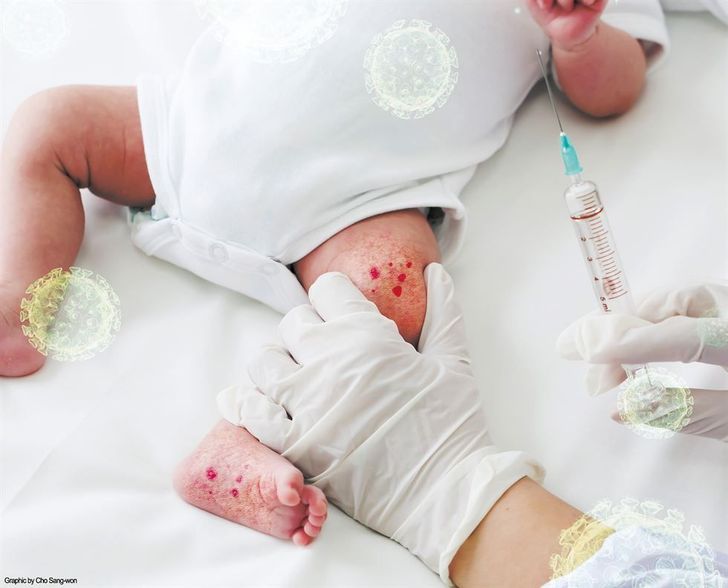
Symptoms usually develop 10 to 12 days after exposure and last seven to 10 days. Initial symptoms typically include fever, often greater than 40 degrees Celsius, cough, a runny nose, inflamed eyes and irritating spots.
Small white spots known as Koplik's spots may form inside the mouth two or three days after the start of symptoms. A red, flat rash also usually starts from the face and spreads to the rest of the body within three to five days.
Health officials say people and their children should be vaccinated, especially before starting elementary school or planning trips to developing countries where measles is more common. Along with vaccinations, maintaining good hygiene is the most important factor in preventing the disease.
People with a vitamin A deficiency are more likely to have severe symptoms and complications if infected.
Experts say those having signs of measles infection are required not to visit a hospital but report to the health authorities for a free home inspection.