INTERVIEW Cafe owner breaks bias against refugees
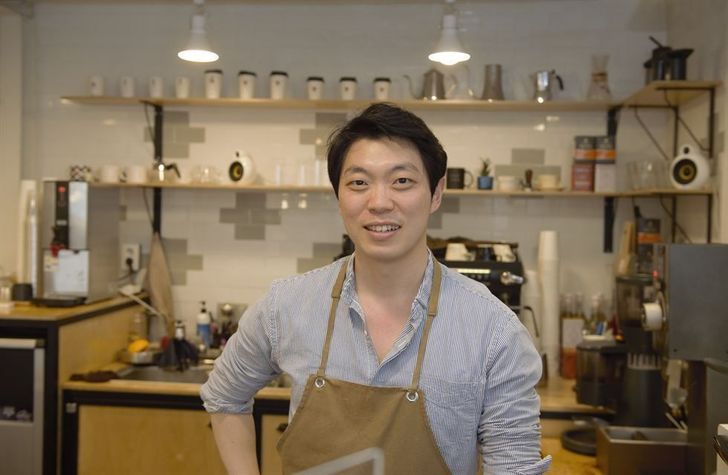
Mun Jun-suk poses for a photo inside his cafe, “Tomorrow's Coffee,” in Hyehwa, Seoul, that trains and employs African refugees as baristas. / Korea Times photo by Lee Suh-yoon
By Lee Suh-yoon
Mun Jun-suk, 35, looks at three things when recruiting baristas for his small coffee shop, Tommorow's Cafe — communication skills, love for coffee and the ability to overturn negative social stereotypes.
Mun left his office job in 2014 to open the cafe in Hyehwa, Seoul.
The motivation behind this sudden career change was not simply to leave his dreary office job.
Mun wanted to break down negative stereotypes of African refugees he met while doing volunteer work with his church.
“I used to hold prejudices against African refugees before the volunteer work,” Mun said in a recent interview at his cafe.
“But as I interacted with them and was invited into their homes, I realized they were good people, full of energy, optimistic about life and full of talent. Sometimes, I felt like the one who was being consoled.”
Mun's experience led him to open the cafe and train and employ African refugees as baristas.
“I wanted more Koreans to see the good side of African refugees so people would stop discriminating against them,” Mun said. “That's when I came up with the idea of opening a cafe as a space where we can break down communication barriers.”
So far, eight refugees from countries such as Congo, Egypt and Kenya have graduated from the cafe's two-year barista training and employment program. The employees also receive Korean language lessons every week.
One refugee from Burundi who currently works with Mun says the barista and customers are able to build meaningful connections here.
“Despite the language barrier, the barista and customers often strike up casual conversations, starting with where the barista is from,” Mun said. “Two weeks ago, a customer even visited her home, and they cooked meals together. Seeing this kind of friendship really inspires me.”
Some baristas who graduated from the cafe left Korea after their asylum applications were turned down. Two others moved on to work at other establishments.
“The most satisfying moments are when the refugees move on to other cafes and are able to support themselves because they acquired a good grasp of Korean, barista skills and the service culture,” Mun said.
Mun says he feels disheartened by the recent public criticism toward Yemeni refugees on Jeju Island.
“I hope public discussions can be held based on accurate information, not based on stereotypes such as labeling all Muslims as terrorists,” Mun said. “Wrong information can stoke fear.”
Mun also hopes the refugee issue could prompt the government to take “proper” action for the refugees.
“Though Korea is a country with a refugee protection law, the situation for refugees here has steadily worsened due to indifference and neglect,” Mun said. “Whether positive or negative, I hope this public discussion about refugees can get the government to finally respond to this issue in a humane way.”