Household products under scrutiny for radioactive emissions
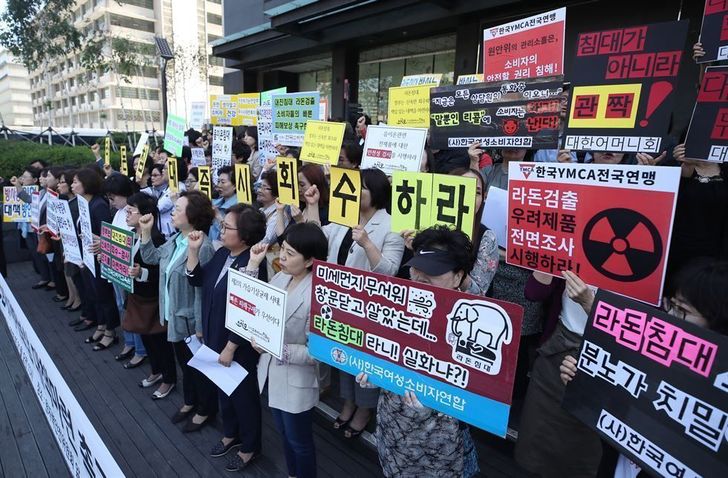
Consumer and civic groups demand an immediate recall of mattresses found to emit harmful levels of radiation in front of the Nuclear Safety and Security Commission building at Jongno, downtown Seoul, Monday. / Yonhap
By Lee Suh-yoon
A recent public health scare over “radioactive mattresses” found to emit radon nine times the safety standard is spreading to other household products.
Radon – a radioactive gas – is emitted by monazite sand, a natural mineral that releases “negative ions.” Manufacturer Daijin Bed applied it to the inner layer of the mattresses for alleged health benefits. Excessive radon exposure has been found to cause lung cancer.
Nuclear Safety and Security Commission data, acquired and released by Democratic Party of Korea Rep. Kwon Chil-seung on Tuesday, shows Daijin Bed's monazite sand supplier distributed even more of the radioactive substance to three other local firms over the years.
One bought 12 tons of monazite sand between 2014 and 2018 – almost quadruple the amount Daijin Bed bought between 2013 and 2016 – to produce various “negative-ion” health products like bracelets and laundry washing balls.
Data shows the supplier sold over 40 tons of monazite sand over the past five years.
According to the nuclear safety commission, this radioactive material was distributed to over 66 local firms. Eleven were linked to household products.
“The Nuclear Safety and Security Commission should conduct speedy investigations into firms that bought monazite to prevent future harm,” Rep. Kwon Chil-seung said.