Maxillofacial surgery pioneer values social responsibility
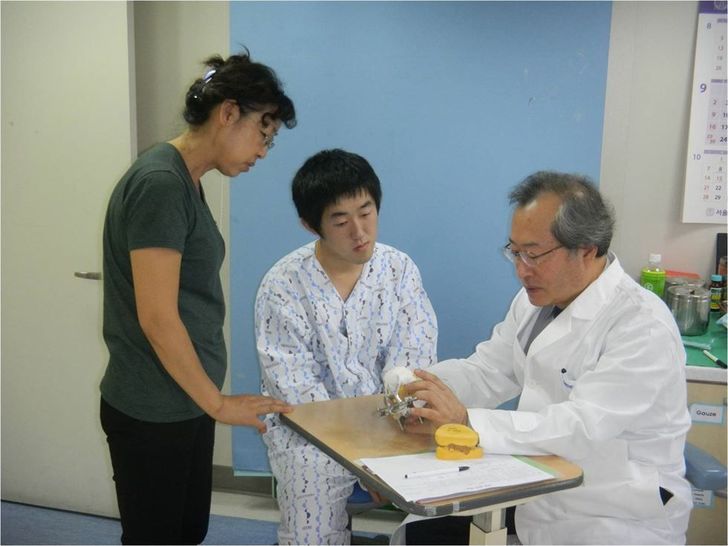
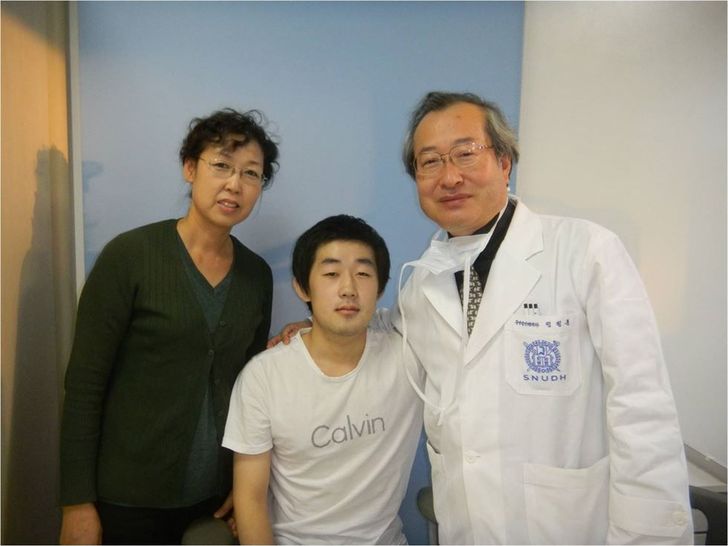
In the first photo, a Chinese man, center, consults with Dr. Choung Pill-hoon, right, before undergoing maxillofacial surgery at Seoul National University Dental Hospital in 2012. The second photo shows the man smiling after the successful procedure. Courtesy of Seoul National University Dental Hospital
By Lee Kyung-min
Choung Pill-hoon, 64, a renowned specialist of oral and maxillofacial surgery at Seoul National University Dental Hospital (SNUDH), was a pioneer in developing Intraoral Le Fort II Osteotomy, or Choung's 9 Osteotomy, a method using just a single intraoral incision to correct deformities in the mid-facial nasomaxillary _ located between the nasal bone and the jaw. His method of removing nasal, jaw, and cheek bones did not involve facial opening _ which inevitably entails huge scars _ but a simple incision inside the mouth, thereby achieving the desired appearance with minimal scarring. The method is known to induce a more desired outcome especially for Asians most of whom have a low nasal bridge, which means smaller room through which surgeons should remove facial bones.
“I finished developing the method in 1994 and held a presentation at a doctors' conference in Budapest the next year, which was met by a long standing ovation from all the surgeons there,” he said. What could have been a historic recognition in the history of maxillofacial surgery since the first operation was performed in 1849, he said, was overshadowed by the collapse of the Sampoong Department Store in Gangnam, southern Seoul, on June 29, 1995. The colossal disaster killed over 500 and injured nearly 1,000 others, marking the country's worst disaster. “I was watching TV at the hotel, and I saw the news painting Korea as a country whose shortcuts in development resulted in the collapse. I was so ashamed I could not attend the remaining sessions of the conference the following day and immediately came back to Korea. In the 150 years of the history of oral and maxillofacial surgery, nobody thought of performing nasomaxillary surgery intraorally but me.”
The method is believed to be reproducible, stable and safe, as proven by long-term follow-ups over 20 years, according to various medical journals. Many Chinese students from Yanbian University trained under Choung, a former two-term dean of the Seoul National University School of Dentistry. “I was the first Korean doctor invited to Japan to give a lecture on the method. I gave the lecture at Nagoya University in 1996.”
Choung Han-wool, his son, also an oral and maxillofacial surgeon at SNUDH, is following in his father's footsteps to continue and master the complex, complicated surgical technique. The Choung method, the senior Choung said, will be published following a contract with Springer, a global publishing company publishing books, e-books and peer-reviewed journals in science, humanities, technical and medical fields.
Volunteer work
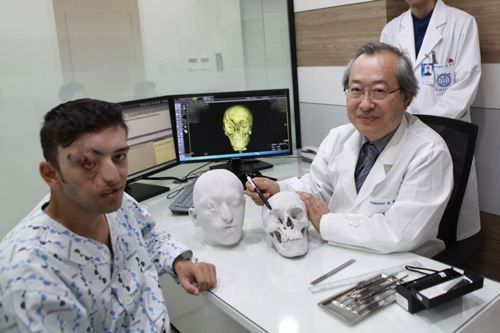
/Akhmadjonov Mukhriddin, consults with Dr. Choung before undergoing maxillofacial surgery at Seoul National University Dental Hospital in 2016. Courtesy of Seoul National university Dental Hospital

Akhmadjonov Mukhriddin, right, smiles at Incheon International Airport after successful maxillofacial surgery. Courtesy of Seoul National university Dental Hospital
Akhmadjonov Mukhriddin, 25, from Uzbekistan, said his “life changed” after Choung performed the 13-hour surgery in 2016 to correct his craniofacial cleft, a deformity he had lived with his entire life. He had a cleft lip and cleft palate at birth, which continued to develop into a facial cleft affecting his lower chin all the way up the frontal lobe. Despite five earlier surgeries, his condition barely improved.
A cleft lip and cleft palate refer to openings or splits in the upper lip, the roof of the mouth (palate) or both. Symptoms include difficulty swallowing, with the potential for liquids or foods to come out the nose, a nasal speaking voice and chronic ear infections. Facial cleft is the collective term for all sorts of clefts affecting structures including bone, soft tissue and skin. In most cases, they are caused by an interaction of genetic and environmental factors, and a definite cause isn't known.
“I had never felt comfortable eating, looking at others, much less myself my entire life. Now, I have found a new life. I feel so grateful to doctors who helped me live a new and happy life,” the then-23-year-old man said, according to SNUDH.
He heard about volunteer activities organized by the Korean Association of Research and Charity for Craniofacial Deformity, which was in Uzbekistan for free medical treatment and consultation for facial deformity patients. The nonprofit organization comprised of SNUDH doctors was set up by Choung in 2002 to offer consultations and perform the highly difficult and expensive procedure on patients from financially underprivileged backgrounds. As of January, the group helped 829 patients in 15 countries including Uzbekistan, Kyrgyzstan, Laos, the Philippines, Nepal, India, China, Vietnam, Kenya, Ethiopia, Jordan, Cambodia and Egypt.
Choung saw the young man had asked him if he could to go to Korea where he would undergo surgery with the help of skilled medical professionals and high-tech equipment. The association paid for his flight tickets and part of the operation's cost with the remaining fee paid by SNUDH. “The scope of the cleft reached almost all parts of his face, which required highly efficient and extensive surgical skills from an experienced surgeon. I am happy I helped the young man gain confidence,” Choung said.
Choung said he will happily perform the highly complicated surgery for free on five patients. Visit goodface.net or snudh.org to contact Choung.