Exclusive KP to seek opinions of irregular delivery personnel over working conditions
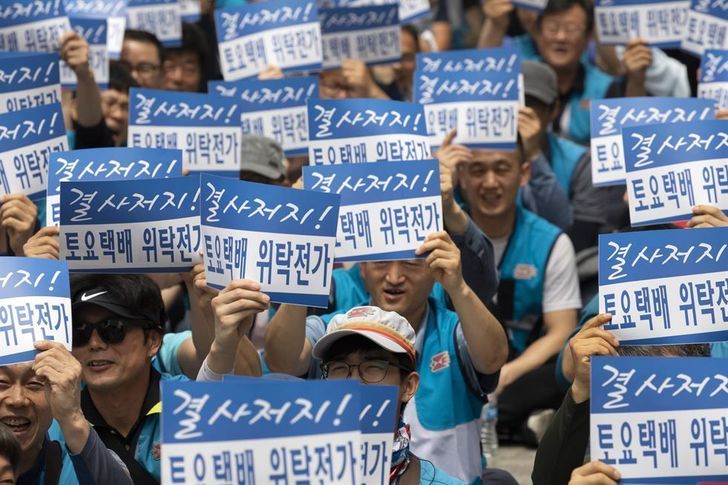
A group of irregular delivery personnel at Korea Post hold rally demanding the state-run postal service scrap its plan to remove Saturday shifts and reduce the weekly working hours, which they fear they will be "dumped” the work formerly undertaken by regular workers at KP, all of whom are civil servants near Gwanghwamun, Seoul, Monday. Photo by Korea Times Shim Hyun-chul
By Lee Kyung-min
Korea Post (KP) plans to conduct an in-depth survey on around 2,200 irregular delivery personnel under KP contract on their opinion about current working conditions concerning wages, shifts and workload.
“The government will conduct the survey on all irregular delivery personnel about whether they are willing to work on Saturdays or increase their workloads and the resulting increase in wages. The results will be out as early as this month, or early next month at the latest,” an official of the state-run postal service told The Korea Times, Tuesday.
The decision effectively postpones the KP-announced measure slated to take effect in July, under which gradual steps were to be taken in order to remove Saturday shifts and reduce the weekly working hours to below 52 from the current 68 and over.
The measure, according to a group of irregular KP delivery workers, would have put them under enormous pressure as the work formerly undertaken by regular workers at KP, all of whom are civil servants, would be dumped on them.
The group held a street rally, Monday, protesting the government's plan to reduce working hours. The workers – 400 according to the rally organizer and 250 according to KP – stressed what they called a short-sighted measure without a corresponding increase in manpower will only worsen the already harsh working conditions of the “marginalized” group, whom the new “worker-friendly” plan fails to include.
“The measure is senseless,” a member of the group said. “In some regions that have already implemented the no-work-on-Saturdays policy, the workload was reported beyond unmanageable. Some said they worked almost to midnight, but were still unable to finish what they were assigned for the day.”
The group dismissed KP's follow-up plan to increase the number of workers, adding it was not a solution to the fundamental problem. “This is considered a politically sensitive issue. KP earlier declined to specify neither the number of planned new hires nor if they will be hired at all,” a member of the group said. One KP irregular delivery personnel worker received 1,266 won ($1) per package, and they make an average of 180 deliveries per day.
Meanwhile, KP's planned reduction of working hours reflected the public outcry following the growing number of delivery workers' deaths over the past few years. According to data submitted to Rep. Choi Myeong-gil of the then People's Party last October, of 218 who worked for KP who died between 2012 and September 2017, 144 died due to illness and 34 committed suicide. Of them, only 24 were recognized as having died while on duty, accounting for about one out of 10. While it was difficult to attribute the harsh working conditions to the suicides and suspected overwork-driven sudden deaths, Choi said, an average of more than 30 deaths at a single workplace drew enough cause to look into their working conditions.
Koreans work an average of 2,069 hours per year, much more than the average 1,764 hours of OECD member nations. Other developed countries have been reducing working hours to promote balance between work and life and to boost consumption and economic growth.