Ajou to get 'doctor helicopter' soon
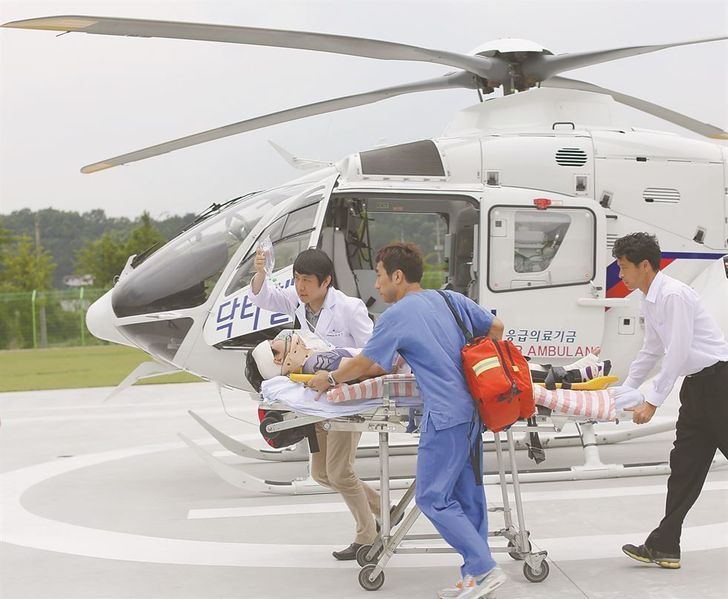
Emergency medical staff is swiftly escorting a critical patient after unloading him from the doctor helicopter. The Korea Times file
By Kim Hyun-bin
Ajou University Hospital will be able to get its own emergency helicopter that can transport patients in critical condition.
The Ministry of Health and Welfare has decided to dispatch a so-called “doctor helicopter” to the hospital.
It said Thursday this would be the country's seventh medical transport helicopter.
“It is extremely difficult to rapidly transport seriously injured patients by land in Gyeonggi Province. The roads in the region face constant traffic congestion. This is why the government decided to dispatch the helicopter to Ajou Hospital,” the ministry said in a press statement.
This comes after Lee Cook-jong, a trauma specialist at Ajou Hospital, has repeatedly requested such a transport helicopter over the past seven years in order to treat patients in time.
Lee is known for treating Seok Hye-gyun, captain of the freighter Samho Jewerly, who was shot during a rescue mission after being held hostage by Somali pirates in January 2011.
He also treated a North Korean defector soldier who was seriously injured by rifle fire from North Korean soldiers while crossing the Military Demarcation Line via the Joint Security Area (JSA) last November.
Lee said trauma centers need financial support and equipment, stressing their poor working conditions and lack of manpower.
But the health ministry declined his request, citing budget concerns and lack of personnel.
Since March 2011, Ajou University Hospital flew in 250 critical patients using helicopters provided by Gyeonggi Fire Services.
But those helicopters take about 18 minutes to arrive at the hospital's helipad.
Once dispatched to Ajou, the hospital will have the helicopter on its rooftop helipad, and it will be on standby 24 hours a day.
In case of an emergency, the helicopter will be ready to take off within five minutes.
“We have a chance to become the model (for other hospitals),” said Lee.
”Having great equipment is important. But what is more important is obtaining and maintaining great staff. Otherwise, the equipment becomes worthless.”
The nation's first two medical transport helicopters were dispatched to Gachon University Gil Medical Hospital and Mokpo Hankook Hospital in September 2011.
Four additional helicopters were given to medical centers in areas including in Gangwon and North Gyeongsang provinces.
Early this year, the government announced measures to improve the medical treatment conditions to reduce the death rate to below 20 percent in seven years.
The fatality rate of injuries reached 30.5 percent in 2015.