Doctors, gov't tussle over healthcare policy
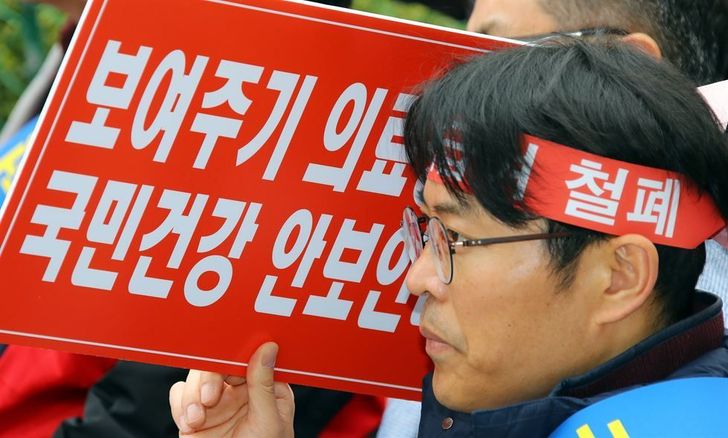
A doctor holds a sign at a rally in Seoul, March 18, protesting health insurance coverage proposed by President Moon Jae-in. The sign reads: 'A populist policy costs public health!' / Yonhap
By Jung Da-min
The conflict between the government and the medical community is heating up over the former's expanded health insurance coverage project called “Moon Jae-in care.”
The negotiation between the Ministry of Health and Welfare and the Korean Medical Association (KMA), doctors' representative group, recently broke down.
“Moon Jae-in care” aims to provide financial support for all treatments and medications including charges for MRIs, ultrasound, hospital room and nursing care. But the plan excludes support for cosmetic surgery and treatment.
The state-led insurance plan will also cover costs of abdomen ultrasonography in April. This was part of President Moon's pledges he made last year during his election campaign to reduce increasing medical cost burden especially among the elderly.
Doctors say they basically agree with the government's intention to help reduce medical costs amid the country's aging population.
But they say the new policy is not sustainable, arguing they will have to work more hours to cover their losses.
Currently, doctors here only get paid about 37 percent of the amount those in Organization Economic Cooperation and Development (OECD) countries on average for treating a patient.
They said this is extremely low. To cover potential losses under the policy, hospitals will have to cut costs by letting go of, or reducing nurses' salaries.
“Doctors and nurses in Korea have to work three times more than those in other countries to make up for the losses,” said Heo Dae-seog, a doctor at the Seoul National University College of Medicine in Seoul.
“It poses safety threats as we have seen from a hospital fire in Miryang that killed 41 people, and a medical accident at Ewha Womans University Mokdong Hospital that killed 4 infants.”
The two hospital accidents that happened in recent months are not irrelevant to the lack of manpower, the doctor claimed.
Residents and nurses here have been struggling with poor work conditions.
They mostly work overtime without getting appropriate salaries in accordance with the amount of hours they contribute to the current system.
“The current health insurance system is ridiculously obsessive,” said a student at a nursing college in Seoul.
“I like the idea that hospital costs are getting lower. But the government is not communicating sufficiently with the medical community. This is why the current medical charge is absurdly low, leaving us to be exploited by hospitals to make profits.”
After the negotiations with the country's health authorities broke down, the KMA said that there will be no more talks with the government during KMA President Choi Dae-zip's term.
Choi was elected as the president of the doctor community on March 23, surprising the community since he is considered an “extreme rightist or conservative” who has been supporting the imprisoned former President Park Geun-hye.
In 2016, per capita medical spending stood at 1.27 million won, according to latest data by the Korea Institute for Health and Social Affairs.
But medical treatment costs for each elderly person reached 3.8 million won on average.
The aggregate amount of medical costs for the elderly is forecast to reach 91.3 trillion won by 2030, the institute noted.
The total medical spending covered by the state insurance plan is expected to reach 126 trillion won in 12 years.