Corruption scandals take toll on Korea's spirit of giving
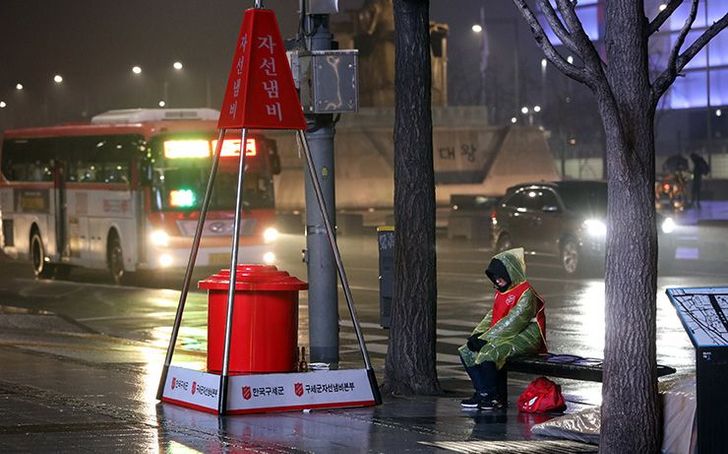
A Salvation Army bell ringer in raincoat sits idle in rain near a red kettle in Gwanghwamun, downtown Seoul, on Dec. 30. / Yonhap
By Park Si-soo
The spirit of giving that warms Korean society this time of the year seems to be losing its steam rapidly in the wake of the protracted economic slowdown and corruption scandals involving charities.
The number of people who seek the tax deduction given to donors has plunged in recent years, state data showed.
A total of 715,260 received the deduction in 2016, the latest data available, down 8.8 percent from a year earlier, the National Tax Service said. It was a 28.6 percent drop from 2012 when 886,617 people benefited from the tax cut.
The downturn continued in 2017. Major charities are said to be falling well short of their fundraising targets. The Community Chest of Korea, one of the biggest charities, said as of December 31 its fundraising reached 65 percent of its goal of 399.4 billion won. At the same time in previous years, the rate hovered around 70 percent, it said.
The Salvation Army of Korea, another major charity, is also wrestling with the same problem. Its provincial branch in Gangwon Province said as of December 31 it was only halfway to meeting its target of 15.8 billion won.
Such apathy toward donation is also found in a recent Statistics Korea survey. It showed only 26.7 percent of surveyed people had donated in 2017, down from 36.4 percent in 2016.
Analysts pointed to the protracted economic slowdown as one reason. They noted a bigger cause is people’s distrust of charities.
The loss of public confidence could largely be blamed on several charities hitting the headlines in recent years over embezzlement and other corruption scandals.
The latest scandal was in October, in which a murder suspect had enjoyed an affluent life for years with donations of around 1 billion won given to him to treat his daughter’s rare disease.
“This trend will continue unless radical measures are adopted to bolster transparency of the use of donations,” social welfare professor Chung Moo-sung from Soongsil University told a local daily.