Challenge and response to low fertility in era of ageing population
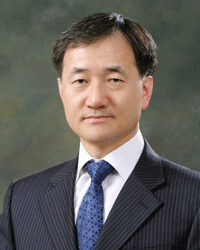
Park Neung-hoo
By Park Neung-hoo
Korea is burdened by socio-structural instability in employment, housing and education and an immature social safety net in the global low-growth environment.
Growth-oriented policies driven by effectiveness made Korea the world’s 11th economic giant at an unprecedented pace, but life satisfaction fell into the lowest bracket of 29 out of 35 OECD member countries.
Against this backdrop, the young generation which hold the future in their hands almost despairs of marriage and parenthood.
A whopping 9.4 percent of youth unemployment as of August 2017 and the excessive burden of housing costs get in the way of their marriage.
Even married couples are let down by the social system and culture that generate unbearable costs of childbearing and rearing.
And this reality led to the low-fertility phenomenon. The number of newborns in Korea, which once recorded more than 1 million in 1971, plunged to 406,000 last year.
Low fertility, an aging population and subsequent disruptions in demographic structure would cause a significant shock across our society.
To preemptively respond to such a crisis, the government launched a Presidential Committee on Ageing Society and Population Policy in 2005, but things have only got worse.
To reverse the trend, we have to make a tectonic shift toward the “Inclusive Welfare State,” where the government ensures that people enjoy at least a basic livelihood and necessary services, including job opportunities, housing, medical care and social care without worrying about accessibility and availability.
When our society truly becomes a place where having and raising babies is a source of happiness, only then will Korea be able to resolve the low-fertility issue.
To realize such a paradigm shift, the government is implementing a series of concrete policies.
First, the government will expand investment in the future generation and enhance governmental responsibility for raising children.
Providing support for the future generation and allocating a larger portion of welfare expenditures will pay off since they serve as social investments that will eventually drive growth.
To make this spending worthy, we will introduce a universal child allowance system, increase investment in child health and build more public childcare centers.
Second, we will make our society more favorable to childbirth and rearing by striking a balance between work and life through an increase of support for maternity and childcare leave, a reduction of work hours for childcare and improvement of corporate culture and the labor environment.
However, the government alone cannot fix a work culture that values long working hours, which makes childbearing even harder.
The improvement movement inside organizations, the awareness-raising activities of the media and civic societies and individual efforts of each citizen are all the more crucial.
Third, we drew up measures to create the basic foundation for youth to dream of marriage and parenthood.
If we succeed in job policies, including the transition from temporary to permanent positions and public housing projects for newlywed couples, we would be able to level the playing field for youth.
Last but not least, the government will strengthen its control tower function to establish an all-out response mechanism for the low fertility and aging population crisis.
In this regard, we will shake up the presidential committee to engage more private sector participation and enhance communication with the young generation being directly affected by the current situation.
The future is something we create, it is not given to us. If we keep doing business as usual, our future will never be bright.
The Ministry of Health and Welfare will pave the way for the “Inclusive Welfare State,” defining it as a new paradigm to ensure sustainable development.
We will also do our best to create a stable society where people can plan their futures, give birth and raise children with no fears.
To this end, all members of society, including corporations, media and civic societies, need to stand shoulder to shoulder with the government and take bold action in collaborative efforts.
The writer is Health and Welfare Minister