Saemangeum's past haunts Jamboree

People film at the water's edge on a tidal flat a few kilometers south of the World Scout Jamboree campground at Saemangeum in Buan, North Jeolla Province, June 16. Korea Times photo by S Latham
By S Latham
In 1991 work began on filling in an extraordinary natural estuary home to hundreds of thousands of migratory birds on the southwestern coast of Korea. That same year, Korea successfully hosted the 17th World Scout Jamboree in Seoraksan National Park. Three decades later, the Jamboree would return to Korea, albeit on an utterly transformed landscape. After decades of fierce national argument, trillions of won and with the migratory shorebirds largely banished, the giant estuary is now a massive infill of flat land that hosted the 25th World Scout Jamboree, the most infamous global scouting event in a century.
“We can't avoid the heat,” a Korean Scout at the Saemangeum campground in North Jeolla Province said on Aug. 3. Five days later, event organizers began relocating all Jamboree participants to escape ― not the heat but another threat of nature ― a typhoon. Business conglomerates became the heroes, rushing to the aid of Scouts at the mercy of a hostile environment and incompetent environmental control. Saemangeum, the site chosen for the environmental lessons of the Scouting movement, became the site for a lesson in ecophobia.
According to Sungkyunkwan University professor Simon C. Estok, the author of “The Ecophobia Hypothesis,” Saemangeum was a bad idea for the Jamboree and the reclamation is an illustration of the ecophobia reflex, which he says is fear and control of nature ― “a rational fear run amok.”
“The Saemangeum project obliterated features of the natural environment so that a global free trade area could be stamped onto those newly controlled spaces,” he told The Korea Times. “Saemangeum reeks of ecophobia not only in its deliberate violence against nature but in its?indifference?to nature ― to the migratory birds and inter-tidal ecologies in this case.”
On Aug. 9, a contingent of Australian Scouts were exploring Namdaemun Market in Seoul after relocating early from Saemangeum. Referring to Saemangeum, one Scout said, “Why would you hold it there? It's a wetland!”
But there is little left of that remarkable wetland. The 27-square-kilometer ecosystem fed by the Mangyeung and Dongjin rivers once hosted nearly half a million migratory birds, shallows full of fish and thousands of fisher folk who helped feed the nation.
“The mood is desolate,” Kim Jeong-hwan said of the feeling around Buan since the failed Jamboree. Kim and his wife run a seafood restaurant on the westernmost end of Byeonsanbando. “People are too upset to talk about the Jamboree,” the 25-year-long resident said two days after the closing ceremony.
“Small business people, including us, prepared for extra visitors during the Jamboree. But they never came. Even the general public could have predicted the problems such as heat and mosquitoes. But the organizers and government couldn't work it out.”
The vast “getbol” (tidal flat) has been strangled by the world's longest seawall. Symbolizing progress and national dreaming, it encircled 401 square kilometers of critical ecological wonder on which politicians would project their fantasies. Still today, the Saemangeum Development and Investment Agency trumpets the utopic dreams of a “new civilization” built upon harmony between humanity and nature.
The “Great Wall on the sea” is a strange place to drive. The wide roads run straight for kilometer after kilometer. Grasping the scale of Saemangeum is near impossible, for the reclaimed land stretches beyond the hazed horizon. The pride of Hyundai is stamped on enormous wind turbines that tower over road stops where aggressive mosquitoes lurk. A large rusted sign reads “I Love Saemangeum.” At the northern end near Gunsan, inhospitable industrial violence thrives. A hyper rationality is stamped in massive square grid planning, trodden by noisy trucks and riddled with rows of empty lots.
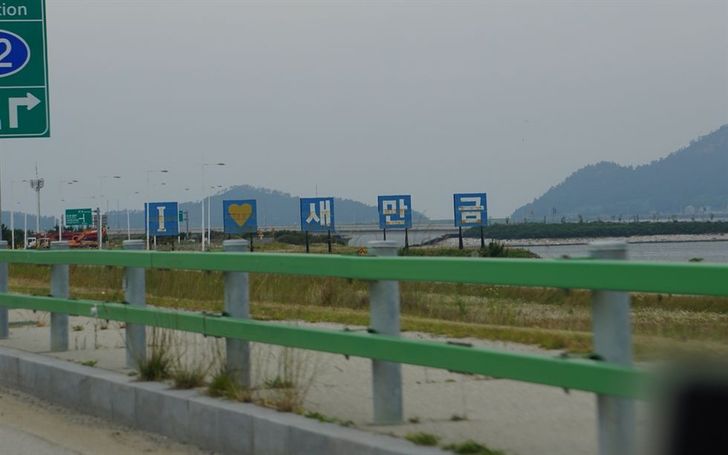
A sign reads "I Heart Saemangeum" by the sea road at Saemangeum in North Jeolla Province, June 16. Korea Times photo by S Latham
Estok, who has spent most of his professional life in Korea, has been watching the Saemangeum reclamation project unfold.
“What was done with Saemangeum was like reformatting a hard drive with an entirely different program ― the erasing of the natural in favor of an entirely different ecology determined not by the geography and natural forces of the place but by our needs alone,” he said.?“Saemangeum offered no threat to our safety, no unpredictable agencies that threatened our control, and its reformatting is an ecophobic expression of power.”
According to Kim, most species of fish, and especially clams, have been lost since the reclamation was completed. “There's not much fish so a lot of fishermen have left,” he said on June 17 just weeks before the Jamboree.
The government, Kim said, gave local fishermen payouts to help them transition to other industries such as land farming. “Many of them have already used that money and they lost their livelihoods too. Some fishermen were given land to farm, but it still cannot be used.”
Amid it all, a spectacular natural beauty continued to quietly endure behind the frazzled scenes of Saemangeum. The charms of Byeonsanbando National Park including the sea, magnificent mountains, noble forests, rivers and amazing golden coastlines played little part in the loud disappointment of the Jamboree. The unassuming and humble charm of its people, products of a beautiful and loved geography, remain largely hidden from the world.
In the meantime, fingers continue being pointed over the failed Jamboree and the Saemangeum politics intertwined therein. Scouts suffered at the hands of the environment and the environment suffered at the hands of our narrative. Saemangeum became a place to be rescued from, a place to be forgotten. A largely negligent and attention-occupied society has allowed this to happen.
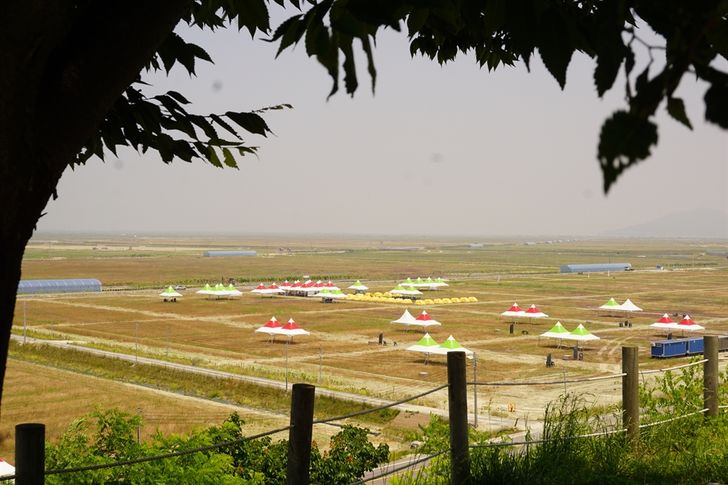
Tents are set up at the campground for the 25th World Scout Jamboree in Saemangeum, North Jeolla Province, June 16, six weeks before approximately 45,000 visitors were expected. Korea Times photo by S Latham