Hazara refugees in Korea raise their voices against Taliban

Rezayi Qudratullah and Asil Kohammad Arif pose outside Hanokers in downtown Seoul, July 30. Courtesy of Bereket Alemayehu
By Bereket Alemayehu
The Afghanistan community in South Korea has an estimated population of about 1,000, and among that number about 200 of them are believed to belong to the Hazara ethnic minority.
Rezayi Qudratullah and Asil Kohammad Arif are refugee applicants of the Hazara ethnic group from Afghanistan who have lived in Korea for about five years. They have been raising their voices on behalf of the Hazara people, sharing information about their ethnic heritage and the genocidal crimes against their people ― of the past as well as the present at the hands of the Taliban government of Afghanistan ― in addition to their own story of living in exile far from their homeland.
As the world's attention fluctuates between headlines of geopolitical rivalries and international conflicts, the media often neglects to portray the full picture of Afghanistan's complex reality. Korea's media landscape, for instance, often provides only a fragmented view of Afghanistan's turmoil, not to mention the
over the resettlement of the so-called "
" in Korea.
Korea has recently become a sanctuary for many Hazara refugees who fled the horrors of their homeland. But the history of this ethnic minority is little-known to the public in Korea. According to Rezayi and Asil, the Hazaras are historically a big ethnic group in central Asia related to Mongolians and Turks, who now live in Afghanistan, Iran, Pakistan, Turkmenistan and Kazakhstan. The Hazaras have Asian features. Hazaras speak Hazarika which has words in common with Turkish, Uzbek and Mongolian. Millions of Hazara people in Afghanistan have been forced to leave their homeland.
Based on the Minority Rights Group International website, the
in Afghanistan and have long faced violence and discrimination. This is partly to do with religion: historically, the Shi'a minority, regardless of ethnicity, has faced long-term persecution from Afghanistan's majority Sunni population. Furthermore, Hazaras have also been targeted for violence by extremist groups, including the Taliban and the regional affiliate of the so-called Islamic State.?
The systemic discrimination and targeted violence against the Hazaras, due mainly to their distinctive ethnic features and religious beliefs, remains largely untold and overshadowed by the media's limited attention. This tendency diminishes the broader narrative of the Afghan conflict and undermines the urgency of addressing the plight of marginalized communities.
For Rezayi and Asil, the past two decades, from 2001 to 2021 during the U.S.-led military occupation, were a golden age for the Hazara people, who achieved progress in just 20 years which would normally take 100 years. The Hazaras were able to study in schools and universities, held significant positions in the Afghanistan government and army, participated in the Olympic Games and earned medals, became stars in music and dance competitions and gained global recognition for their discoveries and inventions.
Against this backdrop, Rezayi and Asil carry with them a history shaped by resilience, survival, and a search for safety. They have been raising their voices to inform the Korean public about the profound atrocities this ethnic minority faces, along with its human cost, which includes a
last year that targeted Hazara girls at an education center in Kabul. They are deeply concerned about the return of the Taliban to power in Afghanistan, who they believe pose a direct threat and danger to their people.
“Koreans are well aware of refugees from Afghanistan whom the South Korean government brought to Korea through an evacuation operation two years ago,” said Yonsei University cultural anthropology professor Kim Hyun-mee, one of the leading scholars on refugee issues in South Korea. “They worked at the South Korean Embassy and other Korean agencies, and that's why the Korean government granted them the status of 'special contributors.'”
However, she added that most Koreans do not know about the plight of the Hazara ethnic minority, which accounts for 20 percent of Afghanistan's population, due to the long history of genocide and deportation. “I think it's a severe issue, especially in the sense that Hazara young women and girls, who are considered to be responsible for the reproduction of their ethnicity, are often the victims of suicide bombings,” she said. “We need to look more dynamically at and address the power structures that result from the complex discrimination based on race, religion, ethnicity and gender that create refugees.”
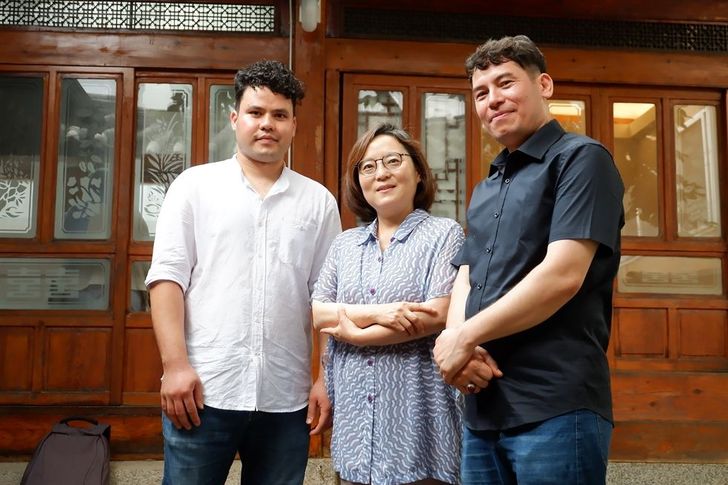
Asil Kohammad Arif, Kim Hyun-mee and Rezayi Qudratullah pose at Hanokers in downtown Seoul, July 30. Courtesy of Bereket Alemayehu
Asil said the Taliban is a terrorist group, so he is fortunate to be in Korea where he is content. “Korean society is pretty much interesting that I feel safe and secure in here, except being unrecognized as a refugee has many challenges, such as being unable to find job opportunities and health insurance,” he said.
With their spirits remaining unbroken, Hazara refugees in South Korea shed light on narratives of a journey marked by resilience, survival and a yearning for justice. They demand protection and meaningful actions from the global community for their people.
Bereket Alemayehu is an Ethiopian photo artist, social activist and writer based in Seoul. He's also co-founder of
, a refugee-led social initiative, and freelance contributor for Pressenza Press Agency. Visit
for more information.
Shi'a Hazaras are historically the most discriminated ethnic minority group