Street artist behind 'We.Seoul'd.U' artwork comes forward after 5 years

The "We.Seoul'd.U" heads of former U.S. President Donald Trump and his North Korean counterpart Kim Jong-un wheatpasted on the wall of U.S. Army Garrison Yongsan in central Seoul's Haebangchon neighborhood show signs of wear, Nov. 20, 2021. Korea Times photo by Jon Dunbar
By Jon Dunbar
Former U.S. President Donald Trump and North Korean leader Kim Jong-un met for the first time on June 12, 2018, in Singapore. The next morning, grotesque versions of their faces appeared on a cinder block wall in central Seoul's Haebangchon (HBC) neighborhood, at the southern end of Sinheung-ro over the iconic kimchi pots that mark the alley. Above the two faces was stenciled “We.Seoul'd.U,” a parody of Seoul Metropolitan City's divisive former slogan.
The work of art has remained in place for over five years, left alone for most of this time but still observed by all those who enter the neighborhood on this side. The heads, which are made of paper affixed to the wall by wheatpaste, have been peeling a little in recent years, and more recently someone appears to have attempted to paint over them with white paint.
Now that they've been there for so long,
, who also goes by JaMez, decided it was finally time to admit he was the one who created them ― as well as three other similar heads nearby.
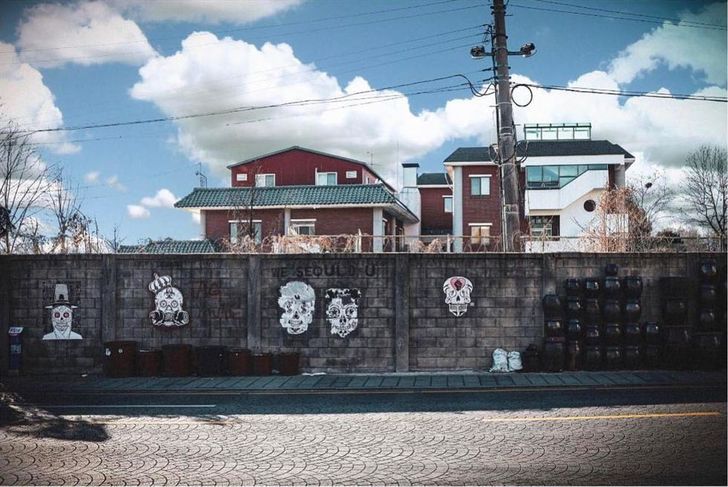
Various heads are wheatpasted on the wall of U.S. Army Garrison Yongsan in central Seoul's Haebangchon neighborhood. / Courtesy of James Beckwith
“Everyone was, I don't want to say getting excited but making a big deal about Trump and Kim Jong-un meeting, when in my mind I felt that it was all a charade and would never amount to anything, and that's why the top says 'We Seoul'd U,'” he said. “It's all for me just sleight of hand and just a joke, and that was my idea. 'Hey look at us, we're pretending to do something, you're all thinking something's gonna happen and we're selling you a lot of crap.'”
Beckwith is a well-respected and established entrepreneur and artist in the city, serving as the
foreign president of the Yongsan Fine Arts Association
, and has lived in Korea for over 22 years. But he's also done a fair amount of street art, some commissioned and some clandestine.
For those who know him and are connected on social media, his authorship wasn't a very well-kept secret.
“It's all on my Instagram anyways,” he told The Korea Times. “If someone really wanted to find it they could.”
Part of what made the Trump-Kim heads stand out was their prominent location, right on the wall of U.S. Army Garrison Yongsan. But Beckwith said he didn't choose that location for any political reason related to the U.S. or its military presence in the neighborhood.
“I thought that I wanted to put something here because I have a lot of friends in HBC and I know they make their morning walk to Noksapyeong Station on the way to work and it's kind of boring, and I thought it might be fun, every once in a while to put a new piece of artwork for people to notice. It's a massive intersection as well,” he said. “The thing about street art, location is everything, and that's a pretty good location, so that was also the fun of it. As risky as it is, it feels that much more rewarding when you get away with it.”
He said most of the heads were pasted up at around 3 a.m. or 4 a.m., planned for when the fewest people would be around.
“That's the thing about HBC ― at 3 a.m. or 4 a.m. it's still going pretty hard sometimes, especially on the weekends,” he said. “The first one I did there, I was super paranoid. But after doing it a couple of times, people don't even care, they don't even look at you. Like I'm just doing my thing and they're walking by. Some people might glance.”
In order to throw up his art fast, he resorted to wheatpasting, a form of street art that has some advantages over spraypaint. It is easier to remove glued paper than spraypaint, as it can be scraped or powerwashed off most surfaces. It's also quick to deploy, as most of the creative work is completed on paper in advance, and all one has to do at the site is paste it up.
“That intersection is so busy, there's no way I could put up a proper piece on that wall without getting caught,” he said. “This lets me put up a full piece, also it's kind of like if I did get caught, it's just paper, I'll scrape it off. I always thought maybe it might be a safety net but mostly it's because I could put a whole piece up in just a matter of minutes.”
Each head took him only a couple of minutes to paste up.
After completing the first heads, they were left untouched for years, with neither anybody attempting to remove them nor other street artists or taggers marking the same wall. This seems to show a nearly universal respect for the piece.
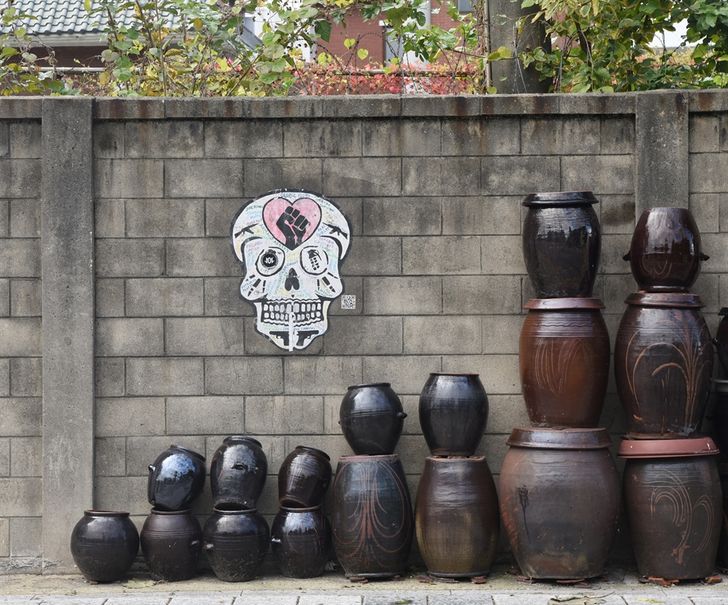
This head, wheatpasted on the wall of U.S. Army Garrison Yongsan in central Seoul's Haebangchon neighborhood, is a tribute to the Black Lives Matter movement. Korea Times photo by Jon Dunbar
The only one who felt empowered to put up more art on the same wall, then, was Beckwith. The next one he put up, to the right of all the skulls, was a tribute to the Black Lives Matter movement, containing the names of people killed by police in the U.S.
He added that the heads are only parts of larger canvases that show a bigger picture, and all of them can be viewed on Instagram.
For instance, the head wearing the gas mask, clearly inspired by the pandemic, comes from a
.
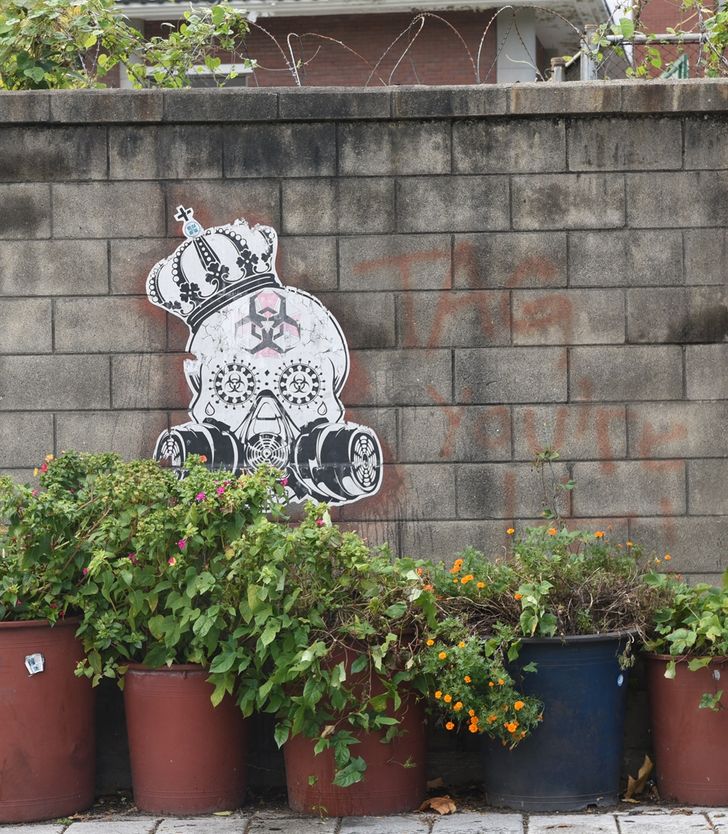
This skull wearing a crown and gasmask, wheatpasted on the wall of U.S. Army Garrison Yongsan in central Seoul's Haebangchon neighborhood, is part of a later piece depicting the body of Jesus, made during the pandemic. Korea Times photo by Jon Dunbar
“The full canvas of that is the body of Jesus with this corona skull,” he said. “The reason I thought of that is because when corona started, the superspreaders were all coming from churches. They thought 'Let's go to church because Jesus will save us,' except going to church was spreading the virus the most, especially here in Korea.”
The fifth one best embodies his art style, drawing from elements of Korea and Mexico. “I've been painting Day of the Dead-type skulls for a long time, and I always thought it would be cool to create a fusion Korean one because I've been living here for 22 years, so I feel just as Korean as I do American and Latin American and so I just thought it might be an interesting thing.”
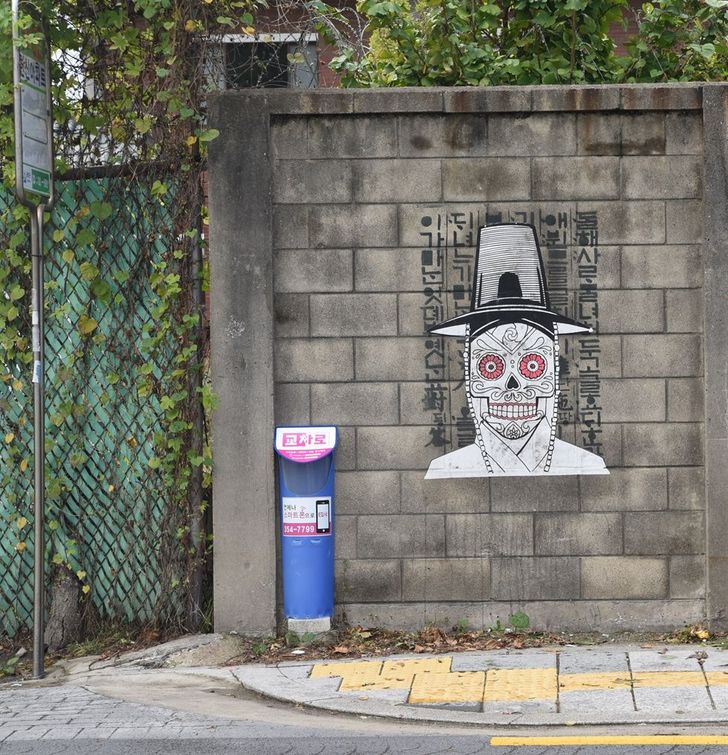
This head, wheatpasted on the wall of U.S. Army Garrison Yongsan in central Seoul's Haebangchon neighborhood, mixes imagery from Korean and Mexican culture, representing artist James Beckwith's background. Korea Times photo by Jon Dunbar
He admitted it was a little autobiographical, although he didn't sign his name as the artist or leave any similar mark.
“Most of the stuff that I put up in the streets, unless it was commissioned, I don't even put my name,” he said.
“With my street art, I don't really want to tell anyone how to think. That's why I don't sign it. People think don't sign it because I'm worried about getting caught. That's actually not it. I don't want to influence. I just want people to look at it and think for themselves. I don't really like the kind of artists that tell people what to think, especially when it comes to political stuff, because that's all opinion-based information anyways.”
He says in this day and age, where everyone sees in black and white, red and blue, he considers himself gray when it comes to politics.
“I've been here for 22 years. I live in my own bubble here. I understand the politics of the U.S. is very important, but I focus more on the things that I have to do here. I don't entirely feel that I have any control over who's going to be the next president and what's going to happen. I don't really care to push any agenda anyways.”