Cityscapes Trespassing on Korea Times history

The old Korea Times building seen during demolition on Sept. 2, 2007, with Gyeongbok Palace in the background. / Courtesy of Ron Bandun
By Ron Bandun
It's appropriate that I now have a column with The Korea Times, because I've had opportunities to explore a number of former and current buildings associated with this newspaper.
Way back in summer 2007, when I was still a fairly inexperienced urban explorer, I stood across the street as the former Hankook Ilbo building next to Gwanghwamun in downtown Seoul was disassembled before my eyes.
This building, a concrete behemoth located at the site of today's Twin Tree Towers, housed the Hankook Ilbo and The Korea Times offices for decades prior to my arrival. Thanks to fellow columnist Steven L. Shields, I know the newspaper was printed on site, rather than having PDFs or whatever transferred to an off-site print factory as we do nowadays. He also spoke of the “volcano room,” where linotype machines used hot metal (usually lead) for typesetting. Also as vice president of Royal Asiatic Society (RAS) Korea, he's told me the building used to host RAS Korea lectures.
There was a lot of history to the building, designed by legendary architect Kim Swoo-geun. But in 2007 I wasn't skilled enough yet to risk an infiltration into an active demolition site. On my first visit on Aug. 15, I could hear workers inside trashing out the interior, removing any remaining furniture, ripping out all metal fixtures for salvage and to facilitate demolition. They worked nonstop, 24 hours, seven days a week, even on the national holiday. Worse, dozens of riot police buses were parked right up against the construction fence, on account of the Japanese embassy next door.
Sadly I never made it inside the newspaper office before the teardown began.
In early September, I returned and got onto the roof of a nearby taller building, where I could view the demolition from above. How do you knock down a building that size? They placed excavators on the roof and had them chew their way down to the ground level.
But then in 2013, I had another chance with a much different Korea Times building. After attending an RAS Korea lecture, a friend pointed out a small two-story building with a quirky modernist design, located in the alley behind the Somerset Palace where the lecture was held. In the windows, it had signs for Hankook Ilbo, The Korea Times and three smaller affiliated newspapers. My friend promised me a beer if I could get inside.
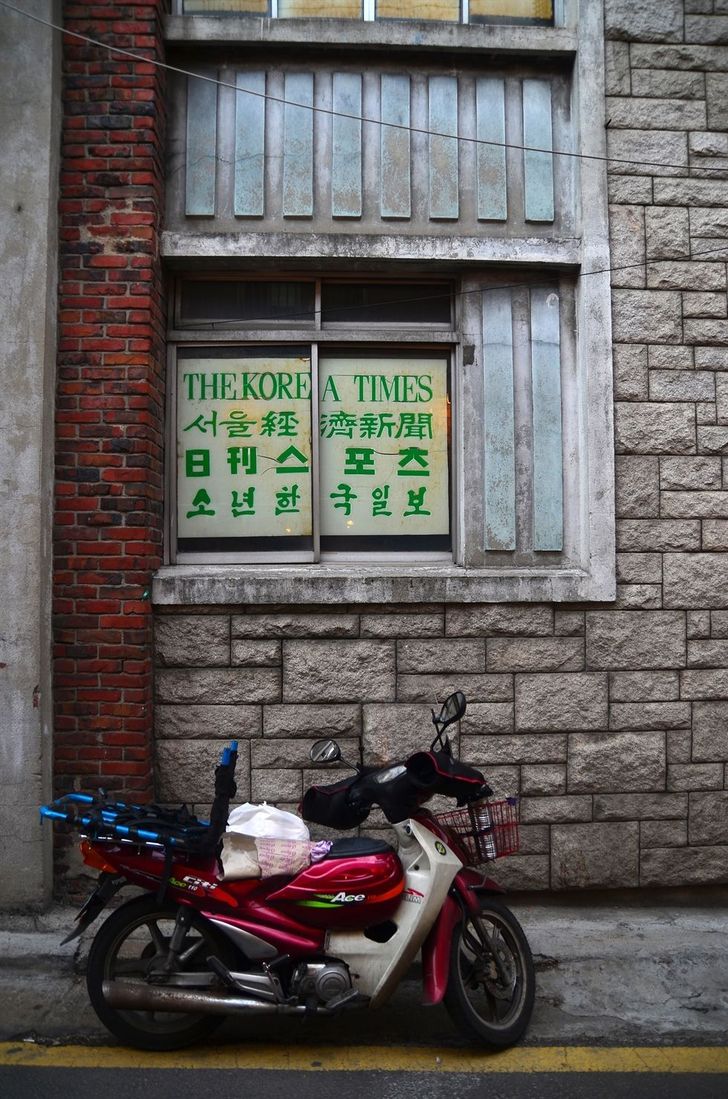
A mysterious unidentified "Korea Times" building in a small alley, photographed on April 9, 2013, before demolition. / Courtesy of Ron Bandun
Next time there was an RAS Korea lecture, I showed up early, made my way around behind the building, and slipped in through an unlocked back gate. Once inside, I could go between the floors and get up to the roof. A calendar inside didn't show the year, but July 1 was on a Monday which happened in 2002, 1996 and 1991. Otherwise there was not much left to see, other than the unique architecture and its unpleasantly small dimensions, with narrow doorways and low ceilings, indicating poor conditions for whoever worked here. I have been totally unable to figure out what exactly this building was used for, and even Shields doesn't know. It was demolished around 2017.
In late 2016, tvN producers went to a great deal of trouble to track me down, hoping for my help on an urban exploration and rooftopping segment for the program “Trenders.” I was very uninterested in appearing on TV, but I played along and helped them visit a few abandoned sites and rooftops.
The one part that made it into the final show was a scene recorded on the roof of the NH Life Building near Seosomun Park, the former location of The Korea Times which had moved out only months earlier. I wasn't shown, only
who had been a prolific urban explorer while she lived here a few years.
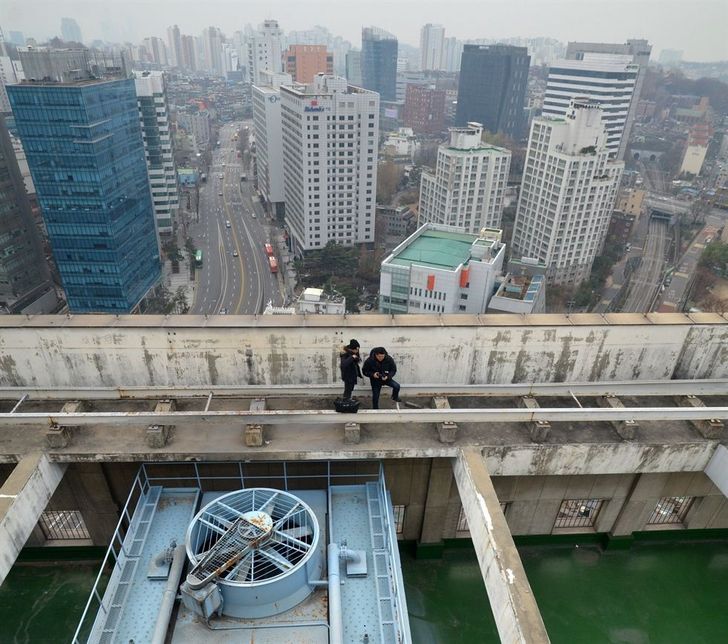
Crew members from tvN prepare to film a segment on rooftopping on the roof of the previous Korea Times building next to Seosomun Park, Dec. 4, 2016. / Courtesy of Ron Bandun
That roof has a pleasant recreational area, but if you climb up a little higher you find a narrow ledge around the circumference which includes a set of train tracks for window-cleaning machinery, and all sorts of dangerous places to stand and pose ― something Kat likes doing far more than I do.
The show hosts seemed alarmed by the segment, and after that I haven't been approached by any more TV producers.
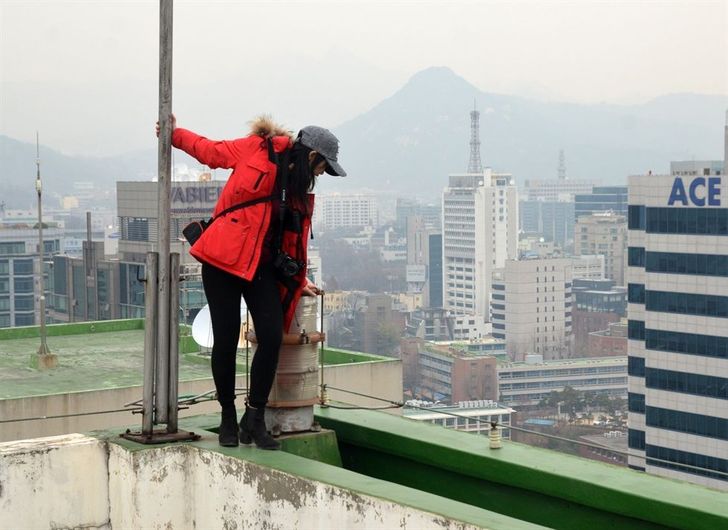
An urban explorer known as Kat strolls around casually on top of a former Korea Times building near Seosomun Park, Dec. 4, 2016. / Courtesy of Ron Bandun
The Korea Times moved to a new location, that same year, and of course the first thing I did when I visited was check out the roof, which I've already
. It's even more spectacular than the previous building, but sometimes access is taken away if it gets too many visitors. I've been up there a few times to enjoy the view, monitor developments in the area and do photo shoots. On one occasion in September 2017, I brought along some visiting musicians here for Zandari Festa, and one ―
― began composing a song on the spot which later became the song “
,” even giving a shout out to The Korea Times in the lyrics.
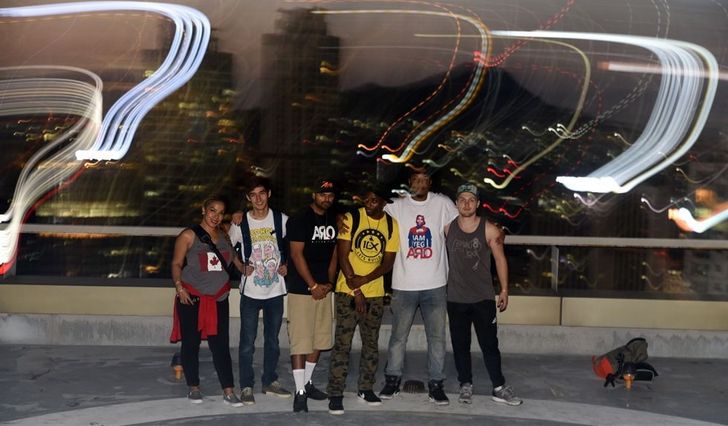
Foreign musicians pose for a group photo on top of the current Korea Times building next to Namdaemun, Oct. 2, 2017. / Courtesy of Ron Bandun
The Korea Times has been with us recording history since 1950. It's also been a part of that history itself.
Ron Bandun is a self-described “anarchaeologist.”