Fight against racism on Seoul streets

Feminist drag artist Debbie (@_____debbie__ on Instagram) kneels during the march in order to "raise [her] voice in alliance." / Courtesy of Michael Hurt
By Michael Hurt
Spike Lee made a statement film called “Get on the Bus” in 1996, in which a group of black men from a hodgepodge of varied backgrounds share a bus ride to the 1995 Million Man March. They are of different political stripes, conflicting social orientations, and a few have some agendas of questionable self-interest. But the bus was a perfect metaphor and heuristic device to enabling viewers to see different sides and come to a practical conclusion in their own different ways.
We may not all take the same path to our imagined destination, we may not all physically get there, nor arrive in the same way. And some people even look suspicious as they go. But everyone gets there and the journey defines the meaning of the endeavor itself, more than the travelers ever thought about before departing.
This past week and weekend of Black Lives Matter (BLM) marches and demonstrations focused a lot of socially constructive energy within Korea into the global and growing whirlwind of support for what this writer believes will be remembered as the beginning of a sort of Second Civil Rights Movement; People in later generations will ask members of this one "What did you do in the spring/summer of 2020?"
This sense of gravitas in feeling the importance of showing solidarity with BLM from even as far away as Seoul is what drove some of the infighting and confusion between different efforts to show support for BLM here in Seoul.
The largest physical demonstration was a march through downtown on Saturday. It was well-attended given some unfortunate, unfounded and hence irresponsible accusations of being a "scam." The same day there was also an online BLM event that seemed to be the easier and safer action for non-Korean citizens who were nervous about the (unlikely and overemphasized) specter of deportation for violating the vaguely worded immigration law prohibiting non-Koreans from engaging in "political activity." The march included somewhere between 100 and 200 participants of a wide variety of backgrounds and interests.
The march itself, from exit 6 of Myeong-dong Station to Hanbit Park next to Cheonggye Stream, was short, breezy as demonstrations go and free of remarkable incident. Most of those present were self-motivated, self-educated youth who had been watching events in the U.S. unfold and keeping up with news in the Korean context and were already waiting for an opportunity to participate.
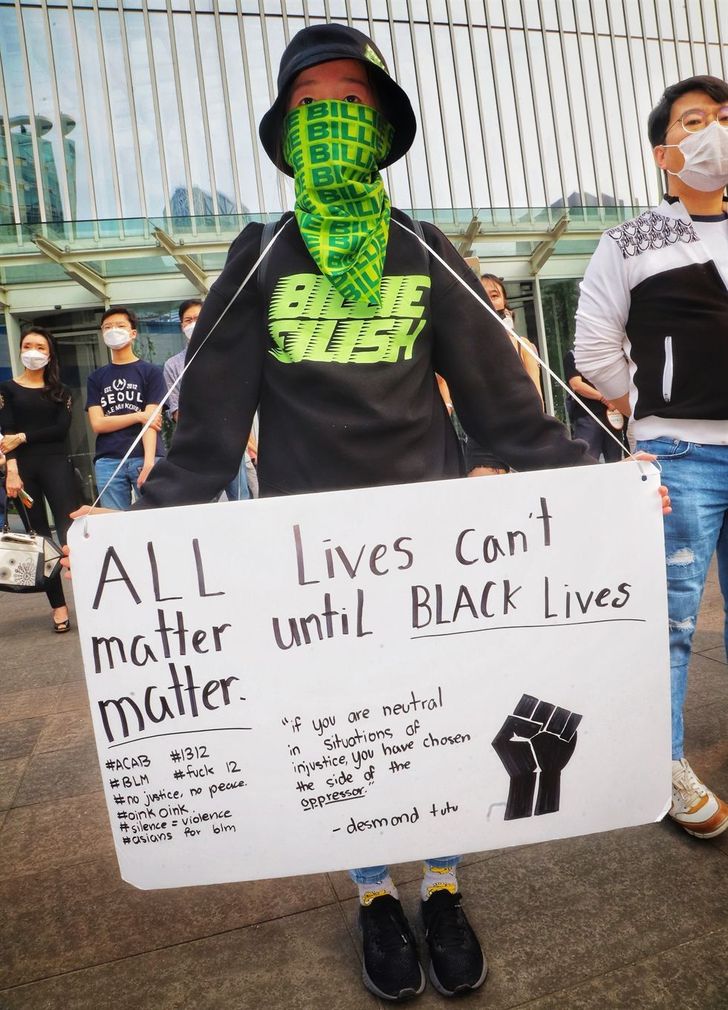
Sohn Selin (@mystii3 on Instagram), a middle school student, shows her solidarity after vehemently arguing with her father, who was against her participating in the demonstration. / Courtesy of Michael Hurt
, a middle school student, kept up with the BLM news reaching her over social media and started developing a strong empathy and desire to participate in the BLM movement. She faced the doubts of her school friends and peers, who all posed variations of the admonitions “there aren't even black people in Korea ― this has nothing to do with Korea” and hence “it's not our business.” Moreover, she struggled against the attitudes amongst her school peers that are "racist, homophobic, transphobic, privileged, sexist, etc." and wanted to actively participate in something she felt could reduce that. Also encountering worried resistance from her father, Sohn had to convince him to let her join the march. She won him over by insisting that "I'd do it myself and if I got lost I would just walk myself home." But she “ended up taking the wrong bus home and had him drive me,” which brought in her dad's support in the end in any case.
Whether or not many minds were changed by the march, it did answer that essential question of "what does this have to do with us (Koreans)?”
A widely shared SBS report on the event linked it to the fight against racism in Korea, practiced by Koreans, which necessitates a focused response to discrimination as a social problem here, and not just way "over there."
And it squashed the many accusations and aspersions cast about who was a "real" extension of BLM in Korea, and the murky notion of whether Koreans mounting a BLM effort was an inappropriate appropriation of African American efforts and origins of the movement. In the end, everyone got to where they were going.
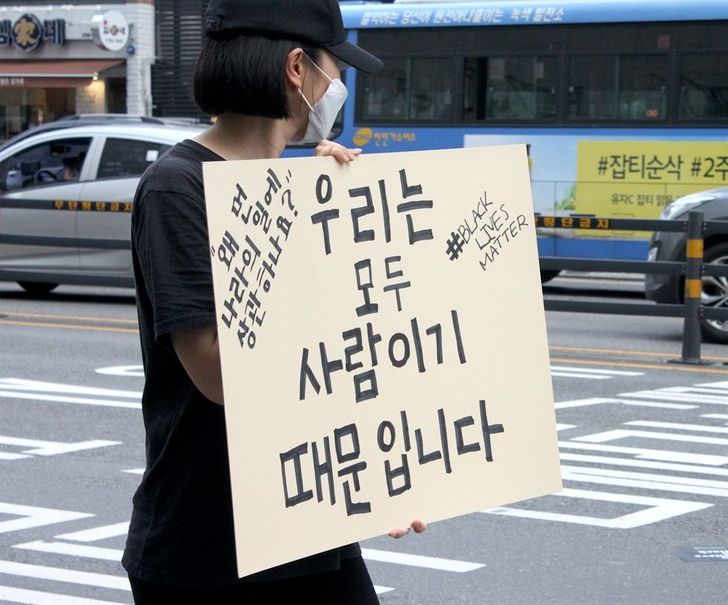
The sign in Korean reads "Why worry about stuff going on in a country far away? ... Because we are all people." Courotesy of Andrew Cho (@andrew_bubba_cho)
In the end, everyone showed up and showed out, and demonstrated in one fell swoop that BLM is not an inherently or actually violent movement (a narrative that tends to dominate U.S. network-dependent, Korean coverage), that there is no "scam" movement if people show up and show out, and that getting there, in the end, is as important as the journey.
Find out how to help at
. Support black-owned businesses in Korea:
.
Dr. Michael W. Hurt (
) is a photographer and professor living in Seoul. He received his doctorate from UC Berkeley's Department of Ethnic Studies and started Korea's first street fashion blog in 2006. He researches youth, subcultures and street fashion as a visual sociologist and fashion photographer living in Seoul He lectures in Cultural Theory and Art History at the Korea National University of the Arts.