Joseon Images Royal palace converted into Seoul's first zoo

Cherry blossoms on the grounds of the zoo and botanical garden, circa 1920s. Robert Neff Collection
By Robert Neff
In the summer of 1908, a “menagerie” was established at Changgyeong Palace by Emperor Sunjong. The menagerie was rather modest ― the chief attractions being a large tiger captured on the slopes of Mount Paektu, a three-meter-long python from India and a kangaroo from Australia ― but it entertained the emperor and he was said to be quite fond of it. Some sources claim he established it in an effort to escape the agony of being under Japan's ever-increasing control.
At some point in 1909, either by his own desire or through Japanese pressure, it was decided to turn the menagerie into Korea's first public zoo.
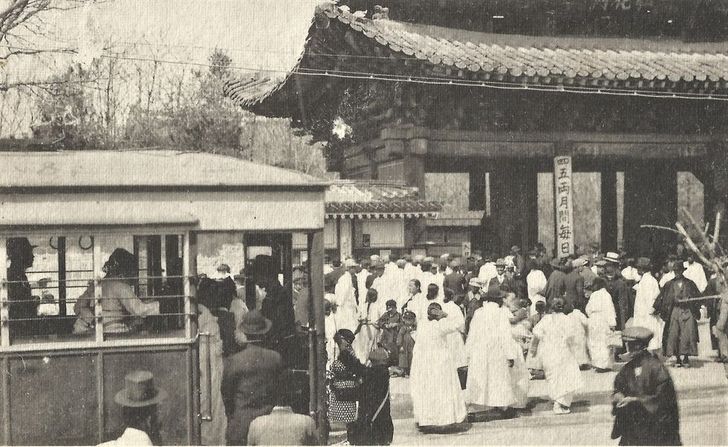
The entrance to the zoo and botanical gardens, circa 1920-1940. Robert Neff Collection
Throughout the year, the palace, once the exclusive domain for Joseon royalty, was transformed into a public domain for the masses ― a combination zoo, botanical garden and museum. The grand opening took place on Nov. 1 ― the entrance fee was 10 sen (a Japanese currency equivalent to 5 cents U.S.) for adults and half that for children. There were 361 animals of 72 species including Siberian tigers, kangaroos, ostriches, camels and orangutans.
It was a tremendous success. Open from 9 a.m. until 5 p.m., every day except Monday and Thursday, it quickly became “the favorite promenade grounds” in Seoul. In the first month, more than 13,600 people visited the complex.
As the zoo became more popular, there was more pressure to improve it. Thousands of cherry trees were planted and great efforts were made to acquire more animals ― especially the larger and harder-to-obtain creatures.
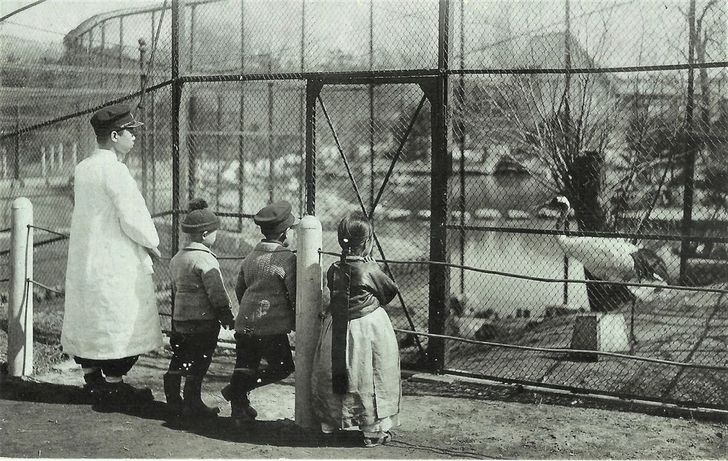
A bird exhibit at the zoo, circa 1920s. Robert Neff Collection.
In March 1910, the governor of Gangwon Province announced that a leopard ― “said to be a very beautiful creature” ― had been captured near Chuncheon. He offered it to the zoo and a few days later, the Imperial Household Department paid 300 yen for the zoo's newest exhibit ― now identified as a tiger.
The tiger, or perhaps the good weather and the blossoms, caused a surge in zoo visitors. On Sunday, April 17, Changgyeong was swarming with 3,400 visitors ― nearly two-thirds were women! Once word got out, one can imagine in the weeks that followed, the number of young single male visitors probably increased.
Efforts were made to obtain elephants and hippos ― as well as the more exotic big cats. Sometimes there was more creativity than accuracy in the exhibit descriptions. In late 1914, the zoo boasted of having three snow leopards which Horace Underwood dismissed as being nothing more than regular leopards and sarcastically noted in a paper presented to the Royal Asiatic Society Korea Branch that “no labels will transform ordinary bears into polar bears.”
In 1930, the only known tiger in the vicinity of Seoul was the one kept in the zoo. It came to be in the zoo through a rather unexpected case of misidentification.
“[It] was picked up as a cub by a small Korean boy, who took it home thinking it was a cat and kept it for some time as a pet, and it was only when the animal started to grow unexpectedly that the presence of this mysterious creature became known and was discovered to be the much prized woolly tiger which had hardly ever been captured alive.”
The success of the zoo also bred competition. In December 1910, Chang Chun-won, the former governor of Gyeonggi Province, purchased a seven-legged ox from a farmer in Icheon, and brought it to his residence in the Jeong-dong area of Seoul. The ox was described as being like a normal ox except it had an additional three legs growing from its back. Chang exhibited his ox from his residence and charged 5 sen per adult and 3 sen per child. Chang's little enterprise was probably not very successful.
While Changgyeong may have been an oasis of serenity for the residents of Seoul, it could not escape the evil that plagued the first half of the 20th century. In early August 1920, Spanish influenza was raging in Korea and the park was closed to the public. It reopened in mid-September, but only to those who could produce medical proof they had been vaccinated twice for the disease.
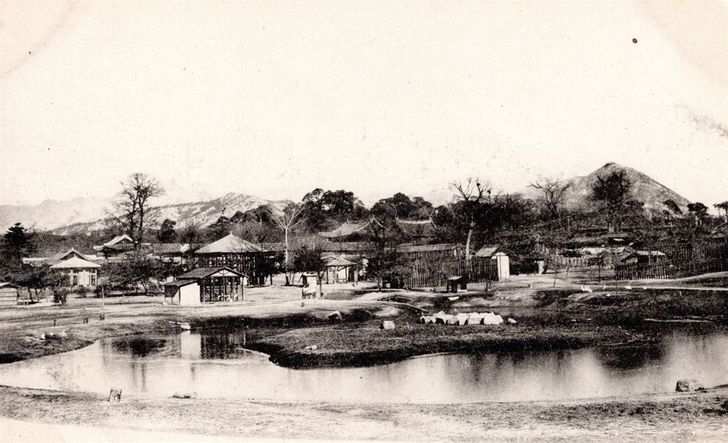
A view of the zoo, circa 1910-1920s. Diane Nars Collection
As World War II raged on and Japan's initial victories were replaced with increasing defeats, feeding and caring for the animals became more difficult. Even more worrisome to the authorities was the possibility of an Allied bomber hitting the zoo and releasing some of the more dangerous animals.
Thus, in late summer 1943, authorities began euthanizing zoo animals throughout the Japanese empire. Initially, the animals were poisoned or starved so their deaths could be explained as natural and not upset the general public. Eventually other methods were used including shooting, stabbing, strangulation and electrocution.
Seoul's zoo was no exception. On July 25, 1945, the order was given to euthanize the animals with poison. Park Yong-dal, a zoo employee, recalled, “I have never experienced greater pains in my heart than when I poisoned to death the animals that I had looked after as if they were my own children.”
According to Park, nearly half of the animals in the zoo were killed. Their deaths were needless as the war was soon lost. On Aug. 15, Emperor Hirohito announced the unconditional surrender of Japan. These zoo animals were, as Mayumi Itoh described them, “the silent victims of World War II.”
Robert Neff is a historian and columnist for The Korea Times. He can be reached at robertneff04@gmail.com.