10 years of changes in Korea's foreign community

Various foreign condiments, including guacamole, once rare in Korea, are on the shelves at a supermarket in Seoul, Dec. 29. / Korea Times photo by Jon Dunbar
By Jon Dunbar
Korea may no longer be a developing country, but change still happens fast here. Foreign residents who have been here over 10 years have felt those changes acutely. And in many ways, our presence has been a catalyst for changes in Korean society.
Notably, the foreign population of Korea has grown considerably. It has also stabilized as it is no longer the norm for Westerners to teach English for only a year and disappear. A
claimed Korea has 2.09 million “immigrants,” meaning foreign residents and naturalized citizens, accounting for 4.1 percent of the total population. Of them, more than 100,000 had voting rights in the 2018 June elections.
We all know about the big societal changes happening in Korea ― mobile apps, smoking bans, air pollution, popularity of cycling, tattoos going mainstream, etc. ― that can be saved for any other article. But what are the ways life has especially changed for foreigners here?
Globalization of food
A big difficulty of life here last decade was the unavailability of good quality foods. Ethnonationalism dictated Koreans' appetites, and what foreign food existed was mediocre.
Then around the turn of last decade, something changed. As more Koreans started exploring the world of cuisine, the market opened up. Food trends arose one after another, with Mexican notably in the late 2000s and Turkish next. Koreans, who have choked down low-quality pizza for decades, discovered a world of new pizza styles. Throughout the 2010s we saw an increase in quantity, quality and diversity of foreign restaurants.
A craft beer revolution accompanied this, with Magpie and Craftworks growing in the alleys of Itaewon's Gyeongnidan. Convenience stores began offering an impressive selection of foreign beers, not just Bud and Beck's, with the infamous 10,000 won for four cans deal. Even makgeolli, a domestic traditional alcohol, enjoyed a trend that peaked in 2011, buoyed by consumer interest in Japan.
And foreign goods, once only found on U.S. bases and in expensive black markets, started appearing in supermarkets. Cheese appeared on shelves, and even in many Korean foods. Bakeries popped up serving good-quality breads, not laden with sugar. Breakfast options became available, and coffee is everywhere. For alternative diets, such as vegetarianism, veganism and halal, it isn't perfect yet but there have been notable developments. Even other goods like deodorant aren't too hard to find now.
All this has made homesickness that much more tolerable for foreign residents.
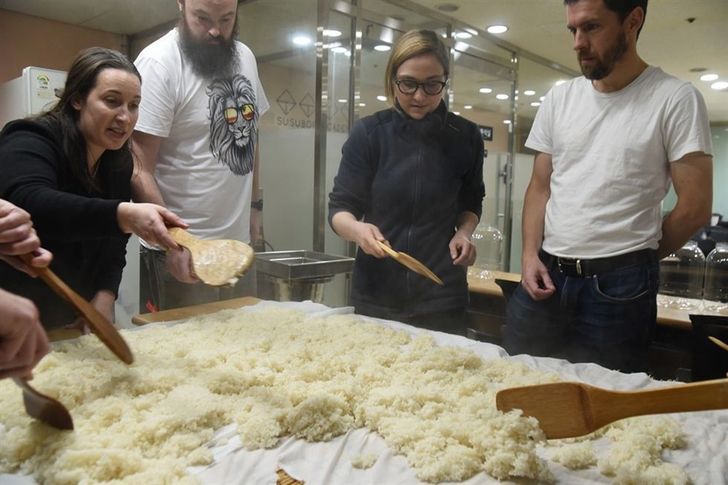
Julia Mellor, an Australian specialist in traditional Korean alcohol and co-founder of The Sool Company, teaches a class on preparing makgeolli, a traditional Korean alcoholic beverage, March 15. / Korea Times photo by Jon Dunbar
Foreigners no longer a novelty
“Hello!”
When's the last time a stranger shouted that at you? Even in remote towns, this and other more harassing behaviors are fading away.
As there are more of us, Koreans see foreigners as less of an abnormality. Rather than being singled out for or skin colors, big eyes or hairstyles, they're more comfortable around us and we're treated like anybody else, with indifference. Even a foreigner speaking Korean is less cause for surprise.
Likewise, businesses, government offices and even technology also show us more respect, as services and staff are available in multiple foreign languages. Korean websites, once locked to foreigners without national ID numbers, offer English-language registration and services. Even immigration services are much improved.
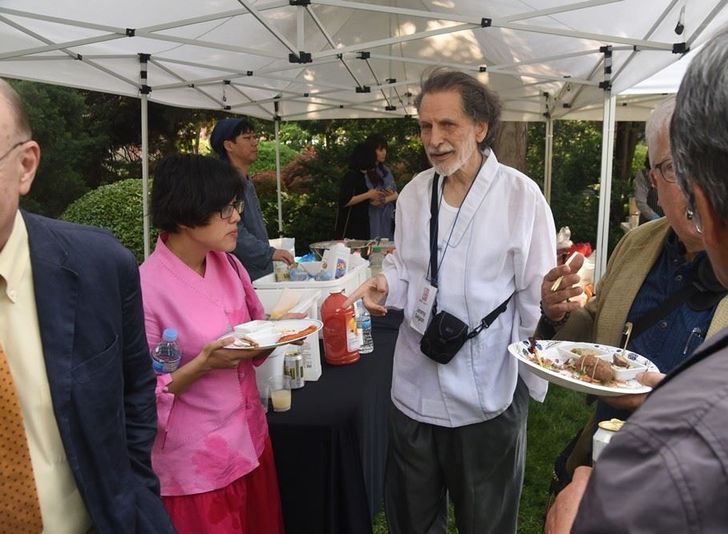
Foreigners wear traditional Korean clothing to a garden party at the U.S. ambassador's residence, June 1. / Korea Times photo by Jon Dunbar
Multiculturalism comes of age
In an effort to offset the aging population as well as provide more wives for rural Korean men, marriage immigration began in the 1990s, peaking in the 2000s before slowing down this decade. This resulted in an influx of women from other Asian countries, particularly China and Vietnam. As of 2018, there were 26,815 foreign men living here married to Korean wives, and a whopping 132,391 foreign wives. Government policy thus tends to target female marriage migrants and their children, many of whom live in remote communities rather than urban centers.
Marriage migration is nothing new here, but as it passes its second full decade, the children of these families are increasingly coming of age. That means high school graduates of mixed national background are about to enter universities, the workforce and mandatory military service.
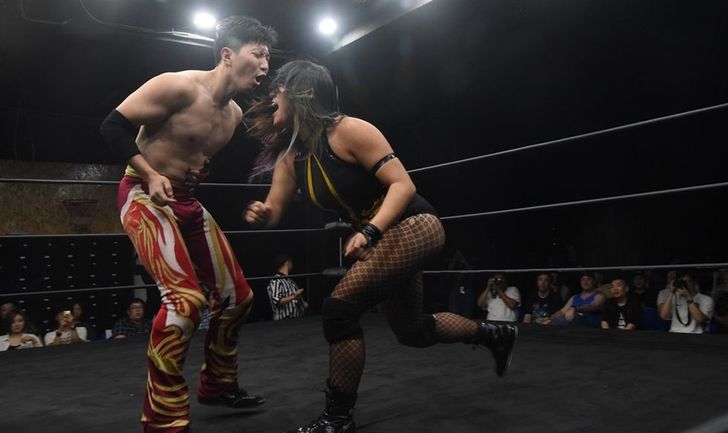
Korean pro wrestler Shiho takes a hit from Zeda Zhang, former WWE femme fatale, during the Pro Wrestling Society (PWS) Phoenix Fest event in Seoul's All Stardium, Aug. 24. / Korea Times photo by Jon Dunbar
More students, tourists, fewer teachers
Korea has had to change for foreigners, motivated especially by economic reasons.
As Korea's aging population goes over the demographic cliff, universities started looking to foreign students for survival. Foreign students were rare at universities last decade and mostly represented regional neighbors, unlike today when many international students come here from around the world. In 2006 Korea had only 32,557 foreign students, but 2017 saw 123,858.
Tourism has also shot up, starting around 2009 when the number of international visitors started rising by double digits each year. We saw stumbles in 2015 due to MERS and 2017 due to Chinese THAAD retaliation, but the trajectory is still upward. The Korean government has worked hard, albeit not always smart, to accommodate them. Now, more things are open during the major holidays. Historic areas in downtown Seoul are awash with visitors wearing cosplay hanbok costumes. Also, Myeong-dong has become a foreign tourist trap.
Meanwhile, there are actually fewer foreign English teachers working here than a decade ago. According to historian Matt VanVolkenburg, budget cuts in 2011 and 2012 deflated the teacher population. Today we have about 8,000 fewer teachers compared to early 2011, and the gender ratio has shifted to a female majority, compared to about two-thirds males in the 2000s. “As a result, more demand for less jobs means salaries have remained the same for well over a decade,” VanVolkenburg added.
On the other hand, more foreigners, probably a lot having gotten their start here as English teachers, are doing more cool things. Artists, business owners and startup founders have become our community builders, and foreigners work in more industries doing things other than teaching English.
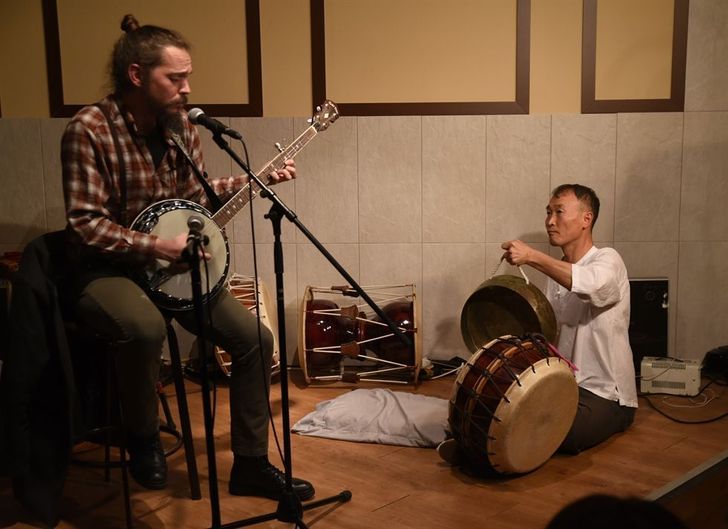
Folk musician Seth Mountain plays the banjo with traditional Korean drummer Im Seon-saeng-nim (teacher) of the Tiger Mountain Family Band at Camarata in Haebangchon on Dec. 29. / Korea Times photo by Jon Dunbar
Cleanliness and hygiene
Two of the main complaints foreigners used to have about Seoul were the filthy streets awash with random sewer odors, and the sorry state of public washrooms.
But foreign visitors these days compliment Korean cities for their clean streets. And not only are you likely to find toilet paper in public washrooms (rather than on tables in restaurants), many toilets even have signs recommending you flush the toilet paper, rather than
. Some of these things are the result of government-led initiatives to make Korea more comfortable for foreigners.
K-pop taken seriously
Psy's viral “Gangnam Style” became Korea's big break-through moment on the global stage, and the more recent success of BTS got more people around the world to take idol pop seriously. Before 2012, K-pop was just one of those things foreigners tried to tune out. Foreign residents remain resistant to its skin-deep charms, but new people moving here are increasingly motivated by K-pop.
And even for skeptics of the heavily commercialized music, we have to admit there have been positive effects for us. The increased interest in K-pop has hastened Korea's economic and diplomatic globalization, and given Koreans much-needed confidence in their own country.

The Vietnamese punk band Cut Lon performs at Seendosi in central Seoul, Nov. 9. / Korea Times photo by Jon Dunbar
Foreign residents feel gentrification
In 10 years, we've seen the character of Seoul's main foreign quarter, Itaewon, change dramatically. What had once been characterized as a sleazy U.S. military camptown has become a global foodie destination. Nearby residential neighborhoods of Haebangchon and Gyeongnidan saw an explosion of foreign businesses, and while the former has stayed together, the latter
in the face of skyrocketing rent.
Change is inevitable in the area, as a plan to
relocate U.S. Forces Korea personnel from Yongsan Garrison
south to Camp Humphreys is nearing its final stages.
The country still has a long way to go to improve the quality of life of foreign residents, but for those who have been around long enough, the changes we've seen have been encouraging.