Joseon Images Forbidden love in 1890s Busan

Busan in the early 1900s / Robert Neff Collection
By Robert Neff
There is a popular tale, especially in Busan, of a forbidden romance between an Englishman's daughter and a Korean servant at the end of the 19th century. Like many scandalous affairs of the past, there was very little evidence to verify the tale ― only hazy anecdotes of family history. Recently, however, another source has been located ― the gossipy account of an unidentified American, probably a missionary. These two sources along with genealogy provide us with a clearer picture of late Joseon's “Romeo and Juliet.”
In summer 1888, John H. Hunt was made commissioner of the Korean Imperial Customs at Busan. He was joined by his wife, Loomis, and their 11-year-old daughter, Florence.
The Western community in Busan at this time was extremely small ― only a handful of Australian and American missionaries along with Customs staff. Eventually, Hunt was able to hire a young English girl to act as his daughter's governess. According to the anonymous American's pen, the two girls did everything together including their studies, reading and exploring the port. Florence was “sweet and bright and merry, as full of activity as a young fawn, and as free.”
But when she was about 16 years old (probably around 1892), her happy world was shattered when jealousy reared its ugly head. Loomis suspected Hunt of having an affair with the governess and demanded the girl be fired. But he adamantly refused, and the young governess stayed on. But things only worsened. “Things were said that could not be unsaid” and the governess finally succumbed to the pressure, tendered her resignation and left. Florence was alone.
Loomis beseeched her husband to send Florence to England where she could attend school and be around people her own age but Hunt refused.
There were occasional visitors to the port but their stays were brief. Few, if any, were suitable companions for a teenage girl. Her father's staff was described as a “gang of world-tossed spume-flecked, loose-lived men of all ages and previous conditions who had slunk away for one reason or another to hide their heads in the sand of the remote customs station.” There may have been some truth to this characterization. One of the staff was alleged to have taken part in Ernst Oppert's infamous raid of 1867 ― an attempt to steal the corpse of the king's grandfather in an effort to force Korea to open to the West.
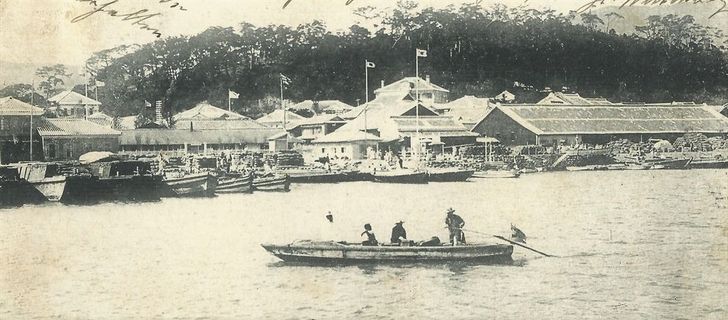
Busan port and Customs authorities, circa early 1900s / Robert Neff Collection
There were also a handful of missionaries. According to one account, Florence befriended one of the young American missionaries ― possibly Dr. Fanny Brown who was 26 at the time. If true, their relationship was short-lived. When Fanny's husband, Hugh, contracted tuberculosis, the Browns were forced to return to the U.S.
Following the Browns' departure, there is very little information about the social life of the foreign community in Busan. We know Loomis was an accomplished piano player and Florence was equally talented with the autoharp. There were occasionally parties held in their home ― one of the last was the British Queen's Diamond Jubilee on June 20 and 21, 1897.
Hunt's home and yacht ― the “Fairy” ― were gaily decorated with flags and lanterns, a large dinner was served to 40 guests and as darkness fell and the sky was lit up with fireworks. Further entertainment was provided by Hunt's wife and daughter, as well as hilarious shadow scenes presented by one of the Italian members of the Customs department. The following morning, a boat race was held. Hunt's yacht came in second. It was possibly the last time the Hunt family enjoyed their life in Korea.
A few months after the party, Florence disappeared. She wasn't the only one missing. In 1896, Hunt had hired Kwon Soon-do, a 23-year-old Korean man, as a houseboy. Unbeknownst to her parents, Florence and Kwon became infatuated with one another and eventually Florence became pregnant. The two, knowing Hunt would disapprove, eloped.
According to the unidentified American, she was found “deserted in the common room of a filthy wayside inn.” Kwon, according to his family, was soon apprehended and imprisoned ― on what charges is unknown.
The shock and shame were too much for Hunt and he promptly submitted a transfer request ― which was granted ― and by Feb. 18, 1898, he and his family were gone.
According to one popular account, Florence gave birth to a son in Hong Kong and Hunt sent back a large sum of money to Kwon, who was released from prison. Why and how much money is unclear but it was enough for Kwon to establish his own commodities store in the port. He later married a young Korean woman and died on Jan. 13, 1934. He, apparently, never forgot Florence or his son.
But how true is this story? We know Florence was in England by at least the summer of 1901 and later met and married an Englishman in 1905. She apparently spent the rest of her life there and died in London on Nov. 8, 1952. No records have been found to indicate she had any children.
In the early 2000s, there was renewed interest in the story after director Hur Jong-sik released a 45-minute film on the affair in 2000. However, as no one could find Florence's name, they made one up for the movie: Elizabeth, probably because it sounded English. The resulting movie was titled "Liz Hunt."
Until only recently, we only had a single source about the story. But now we finally have a second source, and lots of genealogical material.
Robert Neff is a historian and columnist for The Korea Times. He can be reached at robertneff103@gmail.com.