Former Peace Corps volunteers revisit Korea

Former Peace Corps volunteer Paul Hoff visits Sungil Middle School on Oct. 17 during the 2019 U.S. Peace Corps Volunteers Revisit to Korea program. / Courtesy of Paul Hoff
By Jon Dunbar
Last month, 29 former Peace Corps Volunteers (PCV) and their family members returned to Korea to revisit the country they helped along on some of the more difficult parts of its development.
The
welcomed the Americans back from Oct. 12 to 19, for an event that gave them a chance for a reunion and also let them check in on the locations across the country where they had been posted on their missions.
David McCann, who was part of K-1, the first wave of PCVs here and stayed from 1966 to 68, met up with some of his former students for dinner in Insa-dong. He told The Korea Times they remembered a great deal about their time together, over half a century later.
His mission took him to Andong, a remote city in North Gyeongsang Province known for its rich culture, where he taught English conversation to high school students, with class sizes up to 65 students at a time.
“I had been a little worried because I was going to be all by myself in a rural part of Korea, but everyone was very nice,” he said. “For them hearing English was very interesting.”
He recalls in those days the hills were barren except for Buddhist temples, and the gutters along roads were filled with human waste. “It was the way it was,” he said, “and that didn't strike me as strange.”
Also, telephones in Andong didn't work well, and you had to shout to be heard. “When I went to places like Seoul I shouted over the phone and people didn't understand why,” he said.
On this trip, he returned to Andong, which he said was virtually unrecognizable except for the train station.
“The old town that I knew is gone and it has been completely rebuilt and expanded,” he reported. “The school where I worked is brand new, much bigger, totally modern, with everything you could imagine.”
Paul Salarano, was here on a different mission in 1980 and 81 as part of K-51, the final PCV wave. He was posted to Samcheonpo, now part of Sacheon City in South Gyeongsang Province, where he worked in a small health center on tuberculosis (TB) control.
In those days he would visit different parts of the city and go door-to-door, asking residents if they have any TB symptoms and inviting any who did to visit the center for treatment.
On his recent site visit, he was unable to return to the same health center as it had been closed down. However, he got to see a different, updated health center. It was adequately staffed, with around 70 workers ― much more than the 20 he worked with ― and operated out of satellite offices all around the city, around 13 of them by his estimate.
“It was wonderful,” he said. “Instead of people coming to the health center, the health center came to them.”
However, he lamented on the disappearance of the dabang, an old-fashioned style of cafe.
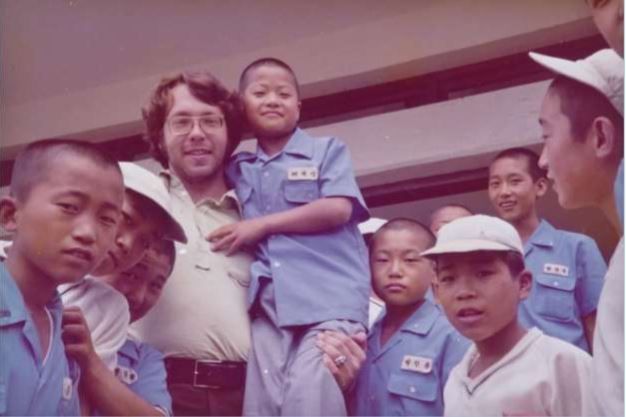
Peace Corps volunteer Paul Hoff poses with students of Sungil Middle School in the 1970s. / Courtesy of Paul Hoff
Paul Hoff, K-27, was here from 1973 to 1975. He was based mostly in Seoul, where he advised Korea's Ministry of Education on revising middle school textbooks. He also traveled the country holding workshops for teachers in regional schools.
The others teased Seoul food as lacking flavor compared to more remote regions. However, he had vivid memories of visiting Chuncheon after his arrival, where he ate “dakgalbi,” which consisted of cuts of chicken meat grilled over charcoal, and has no memory of the stir-fry version that is more popular today. He also vividly recalled enjoying makgeolli and getting to know all the types of kimchi.
All three men became PCVs shortly after graduating college, seeking a new experience and a direction in life, and in some cases as an alternative to joining the military and possibly being sent to Vietnam.
Hoff spoke of the PCV, which left Korea in 1981, in glowing terms. “It's not some government propaganda thing,” he said. “Americans go out and learn about other nations, people and cultures. While there they try to help them with special tasks. That way, the people will get to know Americans.”
“And then you go back to the U.S. and tell people about your host country,” Salarano added.
The event was sponsored by KF, with coordination stateside by
, an organization founded by former PCVs who served in Korea, with the intent of enhancing cultural awareness and friendship between Koreans and Americans. This was the 10th event of its kind.