Korea Encounters Fighting segregation in Seoul's schools in 1969

Korea Times archive
By Matt VanVolkenburg
In the spring of 1969 the Korean government decided to take a principled stand against the stigma associated with Hansen's Disease, also known as leprosy.
Children at a leprosy rehabilitation center in southeastern Seoul known as Ettinger Village, which was established by the American-Korean Foundation in 1966 and housed “63 families of cured lepers,” usually attended school by hiding their identities. In March 1969, the Seoul Board of Education had five such children of cured leprosy patients enroll at nearby Daewang Elementary School and made it clear that the children posed no threat of contagion to the 853 other pupils.
The parents of the other students rejected this, however, and on April 18 they all pulled their children out of the school, saying they would not return until the children from Ettinger Village were gone.
The Korea Times published excerpts of the diary of the oldest of the five children, 12-year-old Noh Song-ae. “Wednesday May 7 ― Met five classmates outside the school door and said 'Let's go in together.' But they refused. I felt like crying. But I controlled myself and entered the classroom. No one was there.”
Unable to convince the parents, the Seoul Board of Education announced on May 6 that it would establish a separate school for these children.
This announcement led to criticism by health ministry personnel and doctors such as Yonsei University professor Lew Joon, who argued, “If the authorities segregate the children the measure will trigger a chain reaction all over the country, resulting in a Korean-style racial segregation.”
In response to the criticism, the Ministry of Education intervened and ordered the city to integrate the children. But when ministry officials and doctors addressed a group of parents at the school on May 9, the parents shouted slogans like “We need no doctors,” “Dismiss the principal” and “Let's go to the education ministry to protest.”
Korea Times archive
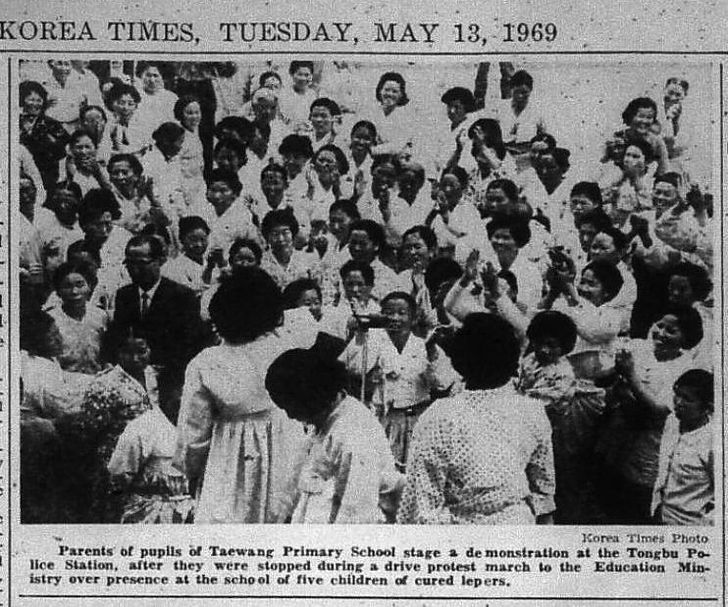
Three days later, 300 parents chartered buses to hold a protest in front of the education ministry but were stopped by police near the Han River. When they refused to disperse, they were taken to a police station where they continued to protest until a Board of Education officer told parents the five children would be hospitalized for medical examination and would not be at school for a week, which placated the protesters.
With the children absent, within two weeks over 300 students had returned to the school, but most stayed away.
To convince the parents to relent, Education Minister Hong Jong-chul on May 17 transferred his daughter to Taewang Primary School. Then, on May 27, the five children were released from the National Medical Center with a clean bill of health and it was decided they would “stay together with the families of four high-ranking officials of the Ministry of Health and Social Affairs.” The four health ministry officials volunteered to take care of them to “prove that the children of negative lepers are neither potential lepers nor infectious.”
In a letter to The Korea Times, a former Hansen's Disease patient criticized the way “lepers and their children have been insulted and treated inhumanely everywhere in this country,” while a group of foreign Seoul Union Church members, including missionaries and USAID and Peace Corps members, wrote a letter urging the Korean government to maintain its courageous position, saying, “Generations of fear, prejudice and superstition when refuted by overwhelming scientific evidence must not be allowed to live.”
Unfortunately, it was not to be. On May 29 it was reported that the government had “bowed down to the determined pressure of the parents…by deciding to set up a new primary school for the five children of negative leper patients.” Despite the protests of their parents, on June 23 the children began attending a school at the Korea Theological Seminary, which was so far from home they had to stay in dorms away from their families during the week ― despite the fact four of the children were only six years old.
Though their families convinced most of their neighbors to petition the government for a new school closer to home, it does not seem one was ever built.
Matt VanVolkenburg has a master's degree in Korean studies from the University of Washington. He is the blogger behind
.