Joseon Images Hori Rikitaro: Hotelier of Jemulpo

Daibutsu Hotel is in the center left in this photo of Jemulpo area in modern-day Incheon in the early 1900s. / Robert Neff Collection
By Robert Neff
In the spring of 1883, Jemulpo (Jung-gu in modern Incheon) was nothing more than “a very small village, consisting of wretchedly-built huts.” But change was in the air and by the end of the year there was a Japanese consulate and a large number of “plank buildings” which served as offices and businesses for the ever-increasing numbers of Japanese merchants. One of these merchants was a rather rotund gentleman named Hori Rikitaro.
At first, Hori was only a small-time trader ― offering provisions for the handful of ships that visited the port ― but he soon realized that as the port grew in size and importance, a hotel would be needed. So, in early 1884, he began to build a two-story Japanese-style hotel.
Even before it was completed, he had at least one Western guest ― William R. Carles, who wrote, “From the windows I command a view of the sea, and, through the floor, of my landlord and his friends.”
By the end of the month, Daibutsu Hotel was in full operation but it wasn't the only “first class” hotel. An enterprising Chinese man (described as “a former bar-boy in a Shanghai hotel”) established his own in a one-story thatched house that ― for some inexplicable reason ― he proudly named “Harry's Hotel.”
The accommodations at these establishments differed greatly.
Guests at Daibutsu Hotel were housed on the second floor in a large common room that, at night, could be subdivided by screens. The numerous windows were covered with wooden shutters “excluding every light.” The bedding consisted of “thin cotton mattress, a bag of rice chaff for a pillow, and two pairs of European blankets” were spread out on the matted floor by the hotel's servants.
Harry's Hotel was basically nothing more than a bar and “billiard room separated by a sheet, and one could sleep on the billiard table.” The only basin available to wash in had to be tipped to one side “to prevent the water running out of a hole on the other side.” However, within a couple of months, the hotel moved to a new two-story building (most likely Japanese style) and patterned after Daibutsu Hotel. The move may have been inspired by the hotel's primary patrons, the Western employees of the Royal Corean Customs service.
There was also a great difference in the fare offered at these hotels. Chicken was especially popular at Harry's Hotel. Even though the hotel had a regular stove, the proprietor preferred to fry chicken over a little charcoal fire contained in empty kerosene cans. His chicken was described as excellent.
At Daibutsu, the fare was Japanese and was served on Japanese lacquered stands. His food was so popular that, on the first floor, he established a restaurant, butcher shop and bakery ― in addition to his small general store.
Obviously, both hotels offered liquid refreshments and, according to some accounts, female companionship. In 1886, more competition moved in. An Austrian established Hotel de Corea which soon became the most popular place partially due to its new billiard tables and wide assortment of alcohol served “by a very fascinating young [Austrian] lady … who could speak fluently every language under the sun ― from Turkish and Arabic to Corean and Japanese.”
Political intrigue and embezzlement soon lead to the demise of Harry's Hotel and it was replaced by Steward's Hotel. There would be other hotels but they were relatively short-lived.
Daibutsu Hotel continued to thrive and even expand. In 1888, it was rebuilt into a modern three-story building which seems to be the basis for it being proclaimed the “first Western-style hotel in Korea.” It would be remodeled again in 1896.
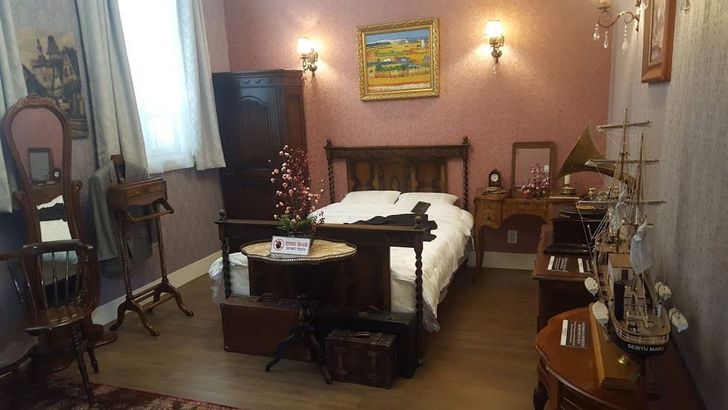
A bedroom is exhibited at Daebul Hotel Museum in Incheon in August 2019. / Courtesy of Robert Neff
While Hori enjoyed a great deal of success, he also suffered severe losses. In the spring of 1892, his second son died in a shipwreck off the coast of Jeolla Province.
During the 1894-95 First Sino-Japanese War, Hori was allegedly accused of treason and sent back to Nagasaki to answer for his crime. Somewhat surprisingly, a Chinese newspaper defended him. It declared Hori to be an ignorant man who could neither read nor write but had acquired a large sum of money through hard work. The paper went on to add, “the Japanese being in need of money came to the conclusion that he was revealing state secrets.”
Apparently there was no truth to the allegations against Hori and he remained in control of his hotel. What became of him is unknown. Around 1919, the hotel was sold and eventually became a Chinese restaurant and bar. In the late 1970s, the building was torn down.
The hotel has since been reconstructed and is now the Daebul Hotel Museum. It is a welcome addition to the historic Jung-gu district. Stop by and take a step back into the past.
Robert Neff is a historian and writer based in Seoul.