Following in the footsteps of Emperor Gwangmu

People sit in front of a stone entrance to Hwanggungu during a recent Royal Asiatic Society Korea Branch (RASKB) walking tour of Korean Empire sites. / Courtesy of RASKB
By Steven L. Shields
The weather was hot on a recent Saturday morning in downtown Seoul, but that did not stop a hardy group of Koreaphiles from gathering near the Westin Chosun Hotel. Members and friends of the
were enthusiastic about tracing the remnants of the short-lived Korean Empire.
Most people do not remember Emperor Gwangmu. He was formerly and later King Gojong. In 1897 he declared Joseon's independence from the Qing Empire. He became an emperor in his own right but was forced to abdicate in 1907 in favor of his son. The Korean Empire ended in 1910, after just 13 years of existence, when the Japanese annexed the country, claiming it as their own. The Japanese “graciously” allowed the emperor to be titled “king” again, and so he is forever remembered only as King Gojong.
Emperor Gwangmu's first task was to build a “temple of heaven.” The two-part complex consisted of an altar and a shrine. All that remains today is the shrine ― an octagonal, three-story hall next to the Westin Chosun Hotel. The Yellow Palace Shrine (Hwang-gung-u) contains memorials to the founder of Joseon and the gods of heaven and earth. Next to the shrine is a set of stone drums that were erected to commemorate Gojong's 40th anniversary of enthronement in 1903. The Japanese demolished the altar in 1913. On the site, they built the first “Chosen” Hotel. The current hotel was built in 1968.
Deoksu Palace, previously a royal villa, became the imperial palace. Emperor Gwangmu adopted the imperial yellow, as well as the imperial dragon emblem. Before 1897, only the emperor in Beijing was allowed to use those symbols.
Behind the palace grounds is the newly restored “King's Road” which connected to the royal library and the Russian Legation, as well as an overpass leading to Gyeonghui Palace. Sandwiched between are the British Embassy and the U.S. ambassador's residence (formerly the site of the embassy). The closeness of several foreign powers provided a degree of security for the emperor, if only psychologically. In the end, the British and Americans supported the Japanese, and Russian influence began to collapse after their stunning defeat by the Japanese in 1905.
The first excursion program of RASKB was organized in the summer of 1958, although occasional site visits had been conducted before. Members and friends visited Gyeongju on one trip, South Jeolla Province on another, and made the first RASKB trip to Mount Seorak (which afterwards became a regular feature of the annual calendar). By 1960 a regular program of tours was well in place, because of the late Carl Miller's enthusiasm for Korea. Miller worked with the Korean government offices of tourism and transport to organize the trips. More than 50 excursions and special events are sponsored every year.
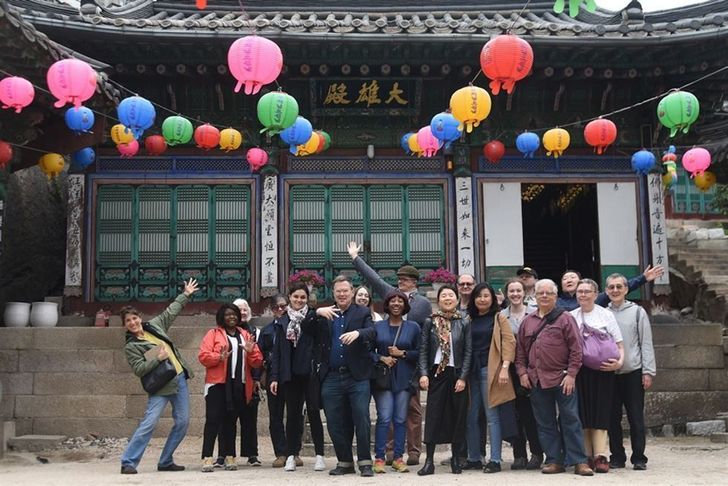
Participants in a Royal Asiatic Society Korea Branch (RASKB) walking tour of Changshin-dong area pose at Anyangam Hermitage on April 28. / Korea Times photo by Jon Dunbar
The society's popular “walking tours” of neighborhoods in and around Seoul attract many. Recent walking tours have included explorations of Samgakji near U.S. Army Garrison Yongsan and Seongsu-dong near Konkuk University. A templestay in June gave members a chance to explore both temple life and an exquisite museum of woodblocks. A day trip to Gangneung and two unique museum visits (the Central National Museum and the Museum of Contemporary History) introduced members and friends to a broad range of art, history and daily life.
In September there is a
, to explore one of Korea's few remaining traditional housing areas. Later in September, a group will walk
. Beginning near Yongsan Station, the trip covers the “forest park” that has been built on the railway right-of-way, ending some 6 km to the northwest in Yeonnam-dong.
In October, the RASKB hosts what may be a
. The overnight venue will visit the homes of five old families of Andong, including the home of Joseon's pre-eminent neo-Confucian scholar, Toegye Yi Hwang. In fact, visitors will be staying in Toegye's descendants' several-centuries-old house. Participants will be wined and dined by these several families, who will serve time-honored family recipes of both food and liquors. Dosan Seowon, a nearby Confucian academy, and Hahoe Village are both on the itinerary. Contact RASKB at www.raskb.com for more information on this exclusive event.
With its monthly business club, monthly literature club, twice a month lectures, the Colloquium in Korean Studies at Korea University, and a full calendar of excursions and other special events, RASKB offers both expats and Koreans a unique opportunity to explore the rich culture of Korea.
Steven L. Shields, a retired cleric, serves as a vice president of the Korea Branch of the Royal Asiatic Society (www.raskb.com) and is a columnist for The Korea Times.
Royal Asiatic Society Korea Branch (RASKB)