Gongpyeong museum reveals struggle with preservation

Gongpyeong Historic Sites Museum in the basement of a new highrise in downtown Seoul places history under glass. / Korea Times photo by Jon Dunbar
By Jon Dunbar
The demolition of Euljiro's hardware shop alleys is getting a surprising amount of attention. Surprising because it's the same old story, and many of the characters are nobody new; all that's changed are the specifics. Originally the plan was to tear down all the low-rise industrial districts along both sides of the Seun Sangga megacomplex, but now that voices are being heard, the city government is making vague promises of preservation, even as excavators continue to bring down old buildings.
Sadly, we can see how this is likely to play out in a previously redeveloped area, not far from Euljiro: Pimatgol, where redevelopment wiped away centuries of living history, except for a number of curious exhibits memorializing the 1910-45 Joseon era.
Pimatgol was formed without much planning during mid-Joseon Kingdom (1392-1910) when land previously for drainage became a back-alley shortcut for commoners. Originally, the alley stretched across the entirety of Seoul, from gate to gate.
As passage through the main thoroughfare of Jongno was intolerably slow for the commoners, who had to prostrate themselves whenever aristocrats passed, they began relying on a network of alleys to slip through unseen. The name Pimatgol literally means “avoid-horse-alley.”
This passage persevered throughout the modern age, continuing to serve as a gathering spot for low-income people in the 20th century including workers, activists and university students. It housed many restaurants, tea shops, bars and other establishments.
You can visit one remaining stretch of Pimatgol today, running from Jonggak Station exit 1 to the Kyobo Building. Only that's not the real Pimatgol.
It now exists in four segments running through an open-air corridor through four highrise buildings. The establishments here are franchises and chains catering to a younger, wealthier clientele. Although some of the original restaurants survived, they have been moved mostly indoors and underground, away from this alley.
Absolutely the only aspect of Pimatgol's continuity that was preserved was the physical open air where the alley ran, not the businesses, not the culture, not the atmosphere.
Alarmingly, a conceptual image displayed on the roof of Seun Sangga shows the vision for Seun Zone 4 ― not the one being demolished now, but presumably the next one: it shows how the design of what appear to be luxury apartments will be built over a maze of historic ground-level passages, just like how the neo-Pimatgol came into being.
The developers of each building carried out various preservation projects intended to preserve history. Walking through neo-Pimatgol, you can see countless monuments to the historic artifacts dug up on site during redevelopment. All of them serve to memorialize the Joseon era, and erase the 20th century. Many fight for floor space with 21st-century pedestrians visiting or passing the building. Nobody will be taken aback that the developers put little effort into heritage preservation. They add these architectural flourishes in exchange for better zoning: more retail space, more floors.
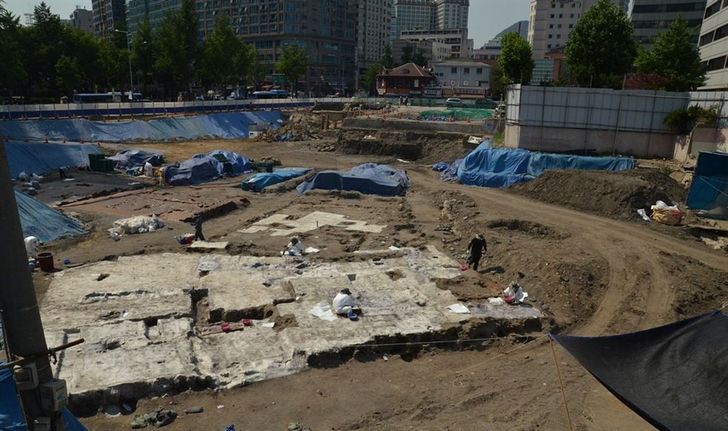
Archaeologists conduct a survey of the site for the Centropolis building in central Seoul on June 15, 2015, prior to excavation. / Korea Times photo by Jon Dunbar
The latest such monument, and the most impressive, is in the basement level of the new Centropolis opened just last year.
Gongpyeong Historic Sites Museum
offers several exhibits on what was there long ago, but more interesting than the historical content on display are the techniques and choices used to preserve urban heritage. One sign even mentions the museum was only built in exchange for zoning for extra commercial floor space. The museum has virtual reality headsets that allow you to stroll through a virtual hanok complex, as well as stone foundations and a few hanok reconstructions.
Nowhere are the buildings mentioned that were destroyed here just earlier this decade. The building site would have been just north of Pimatgol, next to the site of a 2013 fire which burned down a small corner of Insa-dong. Seoulites bemoaned the loss of those buildings, but there was little outrage when manmade forces destroyed this even larger section right next door the following year. All that was lost were humble and slightly seedy establishments that served the working class of Korea's historic capital.
The
Business and Culture Club of the Royal Asiatic Society Korea Branch
will
during lunch hour on Tuesday, March 12. Members and nonmembers are welcome.