INTERVIEW 'Our objective is disbandment'

The United Nations Refugee Agency's Special Envoy Angelina Jolie, right, with the organization's Goodwill Ambassador in Korea Jung Woo-sung, center, and senior public information associate Shin Heinn at UNHCR Korea's office in Jung-gu, Seoul, Nov. 4, 2018. Shin and Chae Hyun-young, interviewees of this report, asked The Korea Times not to conspicuously expose their photos. Courtesy of UNHCR Korea
United Nations Refugee Agency Korea explains its region-specific role and desire to endow its job entirely to the Korean government
By Ko Dong-hwan
At the United Nations Refugee Agency Korea's office, employees half-jokingly say that someday they will no longer be needed in this country.
The statement carries more than a self-deprecating tone. It is the Korean representative of the international organization's ultimate objective.
The agency says achieving the goal is for the good of the Korean government. With its limited authority due to the regional office's geopolitical situation and directives from UNHCR's Geneva headquarters, the agency, in a low-key way, mainly advocates and supports the government and civic NGOs to help refugees.
“The UN Refugee Agency is most encouraged when each state government protects asylum seekers and does its best in helping them,” Shin Heinn, senior public information associate from UNHCR Korea, told The Korea Times.
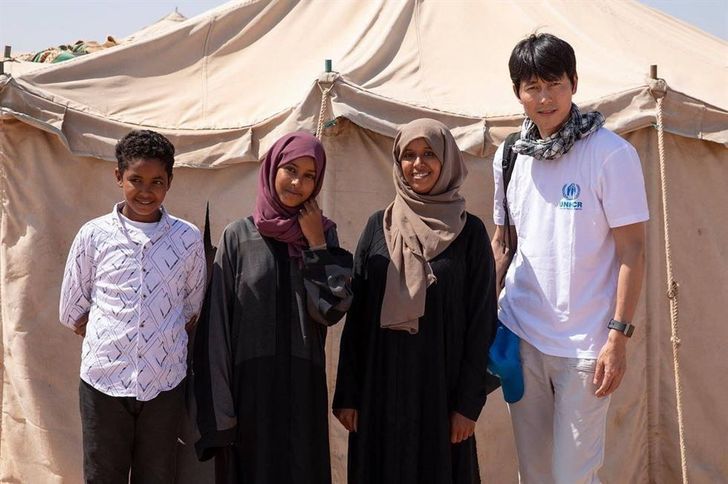
UNHCR Goodwill Ambassador Jung Woo-sung, right, met Yemeni refugees in Djibouti and Malaysia in November 2018. Courtesy of UNHCR Korea Facebook
The Korean representative isn't entitled to conduct its own humanitarian aid agenda without the Moon Jae-in administration's approval. It always works with the Korean government, mostly the Ministry of Justice that manages immigration issues, providing guidance and care for foreigners with urgent needs who do not benefit from state aid.
“If a massive number of refugees hits Europe in a single year, does UNHCR build camps and start protecting them instead of state governments? No,” said UNHCR Korea's associate legal officer Chae Hyun-young. “It can, however, work with the governments. So does its Korean representative, sharing information with the ministry and acting as a watchdog.”
The local office doesn't burden itself with more roles. Instead, it tries to make the central government do more work without spilling responsibilities to NGOs.
“As to what we do, we persuade the government to offer more financial support,” Chae said. “Also, if we have an asylum seeker whose evaluation process takes longer than a year or whose visa extension request was rejected, we call immigration offices to check why, because the outcomes could have resulted from miscommunication due to a language barrier.
“When there is no vacancy at state-run shelters for the foreigners, we reach out to NGOs to see if there is anything available.”
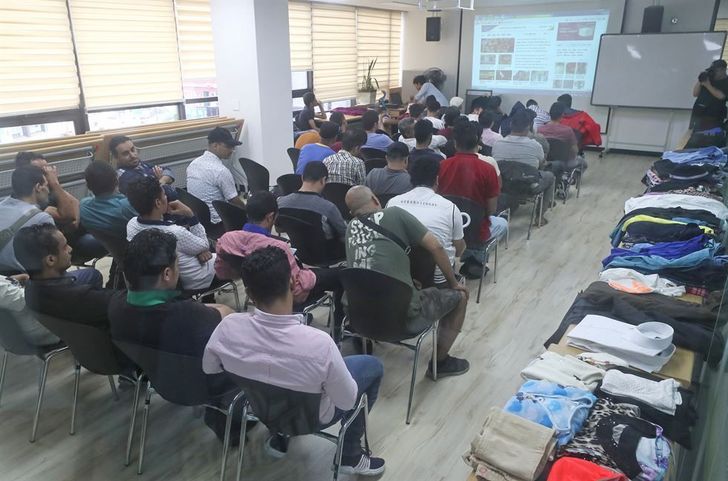
Yemeni asylum seekers wait for talks with the National Human Rights Commission of Korea at the Jeju Immigration Center on Jeju Island, June 29, 2018. Yonhap
No Direct Assistance
Under UNHCR Korea's restrictive job description, the regional office is not allowed to provide any direct help to refugees or asylum seekers, except in emergencies. Its main job is advocating.
Many foreigners, however, visit the agency expecting employment opportunities, shelter or financial support.
“Because we don't run any aid program, we sometimes hit the wall, like when some foreigners come to us with heaps of luggage seeking a place to reside,” Chae said. “In that case, we contact NGOs and beg for any available room.”
Chae said the Korean office in Jung-gu, Seoul, if it had field offices and established networks, could provide certain direct help. But since the state government controls managing asylum seekers in Korea, the office isn't equipped with those auxiliary arms.
“In Jordan, there are some 660,000 Syrians in Zaatari and Azraq refugee camps who had fled from the nearly eight-year-long domestic military conflict,” Shin said. “There, UNHCR, with the Jordan government's agreement, provides direct assistance.
“If a massive number of asylum seekers landed in countries near Korea, then our office's official role would be adjusted to allow us to engage in helping them more directly.”
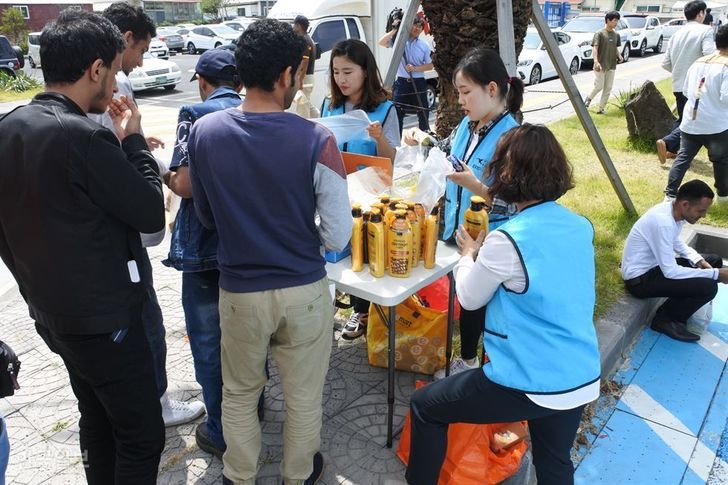
Civic NGO members distribute basic items to Yemeni refugee applicants at a makeshift booth in a parking lot in front of the Jeju Immigration Office, July 18, 2018. Korea Times file
Tight government budget
The state budget for subsidizing asylum seekers in need of basic necessities has always been tight. UNHCR Korea said “the pie is too small to share.”
The subsidy is like a sore thumb for lawmakers who often turn sour at calls for an increase. This year, the National Assembly slashed 350 million won ($308,000) from the refugee budget bill proposed by the justice ministry.
This year's annual state budget for asylum seekers included 3 billion won for operating the Immigration Reception Center on Yeongjongdo Island in Incheon, where asylum seekers stay while waiting for completion of their application's evaluation, and 800 million won for the subsidy pool. Considering that the number of asylum seekers in Korea was over 43,000 as of July this year, the pool is too little to support them all.
“With the shallow subsidy pool, the money is granted to just 10 percent of subsidy applicants, with families with women and children being priority,” Chae said.
“Young men are the least likely to get funded. That's why none of the Yemeni men who sought asylum on Jeju Island earlier this year received the subsidy.”
The agency, when it needs an urgent subsidy pool, asks the Korean Red Cross or Save the Children. The latter provides its funds for the nominal purpose of rearing children but in many cases the money is used for basic necessities like paying rent and heating fees.
Shin says that in the long term, the justice ministry getting the National Assembly to pass the subsidy expansion bill and increasing the pool isn't helpful for the foreigners.
“What is more important is supporting them to find measures to live independently,” Shin said. “We shouldn't look at them as poor. They just came here to seek help. Preparing a refugee camp and isolating them there is our last resort.”
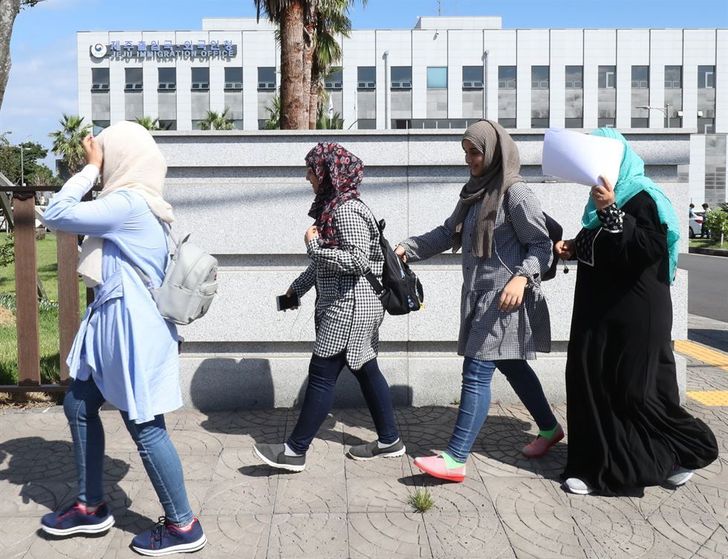
Yemenis who were granted humanitarian stay permits by the Jeju Immigration Office on Sept. 14, 2018, leave the authority's building on Jeju Island. New1
Evaluating asylum seekers
UNHCR Korea does not have any control over evaluating asylum seekers. Unless there was a “system” in which the government could issue legal status or permanent residency based on the agency's evaluation reports, the agency's authority is limited.
One of the Yemeni asylum seekers on Jeju Island who came from Malaysia was confused to find that his refugee status granted in Malaysia by the UN Refugee Agency was ineffective in Korea.
Malaysia is a non-member state of the UN refugee protocols and doesn't officially grant refugee status. The UNHCR refugee status there provided him with immunity to the risk of being incarcerated by the state authority. He challenged why his status was revoked in Korea by the same UNHCR authority.
“UNHCR Korea is helpless without the central government's approval,” said Shin. “How refugee status was granted in Malaysia cannot be applied to Korea.”
What the regional agency can do with the government is negotiate.
“We could persuade the government to at least not repatriate asylum seekers who are from member states of the U.N. refugee protocols,” Chae said.
“UNHCR Korea's ultimate objective is to support the Korean government so its capabilities in evaluating asylum seekers will improve and eventually conduct the job on its own. We would never evaluate asylum seekers instead of the government because of the latter's ineptness. The government would then try to keep relinquishing its responsibility to us.”
By Dec. 14, of the 484 Yemeni asylum seekers on Jeju Island, the justice ministry accepted two journalists as refugees, granted humanitarian stay permits to 412 and rejected 56. The decision drew criticism over why most of the Yemenis ended up with the one-year temporary permit.
“The decision could have been worse amid the raging anti-refugee atmosphere that swept nationwide,” said Chae, aware that it is also the government's role to listen to the public. “We eventually sent no one back to Yemen. While civic groups tend to stick the government with necessary pointers, we try to maintain a good tie with the government.
“UNHCR evaluates asylum seekers in the hope that, although state governments might want to deport them, our assessment could persuade the authorities not to do so. If things went really well and even a single refugee got a chance for resettlement in a third country, that's something we want to see as well.”

Seoul Mayor Park Won-soon, left, and Justice Minister Park Sang-ki show a memorandum of understanding signed at Seoul City Hall, Monday, aimed at improving conditions for foreign residents. Yonhap
Limited job market
Korea signed up to the U.N. refugee protocols in 1992 and its refugee act became effective in 2013, the earliest among Asian countries. A recent memorandum of understanding between Seoul City Hall and the justice ministry raised the possibility of more immigration offices and inviting more foreign talent to the city.
But there are major hurdles to overcome. One of them is diversifying employment chances for asylum seekers.
To embrace those who ask for particular jobs or vocational training, the current structure needs a major shift that involves not just the justice ministry but also the National Assembly, local governments, NGOs and citizens' changed views on refugees.
NGOs, which attract many asylum seekers and refugees looking for jobs, only have limited spots for laboring positions in factories and farms.
Pnan, one of the local NGOs in Seoul dedicated to refugees and asylum seekers, has a long waiting list of job-seeking foreigners who don't mind hard work. Yemenis on Jeju Island, most of whom had held professional positions like journalists, doctors, engineers and teachers, worked at tangerine farms and on fishing vessels because of the poor job market.
“Diversifying the job market for asylum seekers requires revising existing policies,” Chae said. “It would be marvelous if a company showed up and asked for a list of 100 asylum seekers to hire. But there is simply no such system. It would be practically ideal for the Ministry of Employment and Labor to introduce a dedicated bureau, prepared with reserved interpreters. Mixing and matching pipelines to do that, however, is tricky as it must involve more than the justice ministry.”
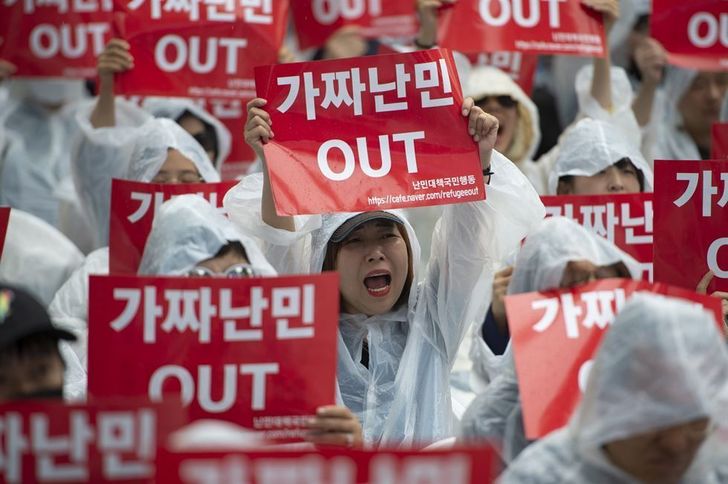
Anti-refugee protesters raise banners that read "Fake Refugees OUT" at a street demonstration at Bosingak in Jongno-gu, Seoul, Sept. 16, 2018. Korea Times photo by Choi Won-suk
The justice ministry tried to improve employment conditions for foreigners, scheduling an open discussion session with civic community members early this year to revise the refugee act. But the bid was unexpectedly blocked by the nationwide anti-refugee movement incited by the influx of Yemenis.
At the center of the raging sentiment, driven largely by young Korean adults, was the idea that their job opportunities were threatened by asylum seekers and refugees. The fact the government held job orientations for the foreigners also angered the protesters.
“It was like a cauldron of all the possible needs from socially discriminated Koreans boiling in rage,” one of the civic communities said, referring to the so-called “Yemenis refugee crisis.”
The country to benchmark is Germany, according to the agency, where over a million asylum seekers were quickly absorbed thanks to coordination among the federal government, local governments and civic communities.
“In Korea, a certain lawmaker suggested the entire budget to subsidize refugees and asylum seekers be repealed,” said Shin, adding that even among politicians there isn't a coherent understanding that protecting asylum seekers is the country's responsibility as a member state of UNHCR.
Chae said: “What we need is closely knit civic NGOs with separate branches from state bureaus dealing with the foreigners so all NGOs get well funded and make particular demands to each bureau.”