The curse of E-6-2

A scene from South Korean documentary film "Host Nation" (2016). Introduced at the 22nd Seoul Human Rights Film Festival in 2017, the film portrays a Filipino woman named Maria, 26, who, dreaming of escaping her poverty-stricken slum, comes to South Korea with an E-6-2 visa, but ends up in an adult entertainment parlor near a USFK camp in a South Korean port city. Korea Times
This is the first of a two-part series about migrant women in Korea who struggle with risks of deportation, physical threats and psychological hazards in much of their daily lives. ― ED.
Migrant workers in Korea with an Arts and Entertainment visa mostly end up in the hands of human traffickers
By Ko Dong-hwan
.jpg)
A Durebang agent talks with women at a bar in an entertainment district near USFK Camp Casey in Dongducheon, Gyeonggi Province. Courtesy of Durebang
Women, mostly Filipinas, who work in bars in the entertainment district near United States Forces Korea's Camp Casey in Dongducheon, hardly go a day without drinking. With bars opening after 6 p.m. and not closing until the last patrons leave, usually in the early morning, some of the women provide customers with whatever they want – from canoodling and lap dancing to oral sex. Some customers suggest heading out for the night (for sex), which is not so good for the women, but good for the bar owners because a customer must pay a bar fine to take one of the women out.
These migrant women's desperate business depends on soldiers from the camp, about 60 kilometers north of Seoul. The soldiers' curfew is 1:00 a.m. When they return to camp, migrant workers replace them in the bars, but there are not as many.
Job agencies have told the women that with an E-6-2 arts and entertainment visa, they would find work as singers, with most of the women unaware they will end up in "red-light" bars.
"There are about 200 foreigners working at some 40 clubs in Dongducheon," Joyce Kim from Durebang, an NGO dedicated to helping the women working in bars near USFK camps, told The Korea Times. Having watched over the migrants for more than five years, she said the migrant women, some of whom are Russian, live above the bars with only one day off every month. The visa allows them to stay in Korea for two years if they do not quit and their work contracts are valid.
The bars are owned and managed by Koreans. In some cases, the employers threaten the women and push them to earn more money, forcing them to work until as late as 10 a.m. This affects the women's health, including their menstruation cycle.
Bar women are paid based on a monthly quota. All Dongducheon bars use this system. At one bar, each woman is required to collect 300-350 points every two weeks.
"Otherwise the bar owners cannot earn enough," Kim said. "Owners use points to humiliate the women with poor sales records by comparing them to women who earn more points."
The system works like this: At a bar which requires women to earn 300-350 points, a $10 glass of "juice" that a woman sells to patrons is worth one point. To fill up the quota, each woman must sell $3,000-$3,500 worth of juice every two weeks. If the women reach their quota, they get paid a bonus called "drink back" worth around $300-$350 in addition to their regular monthly wage of 400,000 won ($354).
"For these women who must send their wages back to their families back home, the points and their earnings are inseparable," Kim said.
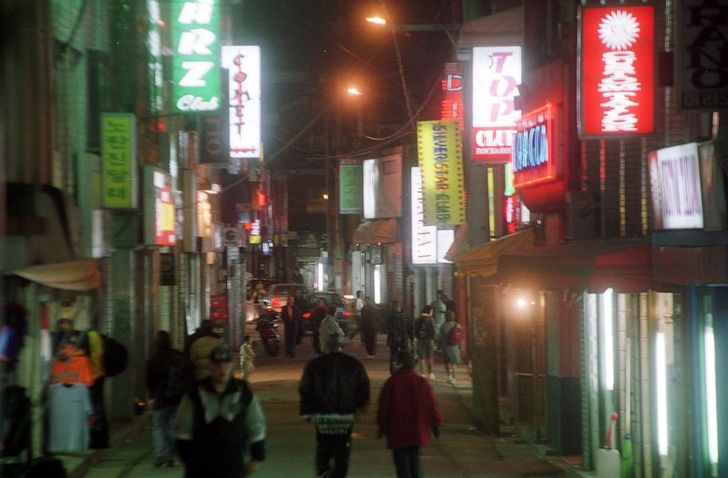
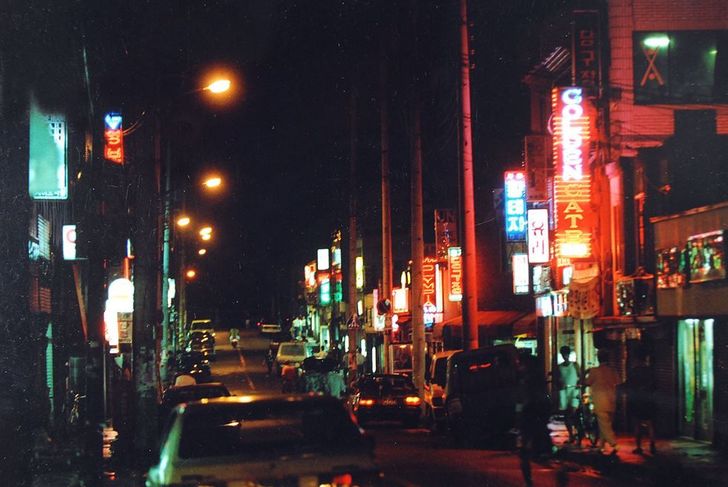
Entertainment districts near USFK camps in Dongducheon (above) and in Songtan near Osan Airbase. Korea Times
Even when they choose to quit working at the bars, the women's hardships continue. With their working visas terminated, they constantly fear deportation and go into hiding, sometimes in spaces offered by Filipino communities.
Expensive hospital bills without medical insurance prevent them seeking treatment for themselves and their children if they have them, most of whom do not know their fathers. The Uijeongbu-based NGO pays the hospital bills for pregnant migrants. If the bills are not paid, babies cannot receive birth certificates and documents of nationality.
"In the past, women faced much harsher working environments, being forced into prostitution and not being paid at all when failing to fill the quota," Kim said.
"But with the number of USFK soldiers reduced due to the shutdown of Camp Stanley in Uijeongbu, and Camp Casey running on rotation shift ahead of their relocation to Camp Humphreys in Pyeongtaek, the number of soldiers visiting the bars has fallen sharply. Bar owners no longer abuse the bar women to the same degree as they did in the past. Plus, the workers have smartphones and maybe able to save some evidence of physical harassment."
Dongducheon bar women also include Russians with B-1 Visas Exempted. They are restricted from employment in Korea but work here for about two months without signing any contracts. If they quit before the period they had agreed with their employer is over, they must repay their monthly wage of 800,000 won.
Filipinas returning for a second time often then have a tougher time. As experienced workers, they are more likely to be hired by bars in "rough" zones with more demanding patrons.
"Many of the women coming with an E-6-2 visa don't exactly know they will work in bars and are forced to provide entertainment and, in some cases, even prostitution, whether they are here for the first or second time," Kim said. "It is clearly human trafficking."
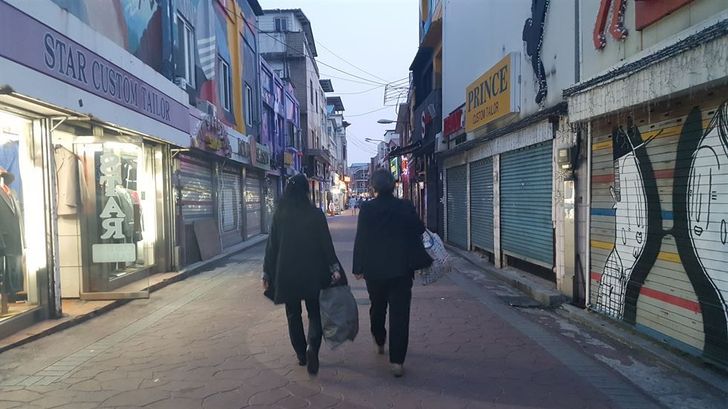
Durebang agents scout the streets of Dongducheon entertainment district, where there are dozens of juice bars and clubs. Soldiers and migrant workers cruise the area at night. Courtesy of Durebang
Quagmire
South Korea signed the U.N. Human Rights "Protocol to Prevent, Suppress and Punish Trafficking in Persons" in 2000 and revised national criminal laws in 2014 to implement the new, broader meaning of human trafficking. But this has largely failed to control the influx of migrant women trafficked into sexual exploitation or bring about the prosecution of those involved in this organized crime.
The problem has persisted mainly because Korean immigration officers, police and prosecutors lacked understanding of the victims and the definition of human trafficking.
The U.S. State Department's "Trafficking in Persons Report" from June 2018 and Korean lawyers studying migrants said Korean law enforcers needed to stop playing by rules that are only effective with Koreans, and to understand the psychological status of the victims, who often live in fear and despair. In the end, the victims, rather than the actual criminals and their accomplices, were penalized and deported due to the officials' inadequate understanding of the situation.
The U.S report recommended that South Korea "train law enforcement officers, prosecutors and judicial officers to understand 'trafficking' does not require kidnapping, buying and selling, force, or confinement" to "proactively identify victims among vulnerable populations." The report cites Korean NGOs saying that Korean government officials "lacked awareness of trafficking issues" and "did not utilize a victim-centered approach" that resulted in authorities arresting, detaining and deporting sex-trafficking victims.
In the meantime, bars and clubs kept a tight leash on the women through various entrapment means. The E-6-2 visa prompted condemnation from the U.N. Human Rights Committee, which said the visa was abused as "a human trafficking channel."
Park Ji-yeon from Seoul-based law firm BKL and three other lawyers said in the public interest law guidebook "Migrant Law Study" that the quota system and bar fines forced on the victims had "created this unique work environment where the sex trade becomes indispensable."
Park said, "Unwillingly winding up in the sex trade, the victims, despite the slight freedom they have, cannot go to the police and live in the shadows, with no choice but to engage in sex trade because they must support their families, pay employers demanding a contract violation penalty or face deportation."

An entrance to an underground adult club. Patrons can enter the venue freely, but for migrant workers, walking out for good entails the risk of deportation and financial hardship. Courtesy of Durebang
Efforts in vain
Following the late 1990s when more migrants began entering Korea on E-6-2 visas, the government has recently taken various steps, with little effect. One example is a joint investigation by the ministries of justice; employment and labor; culture, sports and tourism; and gender equality and family.
"They regularly visited Dongducheon clubs twice a year," Kim said. "The problem is that the ministries notified the club owners of the visit in advance, which gave the employers enough time to hide unregistered workers, return confiscated visas, and force the workers to memorize made-up answers so as not to leave any trace of human trafficking. They lie when the government officials visit them."
Even when police raid the venues, it is mainly the workers who are taken away in handcuffs. With most of them unable to understand any Korean except obscenities that club owners used against them, they cannot properly explain their situation to police. Nor do the victims have any knowledge of their Korean constitutional rights, so it is virtually impossible for them to defend themselves. Police do not even seek interpreters to tell them what the victims are saying before sending them off to immigration offices.
To curb human trafficking, Korean immigration offices started issuing fewer E-6-2 visas compared to previous years. An average of 4,000 migrants with such visas had been arriving each year, peaking one year at 8,000. But in 2017, fewer than 2,000 were issued.
In August 2017, the authority also began checking the Overseas Employment Certificate (OEC) of Filipina migrants. The Philippines government requires all Filipinas leaving the country to have such a certificate, to prevent the women becoming prey for human traffickers.
"So far, Filipinas who ended up at bars and clubs have transgressed their own country's laws by not possessing an OEC when entering Korea," Kim said. "And Korea had not checked this loophole until last year."
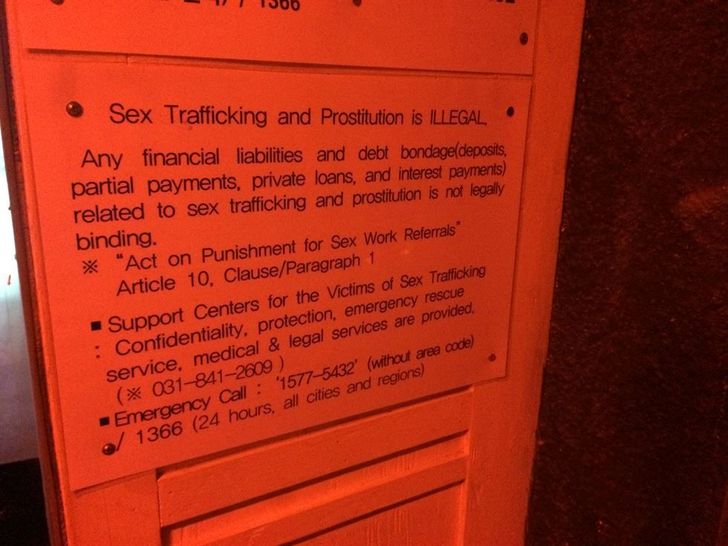
A notice at a Dongducheon sex trade venue. Courtesy of Durebang
An exemplary case of prevention was demonstrated by the USFK in 2016, when it red-tagged all “juicy” clubs near their air bases in Osan and Gunsan as "off limits" to soldiers. It did not take long for the clubs to shut down due to the absence of soldiers who faced zero-tolerance for violating the edict.
"In the case of the U.S. Army, however, former Army General Curtis Scaparrotti warned army soldiers that sexual companionship cannot be bought and banned them from attending the venues," Kim said. "But the effect lasted only a few months."
The proliferation of human trafficking is attributed not just for the failure to prevent it, but also the lack of punishment for those responsible.
Between 2009 and 2016, 40 alleged human trafficking complaints were reported by migrant women with E-6-2 visas. None of the cases saw those responsible ruled guilty; only few of the complaints were filed with prosecutors. Even when sex trading agents and Korean immigration violators pleaded guilty, maximum sentences were no more than a suspended jail term or a fine of less than 10 million won.
"Most of the suspects weren't arraigned because the victims couldn't provide substantial evidence or secure witnesses," Park said. "But considering that the victims' co-workers dare not provide evidence because it would put their employment at risk, and because some victims have been deported, it must be understood that the victims virtually don't stand a chance in the courts."
Regarding the veracity of foreigners' evidence, the Supreme Court ruled in 2012 that law enforcers must take into account victims' psychological status, possible memory loss over time, and linguistic irregularities due to cultural backgrounds.
Park said there also needed to be a "more aggressive investigation" and less reliance on evidence and a reevaluation of each case based on the new definition of human trafficking victims in force in Korea since 2016 following the 2000 U.N. Human Rights Protocol.
"The most difficult problem is prosecuting those involved in the pre-exploitation phases of recruitment and transportation," Park said, citing a U.N. Office on Drugs and Crime report. "Proving the criminality of recruiters and transporters outside the country is difficult because their whereabouts is often unknown."