Rejected asylum seekers decry 'no honorable return'

Fleeing Bangladesh in fear of religious persecution and applying for refugee status after arriving in Gimpo in 2000, Ronel Chakma Nani, right, has been supporting migrant workers and asylum seekers in Korea as director of the Gimpo Immigrant Center. Photos provided by Gimpo Foreign Citizen Support Center
By Ko Dong-hwan
South Korea is a harsh land for asylum seekers.
Of 40,470 who have arrived here, almost 20,400 have been evaluated since 1994 and only 839 accepted as of June 2018. That's about 4 percent and compares starkly with the 3.5 million Syrian refugees in Turkey and the 2.2 million in Lebanon.
So what happens to the 96 percent of asylum seekers in Korea who were rejected?
They have nowhere to go, caught between the country they fled and another country that refuses their entry. They can try a different country but the odds of acceptance are nearly zero. These vagrant souls are haunted by “no honorable return,” a phrase coined by Ronel Chakma Nani, the director of the Gimpo Immigrant Center in Gyeonggi Province.
“Rejected asylum seekers in Korea have no exit,” Nani, who came to Korea from Bangladesh 18 years ago, told The Korea Times. “When they apply for refugee status and get disapproved, they usually appeal. They get disapproved again; they take their cases to a provincial court or as high as the Supreme Court. When that even turns sour, they are left with the only option ― becoming an illegal alien. Even if they sought asylum in another country, what country would possibly grant refugee status to those who were repeatedly disapproved?”
Nani, 46, supports asylum seekers and migrant workers in Gimpo, some 30 kilometers west of Seoul. He has often witnessed rejected refugee applicants see their Korean dreams shattered because their futures are unclear.
They find it difficult to survive, largely because it is extremely difficult to assimilate into Korean society in the face of the high walls of immigration laws and Koreans' biased impression of them.
A Bangladeshi student with a G-1 visa ― which requires a refugee applicant to apply for an extension every three months ― was accepted by an Australian university three years ago. But when the school learned of his status, it refused his enrollment. The same thing happened when he tried to apply to a Korean university. Korean law only allows elementary and junior high education for underage asylum seekers.
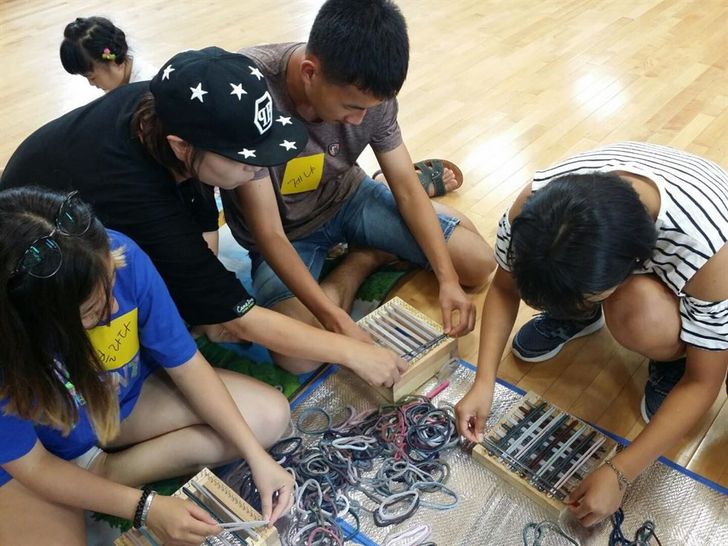
Children of migrant families participate in a summer activity program arranged by the Gimpo Foreign Citizen Support Center on Aug. 12. Young people who often come to Korea not knowing the language can easily become isolated unless a Korean community, an immigration authority or a migrant support center reaches out to them.
Another asylum seeker from the Commonwealth of Independent States, who claimed to hold a doctorate degree, saw his employment contract with a Korean firm canceled after the company discovered his status and told him they could not hire him. But the law allows refugee applicants to pursue careers in Korea six months after filing their applications ― even in professional fields, given they meet all vocational conditions. He was not hired because the company was reluctant to employ an asylum seeker.
“Most of these people don't want to live as bogus refugees, especially those with credentials and educational backgrounds,” Nani said.
While most refugee applicants in Korea are left in limbo, migrant workers here do have a shot ― the E-7-4 visa.
After Korea introduced the employment permit system in 2004, companies in manufacturing sectors that were suffering labor shortages hired foreign workers on E-9 visas reserved for non-professional occupations. After working on the visa for four years and 10 months (three years default and one year and 10 months when employers extended hiring), they can apply for the E-7-4 visa, a professional workers' visa that allows them to stay in Korea as long as they want. Without an E-7-4, they must leave the country and re-enter with a new E-9 visa ― for another four years and 10 months maximum.
The E-7-4 visa, introduced in August 2017 after E-7 visa policies from 2011 were recommended for revision, raised the prospects of migrant workers. It was almost their silver bullet to continue working in Korea legally ― including medical insurance and social insurances that ensure pension, health and industrial accident compensation.
Granted based on a merit-point system and given to the 400 top scorers each year, the E-7-4 pushed workers with Korean dreams to accumulate points that were assessed according to their educational backgrounds, credentials and, most critically, Korean language ability.
“The E-7-4 visa lowered the number of illegal aliens in Korea as it motivated many migrant workers to earn legal protection,” Nani said. “The workers are nowadays very passionate to learn Korean, almost racing each other to master the language. A decade ago, no workers really cared about learning Korean.”
The Ministry of Justice designated the Gimpo Foreign Citizen Support Center, a government office offering a much larger migrant-friendly environment than the small Gimpo Immigrant Center, as the city's main Korean teaching center for migrants. Those that complete the free language program are given 20 points toward the 72-point cap for E-7-4 acquisition. For Nani, the language program was one of the two subjects he counseled foreigners about the most.
“Before the employment permit system was introduced, migrant workers, once their E-9 visa expired, almost unexceptionally stayed put in Korea as an illegal alien,” Nani said. “After the E-7-4 visa was introduced, many of them no longer sought to live here illegally.
“This profoundly shows us that Korean immigration laws must offer migrants benefits and common ground for cooperation between the Korean government and the workers, rather than reining them in with rules and bigotry. The migrant-friendly environment will in the end benefit not only the foreigners but Koreans as well.”
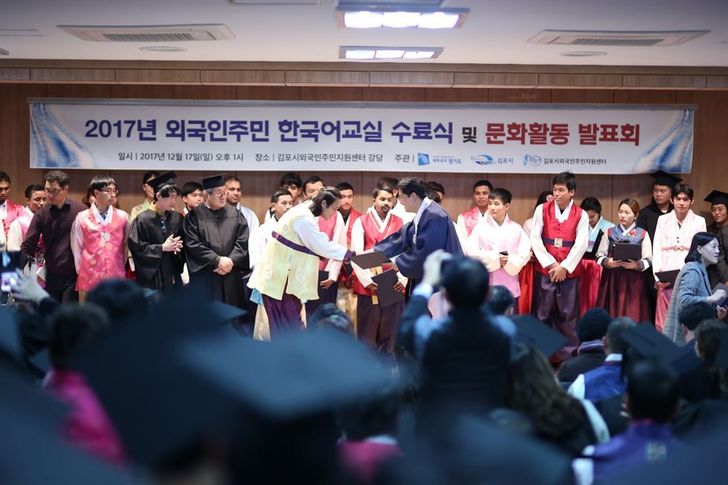
Foreigners who completed a government-funded Korean language program at the Gimpo Foreign Citizen Support Center join a graduation ceremony in December 2017. The center's director Choi Young-il, who established the Gimpo Immigrant Center in 2006, presents a certificate to one of the graduates.
Unpaid wages, violence still rife
Gimpo has been a migrants' nest for decades, including those from 15 countries registered to Korea's employment permit system. Among the group, people from Vietnam, Cambodia, Myanmar, Bangladesh and Nepal stand out. The city is also home to some 200 Jumma, the indigenous peoples of the Chittagong Hill Tracts in Bangladesh. The Buddhism believers left the country because Bengalis were forcing the Islamic faith on them and persecuting those who rejected it.
The city, according to Nani, who has been living there since 2000, still has migrant workers who suffer many problems, from workplace hazards and unpaid wages to forged working hours in their employment contracts. But the most common complaint is that they cannot change jobs without an agreement from their boss. One of the reasons they want to do so is consistent violence.
A Bangladeshi man, whom Nani has been helping change workplaces, abhorred his casting factory job in the city, where he started working in December 2017. The factory didn't give him drinking water, proper gloves and offered a shipping container as a home. The container was so hot during summer he went to an Islamic monastery nearby to sleep. But worst of all, he was beaten for days in February by his manager who did not like his work attitude.
Nani took the case to police. It was later sent to a prosecutor's office, where it was dropped and the manager slapped with a 500,000 won ($440) fine. Nani then took the case to the city office's employment center to change the victim's workplace.
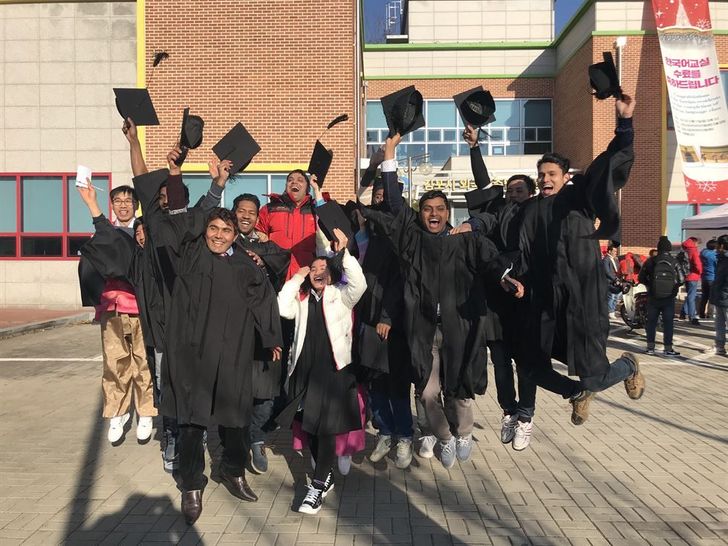
Graduates of the Korean language program at the Gimpo Foreign Citizen Support Center celebrate.
But the authority refused, because not providing drinking water does not infringe Korean labor law and it wasn't the victim's boss who beat him but his manager. A certified labor attorney told Nani, however, that although it was the manager who beat the worker, it was a legitimate reason for workplace change since the “manager was one of the beneficiaries of the victim's labor.”
Nani then took the case to the employment center at the Bucheon City Office south of Gimpo. Two weeks passed and he did not hear from the office. Nani said taking more than two weeks to determine whether the aggressor was a beneficiary “didn't make sense.”
“It seemed as if the city officials were scared of the victim's employer,” Nani said, referring to the authority's tardy response to his petition. He said it was suspicious enough to indicate that racism still affects Korean employers, managers and even government workers.
Nani, one of the Jumma people, first worked for a gold-plating factory in Incheon but quit after seven days and wasn't paid a penny. Moving from factory to factory, he applied for refugee status in 2002. He was granted the status two years later, bringing his wife and son to Korea the year before.
“Working as a consultant for migrant workers, I still become the subject of racism,” Nani said. Korean employers he phoned to discuss their troubled foreign workers often ridiculed his Korean because of a strong foreign accent and told him “put on a Korean person.” Whether it is race or religion, bigotry toward foreigners has pervaded the country deeply.
“Nonetheless, such discrimination would be a sign of a process the country is becoming more ethnically versatile,” Nani said.