Gandhian evangelist cycles Korea after 25,000km across Asia
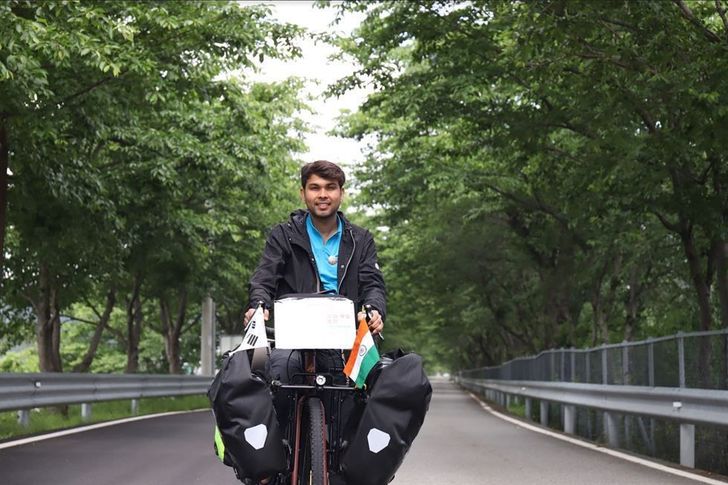
Dnyaneshwar Yeotkar, a missionary from Maharashtra, India, visited South Korea in May this year. Photos provided by Dnyaneshwar Yeotkar
By Ko Dong-hwan
For Dnyaneshwar Yeotkar, 26, an Indian messenger of peace, friendship and global unity who visited South Korea in May, Korean schools that followed the teachings of the great Indian sage Mahatma Gandhi were worth visiting. After all, the historical figure was the inspiration behind the philosopher's daring solo cycling tour across the world that started in November 2016.
With the help of a Korean friend, he was welcomed at Geumsan Gandhi School in South Chungcheong Province and Sancheong Gandhi Middle School in South Gyeongsang Province and allowed to stay to learn about their facilities and curriculums that are based on Gandhi's philosophy of non-violence and peace.
“Many youngsters were excited to know about my mission plan of a tour round the world by bicycle spreading Gandhi's messages,” Yeotkar told The Korea Times.
He praised the unconventional alternative schools for teaching students to find their own interests, where they would fit in society, and their responsibility to the community. Learning about “high ideals,” the students wrote letters of peace and love to the leaders of North and South Korea when he talked about the ongoing conflict between the countries.
“We have advanced to high levels in the material sense, but on a psychic level, we still behave like barbarians killing each other,” the activist said.
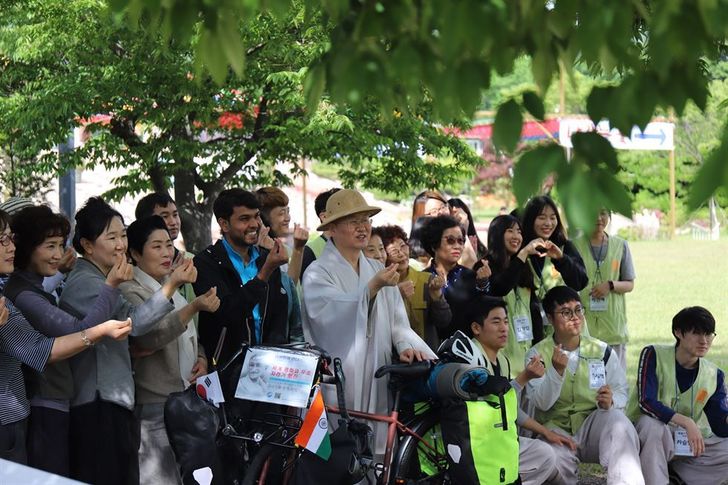
Buddhists from Hongbeopsa Temple in Busan and local students welcomed and blessed Yeotkar, who started his Korean tour from the temple.
Yeotkar also met university students from Suwon, Jeonju, Daegu and Busan and told them about his journey, making arrangements to stay in their schools. He said the students were surprised at his “faith in people.”
“The students praised my mission and admired my courage and faith in other people,” Yeotkar said. “They wondered how I travelled for two years without any money and asked me about my stays, food, visa applications and crossing oceans.”
The traveler and the students, whom he contacted through student unions, discussed the problems of a centralized government administration and the importance of voluntary involvement in societies at times of natural disasters and when the environment needed protecting.
“We have to consider the world as one huge family and work for its welfare,” Yeotkar said.
Yeotkar also met Sikh brothers at a gurudwara in a town before heading to Seoul, his final destination in Korea after starting from the southern port city of Busan. The Sikhs told him he was “courageous and gutsy” to set out on the mission. He said Sikh families and gurudwaras had shown him love and caring throughout his journey, whether he was in Thailand, Singapore, Malaysia or Korea.
He also met expats of various nationalities, comparing their impressions of Korea to his own.
“Many Americans and Europeans, often teaching English and earning good salaries, say Korea is peaceful,” Yeotkar said. “Some African friends, however, said they witnessed 'quiet racism' toward colored people. I asked some teachers about this and they said they used to teach children that Koreans were a special ethnic group. Those who have global exposure are over such discrimination.”
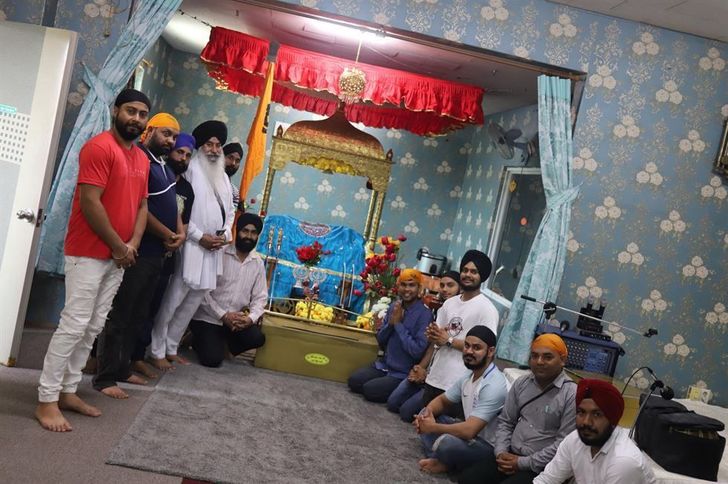
Yeotkar and Sikh brothers at a gurudwara in a town outside Seoul.
Before beginning his tour, the missionary from the Indian province of Maharashtra was already hardened by walking across India with no money at the age of 16. Along the way, he was beaten and left for dead on river banks after being mistaken as a thief. Other times, people who saw him thought he was a beggar. He also lived among a rat-eating tribal community in north India. After two years in 2010, he returned home.
Studying social services, he established an NGO called Maitri Sadhana ― a Sanskrit term meaning “friendship, dedication” ― which involved college students as volunteers. Operating the organization, he realized that the helpless and children were the ones who needed the real friendship of communities the most.
During his tenure at the NGO, he had an epiphany, leading to his decision to make his cycling journey. By chance he read “No Destination: Autobiography of a Pilgrim,” which details the travels of Satish Kumar, who walked nearly 13,000 kilometers across the world with Gandhi's vision of a renewed India at heart. Yeotkar said the book gave him a new purpose in life.

Yeotkar speaks at an international gathering hosted by Busan, the city's immigration office, an international cooperation foundation and ASEAN Culture House.
He was encouraged by India's Minister of External Affairs Sushma Swaraj, who asked Indian missions abroad to help Yeotkar as much as possible. Calling his tour “Vishwa Maitri Yatra,” or “World Peace and Friendship Tour,” Yeotkar's objective was to spread the message of peace and friendship as envisaged by Mahatma Gandhi. The trip was to mark next year's 150th anniversary of Gandhi's birth.
Before arriving in Korea, Yeotkar visited 14 countries including China, Myanmar, Vietnam, Laos, Cambodia, Thailand, Singapore, Indonesia and Malaysia. The journey lasted 560 days and he cycled 25,600 kilometers.
Without official sponsors, Yeotkar constantly struck financial problems along the way. Starving for days, sleeping without a roof, being attacked by animals or treated badly by local residents were common occurrences. The difficulties persisted during his Korean visit.
“I faced lots of troubles in the last two years,” he said. “I faced a tiger, slept beside a snake, had dog bites and got thrown out of a hotel. Still, I kept myself calm. Today I don't have a penny but I am planning to visit the U.S. next (which he actually has done). I am confident because of the spiritual strength and hope inside.”
But the biggest challenge for Yeotkar, a vegan, was finding vegetarian food.
“Sometimes I had to eat just rice, sometimes just fruit,” Yeotkar said. “Korean friends asked me how Indians survive without meat and where we get protein from. I replied that we have many vegetables in India so we don't need meat. I heard about Korean cuisine but unfortunately they were all non-vegetarian.”
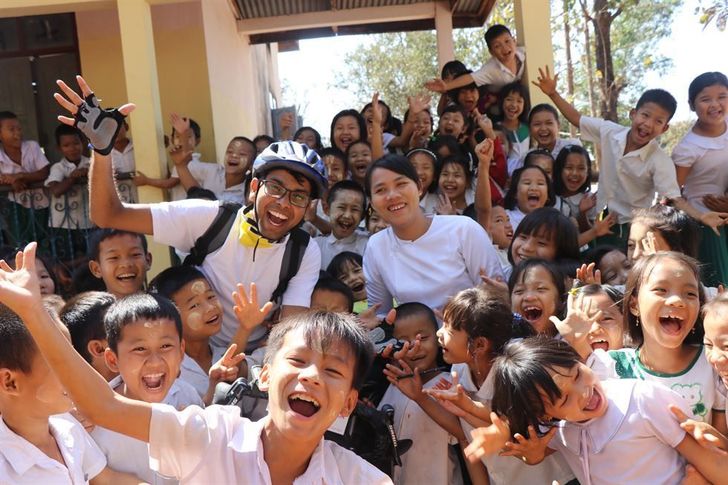
Before Korea, Yeotkar visited 14 countries in Asia. Next is the U.S.
Language was another problem, especially in countryside.
“Many wanted to talk more about my mission but I don't know Korean and they don't know English,” Yeotkar said. “I used Google Translate but it wasn't satisfactory. But I still created a spiritual and loving relationship with people. I feel this is the outcome of my tour.”
He said his spiritual belief kept him going on his pilgrimage.
“I consider spirituality intensely when I am deeply hungry,” Yeotkar said. “I get food from one side. Whenever I am in desperate need, I get help. All these are connected in one way or another.”