'City without border' hosts World Cup for migrants

Thai football players and cheerleaders at the World Cup in Ansan, Gyeonggi Province, celebrate after winning the tournament on June 17. Ansan Migrant Center
By Ko Dong-hwan
While the World Cup in Russia captures global attention, a different international football tournament kicked off in Ansan last weekend.
Instead of national athletes and armies of cheering crowds, migrant workers from 11 countries in Korea took to green fields for their own World Cup.
The Ansan Migrant Center in Gyeonggi Province hosted its 16th annual Ansan World Cup. The one-day event attracted some 500 players competing in football and volleyball. There were 16 football teams and eight volleyball teams from Nigeria, Myanmar, Bangladesh, Vietnam, Uganda, Indonesia, China, Thailand, Cameroon, Liberia and the Philippines. To cheer them on, 500 multi-national fans turned up for the tournament.
“Atmosphere during the event was beyond friendly,” Ansan Migration Center chief Park Chun-ung, who has been directing the event since its inception, told The Korea Times. “It was outrageously exciting and cheerful.”
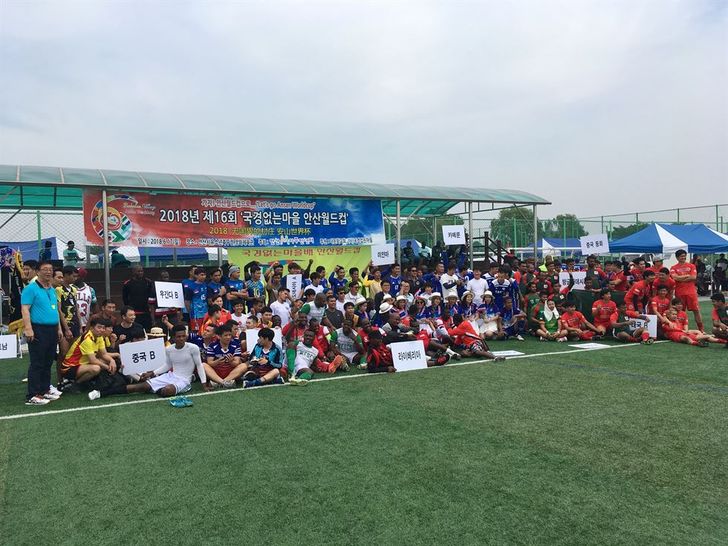
Players from the different countries wait on the sidelines of football fields in Ansan on June 17. Ansan Migrant Center
Thailand took the crown in the football tournament, grabbing the 800,000 won ($720) prize funded by registration fees.
The spectators brought traditional instruments from their countries, or used empty plastic water bottles as percussion instruments, to add extra zeal to their patriotic cheering.
The event is not just a minor festival for migrants. Joined by Park and the city's newly elected mayor Yun Hwa-seob, the tournament has long been seen as the city's signature event, drawing local residents.
“Many people have perceived migrants in Korea as petty factory laborers,” Park said. “But they now boast a lengthy history of settlement, with the first group of migrants coming here almost 25 years ago. And they started forming a culture of leisure, in the form of sports, modern music bands or traditional music gigs.”
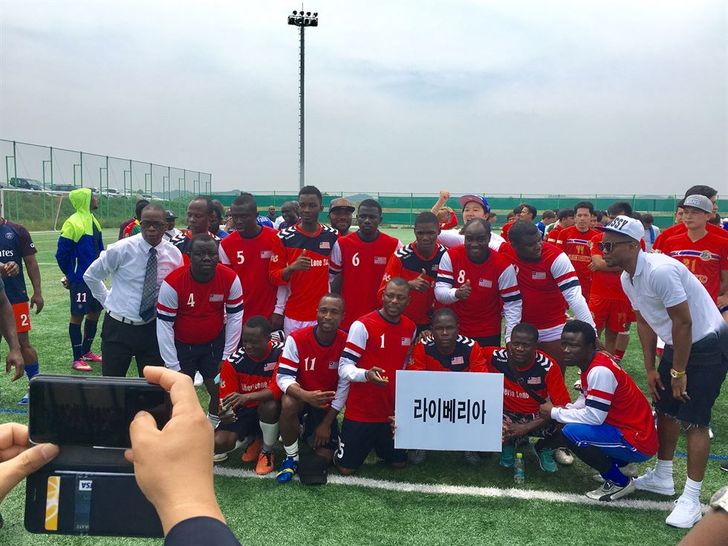
Liberia's football team in the Ansan World Cup poses for a group photo. Ansan Migrant Center
The Ansan World Cup began in 2002, the year of the Korea-Japan World Cup. But what inspired the local sports tournament's birth more was people's willingness ― migrants, as well as residents of Wongok-dong district in the city ― to break down tension in regions with a high concentration of foreigners.
So the first Ansan World Cup began, with Wongok-dong residents bringing lunch for the workers playing football and a TV anchorman volunteering as the main commentator. A team of Korean celebrities, including actor Kim Soo-ro, joined the tournament, spicing up domestic interest.
“The event since then became sort of the city's community festival,” said Park, who has been serving the center since 1994. “And we started calling Ansan 'the City Without Border' as a campaign rooting for regional unification. Now, many migrants long for the event.”
Park said not only has the number of cup participants grown, but their athletic feats have become more impressive each year. The players used to wear colorful fishnet vests to differentiate teams because sports gear was pricey. But players now bring their own colorful uniforms and equipment.
“Workers from certain countries, including Thailand, Vietnam and Indonesia, separately play in their own leagues apart from the World Cup and winning teams earn tickets to play in the Ansan World Cup,” Park said. “We will keep hosting this game.”