Hastily arranged international marriages 'must end'

At the Korea Vietnam Culture Communication Center in Guro-gu, Seoul, November 2011, Vietnamese women who migrated to marry Korean men sing the national anthems of both countries after graduating from a class where they learned about Korean culture and language. Korea Times file
By Ko Dong-hwan
Fewer international marriages in South Korea are ending in divorces. Often hastily arranged marriages are arranged through agencies, usually involving Korean men and foreign women. There can be a high risk of a split because of cultural barriers that couples cannot overcome before wedlock. But thanks to an international marriage guide program that the Ministry of Justice introduced in 2011, the divorce rate has fallen from 115,000 to 7,100 in 2017.
First tested for six months in October 2010, the program was officially launched in March 2011. Korea's immigration laws now state that Koreans who want to marry citizens of China, the Philippines, Vietnam, Cambodia, Uzbekistan, Mongolia and Thailand, or invite them to Korea after marrying them, must attend the four-hour program offered at one of 15 immigration offices in Korea and acquire a program-completion license to apply for international marriage certification.
Yun Byung-seung, Deputy Director of the ministry's Immigrant Integration Division, told The Korea Times the program was run by people with a plenty of experience in consulting about international marriages and people who have so far enjoyed a successful international marriage. Participants get to know the past cases of international marriage that were either successful or ended in a split.
“The program explains cultures of countries from where spouses come to Korea to marry and settle, mostly from Vietnam and China,” said Yun. “It helps the soon-to-marry Koreans understand their future spouses and their cultural backgrounds, as well as informing others interested in international marriage to understand the concept better.”
With Korean men as the grooms in at least 90 percent of international marriages, with their brides as migrants, the program aims to enlighten in advance Koreans about their future spouses to lower the risk of friction, including problems based on communication errors because Koreans rarely get enough time to study the language of their new spouse.
From 2010 until 2017, almost 77,000 Koreans took the program. The number of international marriage certificate applications increased as well. The ministry surveys every six months Korean spouses who had completed the program, with 80-90 percent of respondents saying they benefited from the program.
Most of those who took the program were Korean men in their 40s with a high school diploma, who were marrying Vietnamese women.
The program comprises four sessions ― about the cultural and social aspects of countries of foreign spouses, the process of obtaining an international marriage license, case studies of good/bad international marriages, and protecting human rights.
“It may be short and provide only basic information,” Yun said. “But for those who need a pedestal to improve their relationships with foreign spouses, the program is a good starting point.”
Foreign spouses from the seven countries do not need to learn the program because they usually learn the Korean language and customs before coming to Korea.
The program, which accepts people only through online applications, varies in content based on the nationalities of the applicants' spouses. It uses a pool of instructors, two to three per session, and textbooks for each country. The pool has a varying number of instructors for each of the 15 immigration offices nationwide, excluding branch offices and those at airports.
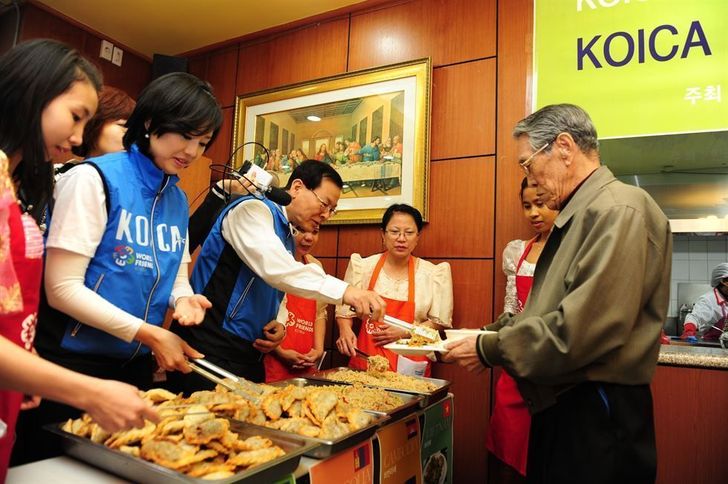
In this photo from March 2011, marriage migrants from Mongolia, Vietnam, the Philippines and Cambodia serve elderly South Koreans at a seniors' welfare center in Sujeong-gu, Sungnam, Gyeonggi Province, as voluntary work. Korea International Cooperation Agency President Park Dae-won, third from left, and the agency's honorary ambassador and then-Hannara Party Rep. Cho Yoon-sun, second from left, joined in. Korea Times file
Before the program was introduced in 2010, international marriages had become a major problem in Korea because of criminal incidents committed against foreign spouses.
In 2007, a Vietnam woman, 19, who migrated to Cheonan in South Chungcheong Province to marry a Korean man, was beaten to death by him one month after the marriage. She was left with 18 broken ribs. Her husband was arrested after he fled, and was jailed for 12 years. The man was introduced to her through a Korean international marriage agency. But the man who did not have a regular job and often locked her in the basement.
In 2010, another Vietnamese woman, 20, was beaten to death by her husband eight days after she arrived to Korea to marry him. She had not known that he was a mental patient.
“The human rights violation cases of marriage migrants to Korea were highlighted by Korean news outlets back then, raising a public outcry against Korean spouses' immature views toward migrants,” Yun said.
“International marriage involving people from Japan or America usually do not entail major human conflicts because the couples spend enough time to get to know each other well, including understanding each other's culture. But arranged marriages omit such critical periods required for any marriage.”
More than 85 percent of Koreans marrying spouses from the seven countries walk the aisle through arranged marriages.
For Koreans, the program was introduced after a jump in high-profile murders and divorces. After the program was introduced, the divorce rate subsided. But the deputy director says the list of countries whose nationals Koreans marry after mandatorily taking the program should not be expanded.
“The list means the Korean government is reluctantly meddling in individuals' marriages,” Yun said. “With signs of improvement, the list will hopefully be reduced. Korea must get rid of hastily arranged international marriages and have more marriages in which couples are given enough time to get to know each other first.”
He said quickly arranged international marriages were also a problem in China, where citizens married people from South American countries just to migrate to advanced countries like the U.S.
“Such cases are hard to find in Korea, where migrants do actually come to settle in Korea through marriage,” Yun said.