Foreigners left in the dark during Pohang earthquakes
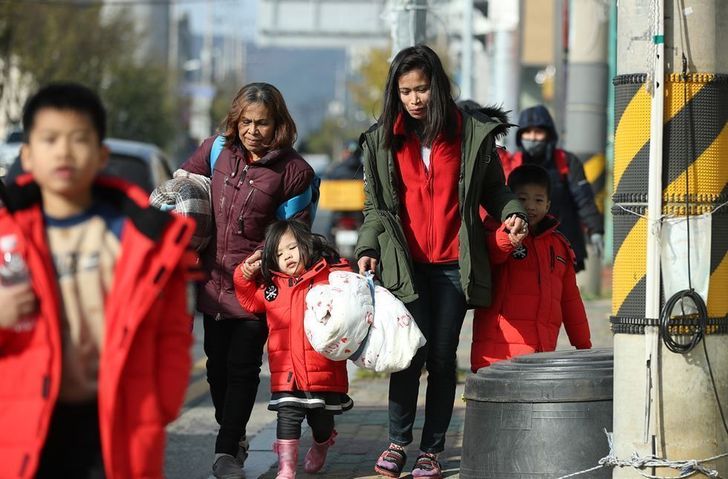
A family is on the way home Friday morning from a public sports facility that held hundreds of residents displaced by the earthquake that hit the southeastern port city of Pohang on Wednesday. / Yonhap
By Chyung Eun-ju, Park Si-soo
Seconds after a powerful 5.4-magnitude earthquake struck Pohang on Nov. 15, millions of smartphones across the country vibrated with a push notification and belted out a nerve-racking “bee” sound.
Koreans instantly realized what had happened and braced for possible shock waves, which reached as far as Seoul nearly 300 kilometers from the quake’s epicenter.
Foreign residents got the emergency notification simultaneously, but many weren’t prepared because the information was in Korean.

Aldo Zelig Uy Tong
“I got the message but I didn’t feel the urgency instantly because it was written in Korean,” said Aldo Zelig Uy Tong, 30, a Filipino student at Seoul National University. “I don’t understand Korean enough. So I had to use Google Translate to figure out what it said.”
Raimon Blancafort, a Spanish professor at Duksung Women’s University, was caught “totally off guard” when he felt the tremors.
“I was very surprised when I felt the tremors because it was something I had never expected to experience here in Seoul,” Blancafort said. “I got the text but I couldn’t understand what it said because it was written in Korean. I was totally in the dark until people explained to me what happened.”
South Korea is transforming into a multicultural society with 1.76 million foreign residents (3.4 percent of the total population) and more to come.

The alert text message sent out to phones by the safety ministry on Nov. 15. / Yonhap
But many foreigners are left in the dark, even in the event of natural disasters, because little information is provided in other languages.
“There are a considerable number of foreigners in Korea that don’t understand Korean,” said a Brazilian student, 24, at Konyang University.
“So this kind of alert text that involves a dangerous situation should be sent out in multiple languages.”
Sending messages in foreign languages ‘inconvenient’?
The Ministry of the Interior and Safety said it had considered sending disaster notifications in multiple languages but ditched the idea because it could cause “inconvenience” to the majority of receivers, who are Korean.
The ministry asked foreign smartphone users to install the “Emergency Ready App,” a state-developed disaster information app that will provide a real-time alert service in English and Chinese from December.
“We have to consider the Koreans first in terms of the disaster alert system,” Kang Myung-gu, a deputy director of the ministry’s disaster and safety status control center, told The Korea Times.
“We had discussed the need to diversify the languages of the disaster alert but dropped the idea because it could cause inconvenience to many Koreans, especially senior citizens who don’t understand English who might take it as a spam message.”
Kang said the alert app would be an efficient solution for foreigners.
Foreigners don’t agree.

Isabel Corado
“Although it is fair since the official language is Korean, I think a message in English is necessary because there are a lot of people who don’t speak Korean,” said Isabel Corado, a Guatemalan graduate student at Seoul National University.
“Receiving a message in two languages doesn’t bother anyone.”
In response to the elderly who might interpret the alerts as spam, Corado said the ministry needs to “educate people about it so they don’t get worried.”
To make the app an effective solution, several foreigners said it’s a prerequisite for the government to promote the app to foreigners.
“I did not know about the app,” said Corado. “I really like the disaster alerts. I would like to have access to the same things in English.”
Tong said he didn’t know about the app either.
“I don’t know any of my classmates who have the app,” he said. “Also, to have to download an app is a barrier unlike the automated alert message.”
Non-smartphone users are also in the dark.
LTE smartphones made before 2013, 3G smartphones and some 2G phones don’t receive disaster alerts, according to the ministry.
“There are as many as 3.84 million people who use 2G phones,” ministry official Kang said.
“Of them, about 3.25 million people received a disaster alert through a shared channel provided by SK Telecom and LG Uplus. But the remaining people – about 590,000 holders of old 2G phones – have no way to get the message because their devices are too outdated to be connected to the shared channel.”