RASKB offers Bongwon-sa tour
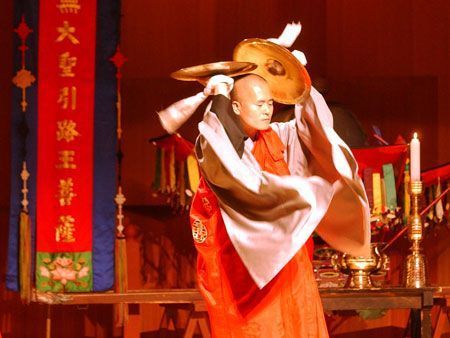
A monk performs a Yeongsan-jae Buddhist ceremony in this file photo. Bongwon-sa, a temple in Seoul, will present the religious performance Thursday. / Korea Times
Temple to present
Yeongsan-jae
Buddhist ceremony
By John Redmond
The Korean branch of the Royal Asiatic Society is offering a special tour of Bongwon-sa, one of Seoul’s greatest temples on June 6 to watch the spectacular Yeongsan-jae Buddhist ceremony.
Yeongsan-jae or “Vulture-Mountain Ceremony” is a religious performance, based on various art forms such as music, dance, drama, literature and philosophy. It is rooted in classical Buddhism but has merged with diverse Korean traditions and has become one of the most important and characteristic traditional Buddhist rituals in Korea.
It was designated by the Korean government as Major Intangible Cultural Property 50, and since then Bongwon-sa, the main temple of the Taego Order, the second-largest Buddhist sect in Korea, has taken the initiative to revive and maintain it. It was listed as one of the Intangible Cultural Heritages of Humanity by UNESCO in 1989.
This lengthy and colorful ritual is a re-enactment of a significant event in the career of Sakyamuni Buddha, called the Vulture Peak Assembly, during which he preached the famous Lotus Sutra.
The main objective of this ceremony is to soothe the souls of the dead and lead them to be reborn in the Pure Land, but sometimes this ceremony is also held to invoke blessings for the security and development of the entire nation.
In front of a large-scale scroll-painting of Buddha and an elaborate altar, offerings are made and various chanting, music and dances are also performed, including the well-known Cymbal Dance, Butterfly Dance and Dharma Drum Dance.
In the past, the whole ceremony took three days and nights, but now it is usually finished in a single day. Through it, the deceased and the participants become one for the purpose of awakening the true dharma of Buddha and leading the way to free everyone from earthly suffering and delusion.
Everyone staying in Korea who is interested in its traditional culture should see this ceremony at least one time; and the beautiful “Phoenix-Origin Temple” isolated in the middle of the urban madness, tucked into a high steep valley on the southern face of Mt. Ansan in busy Seodaemun-gu, is always rewarding to visit.
It will hold its annual public performance of this ritual on Thursday June 6, which is also national Memorial Day holiday, so husbands and older children could also go on the tour.
David A. Mason, professor of Korean cultural tourism, currently working at Gyeongju University and a resident of Korea for 29 years, is a well-known expert on Korea's religious traditions and tourism.
He will guide visitors to this ceremony and explain all about it, and also highlight the temple’s best features.
At 9 a.m. the group will gather on the sidewalk outside of exit 4 of Sinchon Station (green line number 2, in Seodaemun-gu).
Then, they will catch the city bus 7024 for a 12-minute ride, have a short walk up the steep road into the temple to begin a three-hour tour of Yeongsan-jae. When the tour is finished just after noon, those who wish to stay longer at the temple for the ceremony’s afternoon portions can do so.
You can have lunch together with the crowd at the temple’s large cafeteria, or at any of the good Korean restaurants on the road outside, or you might bring your own food along and eat it outdoors. Anyone can walk around the area or leave for home anytime they choose.
Participants are encouraged to bring along simple snacks and beverages (water) for themselves. They should be prepared for sunny weather conditions (hat or parasols, sun block), and wear good sturdy walking-shoes.
All are welcome to take this opportunity to learn all about some of the most fundamental and unique aspects of Korean culture, and view some excellent Buddhist rituals and artworks.
The cost is 30,000 won for members and 35,000 won for non-members.