RASKB to host Seochon tour
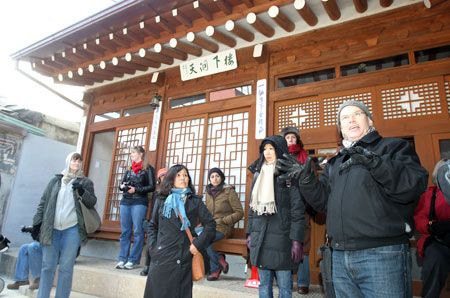
A group of visitors look around the traditional house of the late artist Yi Sang-beom in the Seochon area in Seoul during a tour hosted by the Korea branch of the Royal Asiatic Society on March 11, 2012. / Korea Times file
By John Redmond
The Korea branch of the Royal Asiatic Society (RASKB) invites people to take a tour of lower Seochon. Tour leader Dr. Robert J. Fouser will lead a walk from Tongui-dong to Sakjikdan on May 19 from 1:30 to 5 p.m.
On this excursion, the group will explore part of the Seochon (West Village) neighborhood of Seoul that sits between Gyeongbokgung Palace and Mount Inwang. Composed of 13 small administrative districts called “dongs,” the neighborhood is a showcase of the layers of 20th-century urban history.
Korean-style houses (hanok) and winding alleys represent the 1930s-1950s; markets, commercial strips, and two-story houses bear the features of the 1960s-1980s; concrete-tile residential buildings showcase the 1990s-2000s; and new galleries and cafes represent the present.
Using maps from 1840 and 1936 for historical reference, the excursion will begin at Gyeongbokgung Station.
First to be explored will be the alleys of Tongui-dong, which include an eclectic mixture of hanok, Japanese colonial-period houses, and modern museums and galleries. In recent years, the area has become one of Seoul's newest art districts, and guests will get the chance to drop into a few galleries along the way.
Moving across Jahamunno, the main street in the area, the tour will continue with a walk through the alleys of Chebu-dong, Nuha-dong, and Pilun-dong. The first stop will be Yi Sang's House, an art and cultural space in a hanok that sits on the site where the early 20th-century poet Yi Sang lived.
The area has one of the highest concentrations of alleys that date from the Joseon Kingdom (1392-1910) in Seoul.
Despite development in recent years, the alleys still have a high concentration of hanok, and guests will visit the Yi Sang-beom house, a restored 1930s hanok, and (permission depending), several houses, including recently renovated ones. There will also be a discussion on various issues related to the preservation and adaptation of hanok.
The next stop will be the grounds of Baehwa Women's University, which has several excellent examples of early 20th-century missionary school buildings and offers attractive views of the area. The grounds also contain several important Joseon period stone carvings.
From Pilun-dong, the group will visit the Sajikdan, an altar built in 1394 for biannual harvest rituals. Japanese colonial authorities turned the Sajikdan into a park in 1940 and it has been reduced in size over the years.
The front gate dates from 1720, but was moved in 1962. The excursion will end with a walk through Geumcheon Market on what was once the main street leading from Gyeongbokgung Palace to Sajikdan.
The cost is 20,000 won for RASKB members and 25,000 won for non-members. For more information, call 070-8808-9483 or (02) 763-9483. Meet at exit 3 of Gyeongbokgung Station (Line 3) at 1:30 p.m.