Green Party says shark in Busan harbor is 'climate warning'
Summary
The Green Party said a shark lingering in Busan’s North Port Waterfront Park since Sept. 18 should be viewed as a climate warning, not a tourist attraction. It argued the animal’s appearance is linked to rising sea temperatures and criticized media and social media attention around it. The party also said the government and National Assembly have failed to transform the energy system enough to curb warming seas.
Key Facts
- The party said coastal water temperatures around Busan have risen by about 1.2 degrees Celsius since 2000.
- It said there were 73 reported appearances of large sharks off Korea’s east coast so far this year, compared with 29 during the same period last year.
- The Green Party said fossil fuels such as coal and LNG still account for 56 percent of electricity generation, while nuclear power plants account for 32 percent.
- It said nuclear power plants discharge more than 30 billion tons of heated water into the sea every year.

People take photos of a shark swimming at North Port Waterfront Park in Dong District, Busan, on Sunday. Yonhap
The appearance of a shark drew crowds to a waterfront park in Busan should be seen as a serious warning about rising sea temperatures, not just an inadvertent tourist attraction, Korea's Green Party said.
The party criticized public fascination with the shark, which has remained in the waters around North Port Waterfront Park since Sept. 18, saying its unusual appearance was being treated merely as entertainment.
In a commentary titled "The shark came to warn us" released Tuesday, the Green Party took aim at the attention surrounding the animal.
"Major media outlets are making a fuss about North Port becoming a new 'hot spot,' with more than four times the usual number of visitors, while some people on social media are cheering that 'a shark aquarium has opened in Busan' and calling the shark 'Bukangi,'" the party said.
The nickname "Bukangi" combines the Korean name for the area with a suffix commonly used in Korean nicknames.
The Green Party said the shark's appearance was linked to rising sea temperatures off Busan.
"The appearance of a subtropical shark in Busan's waters is believed to be due to warm-water fish species that sharks prey on moving northward," the party said. "The northward movement of warm-water species is caused by rising sea temperatures due to climate change."
According to the party, coastal water temperatures around Busan have risen by about 1.2 degrees Celsius since 2000. It also said there were 73 reported appearances of large sharks off Korea's east coast so far this year, 2.5 times the 29 recorded during the same period last year.
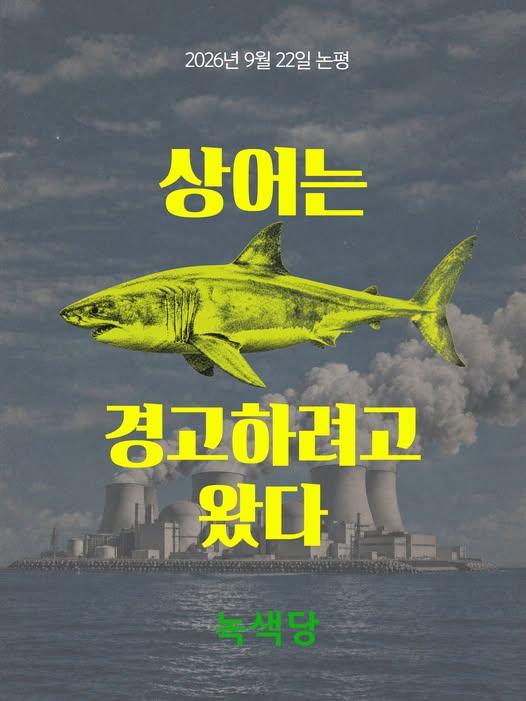
An image accompanying a Green Party commentary titled "The shark came to warn us," released Tuesday / Captured from the Green Party's Facebook account
The Green Party also criticized the government and National Assembly, saying they have failed to transform the country's energy system despite the clear need to curb rising ocean temperatures.
"Fossil fuels such as coal and LNG still account for 56 percent of electricity generation, while nuclear power plants, which account for 32 percent, discharge more than 30 billion tons of heated water into the sea every year," the party said.
"The shark did not come here to entertain us," it said. "Its appearance is a warning to all of us."
This article from the Hankook Ilbo, the sister publication of The Korea Times, was translated by a generative AI system and edited by The Korea Times.
Explore More
- Q.
- Q.
- Q.